
On May 12, 2026, PCOS (polycystic ovary syndrome) was formally renamed PMOS (polyendocrine metabolic ovarian syndrome) through an international medical consensus published in The Lancet*, backed by the Endocrine Society, ASRM, and dozens of other patient and professional organizations. Both names are in use during a multi-year transition period, so we use PMOS throughout this article and note “PCOS” for anyone more familiar with the older term.
PMOS — polyendocrine metabolic ovarian syndrome, formerly known as polycystic ovary syndrome (PCOS) — is a hormonal and metabolic condition that affects the ovaries, but reaches well beyond them. The name change itself reflects something important: the “cysts” seen on ultrasound aren’t actually cysts at all — they’re immature follicles — and the old name led many people to think this was purely an ovarian issue.[1] At Well-Rooted, we’ve always looked at it less as an “ovary problem” and more as a whole-body signal — one that usually traces back to how your body is handling insulin, inflammation, and stress.[2]
Common signs include:
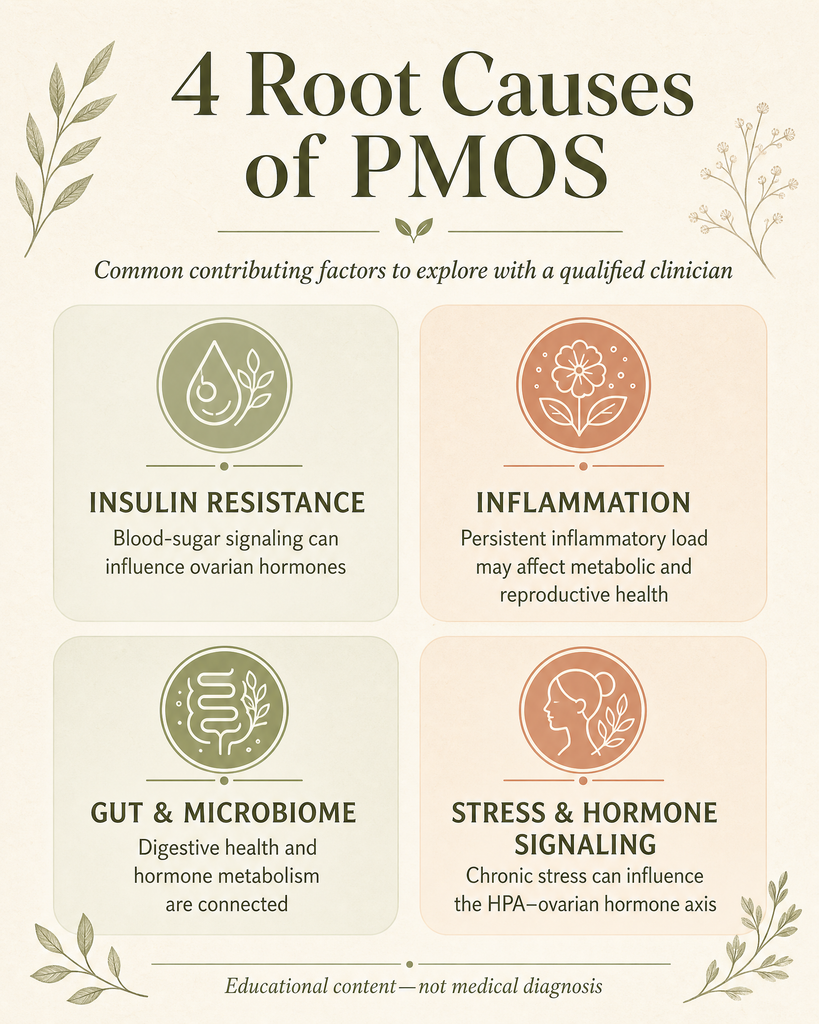
Conventional medicine tends to treat PMOS as one condition with one fix. In functional medicine, we look at PMOS as a pattern with several possible drivers, including:
“PMOS is rarely just one thing. It’s usually your body waving a flag about blood sugar, stress, or inflammation — and the ovaries are just where it shows up.”
| Conventional | Root-Cause Approach | |
| First step | Birth control pill | Comprehensive hormone + metabolic panel |
| Focus | Symptom suppression | Underlying driver (insulin, inflammation, stress) |
| Timeline | Ongoing management | Often measurable improvement in 3–6 months |
1. Prioritize blood sugar stability. Pairing protein and fiber with every meal, and reducing refined sugar, is one of the highest-leverage changes for insulin-driven PMOS.[2]
2. Consider targeted supplementation. Inositol (specifically a myo-inositol/D-chiro-inositol blend) has research support for improving insulin sensitivity and ovulatory function in PMOS.[5]
3. Address inflammation through food. An anti-inflammatory eating pattern — think omega-3s, colorful vegetables, minimal processed seed oils — supports hormone balance long-term.
4. Don’t skip the gut. Probiotics and fiber-rich foods support the gut-hormone connection research is increasingly pointing to.[4]
5. Get the right labs run. Not just an ultrasound — a full picture includes fasting insulin, A1C, DHEA-S, testosterone, and thyroid panel, since thyroid dysfunction can mimic or worsen PMOS symptoms.
If you suspect PMOS, don’t wait it out. Untreated insulin resistance and chronic anovulation carry long-term risks, including type 2 diabetes and endometrial health concerns. A functional medicine provider can help you get the full picture instead of a single prescription.
Wait — is PMOS the same thing as PCOS? Yes. PMOS (polyendocrine metabolic ovarian syndrome) is the new name for the condition previously called PCOS (polycystic ovary syndrome), officially adopted in May 2026. If you were diagnosed with PCOS, that diagnosis still applies — only the name has changed, to better reflect that it’s a whole-body hormonal and metabolic condition, not just an ovarian one.
Can PMOS be reversed? PMOS isn’t “cured,” but symptoms can improve significantly — often dramatically — once the underlying drivers (usually insulin resistance) are addressed.
Do I have to go on birth control? No — birth control can be one tool, but it’s not the only option, and it doesn’t address root cause. This is a conversation to have with your provider based on your goals (including fertility goals).
Is PMOS just about weight? No. Lean PMOS is real and common — this isn’t only a condition affecting women in larger bodies.
PMOS (formerly PCOS) can feel like a life sentence when all you’re offered is a pill and a shrug. But when you look upstream — at insulin, inflammation, and stress — there’s usually a lot more room to feel better than you’ve been told. If this is you, our free guide PCOS, Uncovered walks through exactly the labs and steps we recommend starting with. [Internal link: PMOS/PCOS ebook landing page]