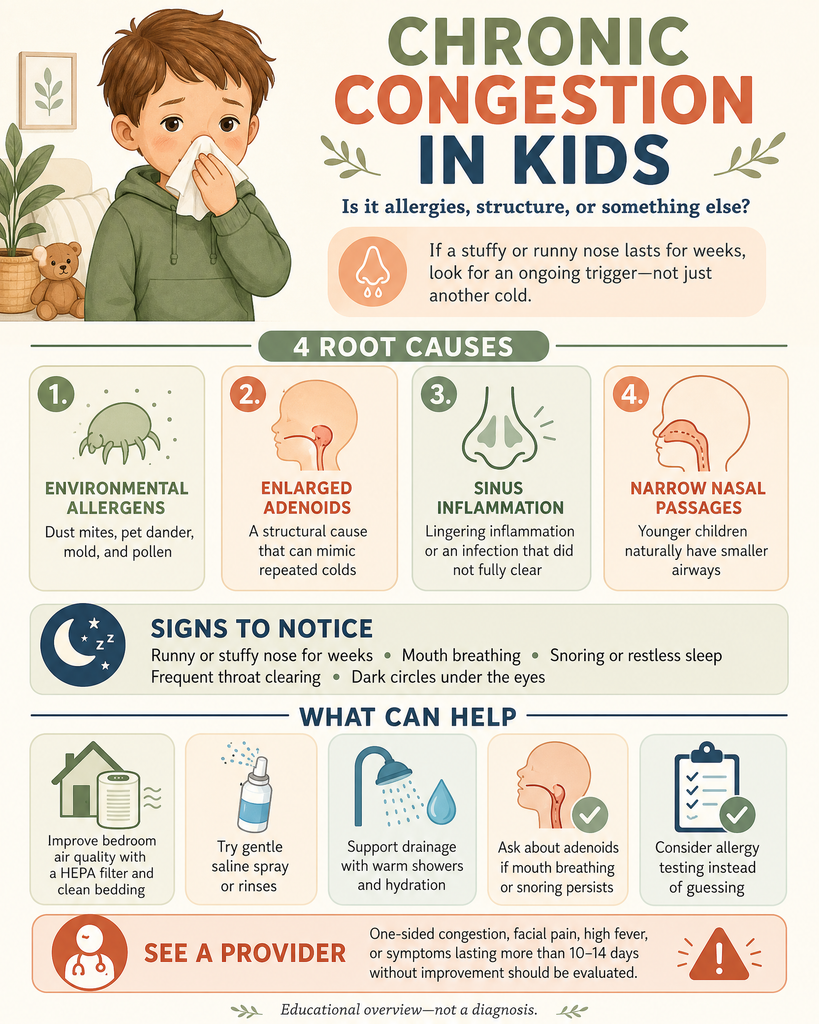
Chronic Congestion in Kids: Is It Allergies, Structure, or Something Else?
Quick Facts
Chronic congestion (lasting more than a few weeks) is often mislabeled as “always having a cold.”
Environmental allergens and structural drainage issues are among the most common drivers.
Persistent mouth breathing from chronic congestion can affect sleep and even facial/dental development over time.
Identifying the actual trigger changes the whole approach — decongestants only manage the moment.
If your child seems to always have a runny or stuffy nose, “kids just get a lot of colds” might be true — but it’s not the full story if it never really goes away. Chronic congestion usually has an identifiable trigger, and it’s worth finding.
What’s Really Happening With Chronic Congestion?
Occasional congestion from a cold is normal. Chronic or recurring congestion, especially without other cold symptoms like fever, points toward an ongoing trigger rather than a string of unrelated illnesses.
Common signs include:
Persistent runny or stuffy nose lasting weeks
Mouth breathing, especially at night
Snoring or restless sleep
Frequent throat clearing
Dark circles under the eyes (“allergic shiners”)
The Root Causes Behind Chronic Congestion
Environmental allergens — dust mites, pet dander, and mold are common year-round triggers, distinct from seasonal pollen.
Enlarged adenoids — a structural cause that can mimic ongoing “colds” and is often missed.
Chronic low-grade sinus inflammation — sometimes from an unresolved infection that never fully cleared.
Anatomical or immature nasal passages — younger children have narrower airways, making drainage naturally slower.
“If your child hasn’t had a truly clear nose in months, that’s not ‘just how kids are’ — that’s a signal worth following.”
Chronic Congestion in Kids: Is It Allergies, Structure, or Something Else? 2
Conventional vs. Root-Cause Approach
Conventional Approach
Root-Cause Approach
First step
Decongestant or antihistamine
Trigger identification (environment, structural)
Focus
Symptom relief
Reduce or remove the actual trigger
Timeline
Hours to days
Often improvement within a few weeks of trigger removal
5 Natural Approaches for Chronic Congestion in Kids
1. Improve indoor air quality. A HEPA filter, regular bedding washes, and reducing dust/pet allergen exposure in the bedroom can make a real difference.
2. Use saline rinses. A gentle saline rinse or spray helps clear allergens and mucus without medication.
3. Support drainage with steam and hydration. Warm showers and adequate fluids help thin mucus and support natural drainage.
4. Ask about adenoid evaluation if mouth breathing persists. If snoring and mouth breathing are constant, it’s worth ruling out a structural component.
5. Rule out allergies with testing rather than guessing. Environmental allergy testing can pinpoint the actual trigger instead of trial and error.
When to See a Provider About Chronic Congestion in Kids
Persistent one-sided congestion, facial pain, high fever, or congestion lasting more than 10–14 days without improvement should be evaluated further.
FAQ
Is chronic congestion always allergies? No — it can be structural or a lingering low-grade infection. Allergies are common but not the only cause.
Could this be related to ear infections? Yes — poor drainage from chronic congestion is a known contributor to recurrent ear infections.
Do air purifiers actually help? For allergen-driven congestion, yes — especially in the bedroom where kids spend the most time.
Does cutting dairy help with congestion? Eliminating dairy can be an effective approach for managing congestion, as dairy proteins and mild sensitivities frequently stimulate excess mucus production and thick secretions in the upper respiratory tract.
Final Thoughts
“Always congested” isn’t just a phase kids grow out of — it’s usually a specific, findable trigger. Environment, structure, and drainage are the first places to look before assuming it’s just another cold.
Is your child experiencing chronic congestion? Our team would love to meet with you.
Click this link to schedule a time to meet with our team
References
American Academy of Pediatrics, “Clinical Practice Guideline for the Diagnosis and Management of Acute Bacterial Sinusitis in Children Aged 1 to 18 Years,” Pediatrics, 2013. https://publications.aap.org/pediatrics/article/132/1/e262/31288/ (defines acute sinusitis as symptoms persisting beyond 10 days; pediatric chronic rhinosinusitis is generally defined as symptoms lasting 12+ weeks per EPOS 2020 guidelines)
Balfour-Lynn IM, “Milk, mucus and myths,” Archives of Disease in Childhood, 2019; Koren Y, et al., “Respiratory effects of acute milk consumption among asthmatic and non-asthmatic children: a randomized controlled study,” BMC Pediatrics, 2020. https://www.ncbi.nlm.nih.gov/pmc/articles/PMC7488715/