
Estrogen dominance describes a ratio, not a single number — estrogen high relative to progesterone. Your estradiol can look completely normal on paper. The most common driver from the mid-30s onward is cycles where ovulation doesn’t happen or the luteal phase falls short, so progesterone never rises to balance estrogen. Estrogen is packaged for removal by the liver and finished off in the gut — when that handoff stalls, estrogen gets reabsorbed instead of leaving. Body fat is hormonally active tissue that produces estrogen, which is why metabolic health and hormone health aren’t separate conversations.
If your periods have gotten heavier, your PMS has gotten louder, and your bra has started feeling like a personal insult the week before your cycle — that combination isn’t random. It’s a pattern, and it usually points somewhere specific.
Estrogen isn’t the villain here. You need it — for your bones, your brain, your skin, your cycle. What causes symptoms is estrogen operating without enough progesterone to balance it.
Progesterone is only made after you ovulate. No ovulation, no progesterone. And ovulation gets less reliable earlier than most women expect — often starting in the mid-30s, well before anyone uses the word perimenopause. When a cycle is anovulatory or the luteal phase is short, estrogen stimulates the uterine lining without its counterweight, which is exactly why bleeding turns heavy, unpredictable, or prolonged.[1]
8 common signs of estrogen dominance
Periods that have gotten heavier, longer, or clottier than they used to be PMS that starts 7–10 days out instead of a day or two Breast tenderness, fullness, or swelling in the second half of the cycle Headaches or migraines that track with your cycle Bloating and water retention that come and go on a monthly rhythm Mood shifts — irritability, anxiety, tearfulness — that lift once bleeding starts Trouble sleeping specifically in the week before your period Weight settling at the hips and thighs despite no real change in habits
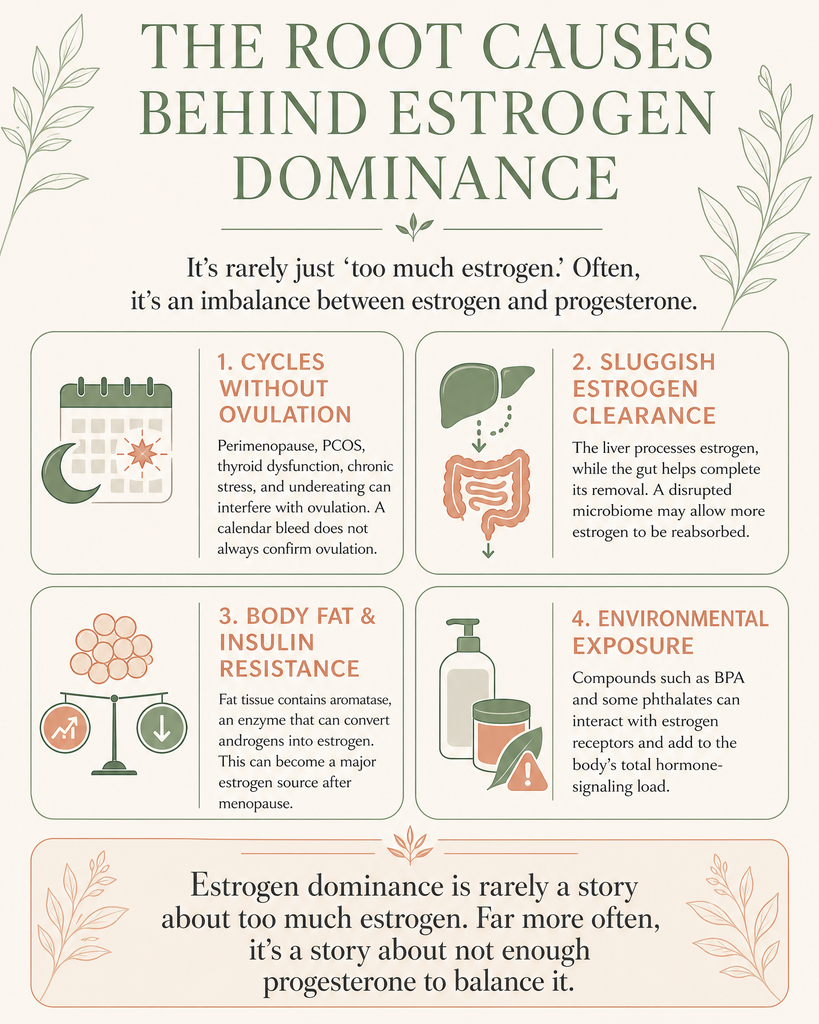
Cycles without ovulation (or with a weak luteal phase). This is the big one. Perimenopause, PMOS (formerly known as PCOS), thyroid dysfunction, chronic stress, and undereating all interfere with ovulation — and a bleed on the calendar doesn’t confirm one happened.[1]
Sluggish estrogen clearance. You may already know the liver processes hormones. What gets less airtime is that the final step happens in your gut. The liver tags used estrogen for disposal, sends it out in bile, and gut bacteria producing an enzyme called beta-glucuronidase can snip that tag off — reactivating the estrogen so it’s reabsorbed instead of excreted. When the gut microbiome is disrupted, more estrogen gets recycled back into circulation.[2]
Body fat and insulin resistance. Adipose tissue contains aromatase, the enzyme that converts androgens into estrogen. Higher body fat means more local estrogen production, and this becomes the dominant estrogen source after menopause.[3]
Environmental estrogen exposure. Compounds like BPA and certain phthalates bind estrogen receptors and interfere with normal hormone signaling. They’re not the whole story, but they add to the total load your body is managing.[4]
“Estrogen dominance is rarely a story about too much estrogen. Far more often, it’s a story about not enough progesterone to balance it.”
| Conventional Approach | Root-Cause Approach | |
|---|---|---|
| First step | Suppress the cycle to control symptoms | Determine whether ovulation is happening and how well estrogen is clearing |
| Testing | Often a single untimed estradiol draw | Progesterone and estradiol timed to days 19–22, plus thyroid, insulin, and gut/liver context |
| Focus | Quiet the symptom | Restore ovulation and estrogen clearance |
| Timeline | Symptom control within a cycle | Meaningful shift usually over 2–3 cycles |
1. Get fiber to 30 grams a day. This is the most direct lever you have on estrogen clearance. When premenopausal women increased fiber from roughly 15 to 30 grams daily using wheat bran, serum estrone and estradiol both dropped measurably in two months.[5] Fiber also increases how much estrogen leaves through the stool rather than getting reabsorbed.[6] Beans, lentils, berries, chia, artichokes, ground flax.
2. Eat cruciferous vegetables daily, food-first. Broccoli, cabbage, Brussels sprouts, cauliflower, and arugula supply the indole compounds involved in estrogen metabolism. Aim for a cup a day rather than reaching first for a supplement.
3. Take an honest look at alcohol. In a study of 603 premenopausal women, those drinking more than 15 grams a day — roughly one to two drinks — had urinary estradiol levels about 26% higher than non-drinkers.[7] For someone already dealing with heavy periods and breast tenderness, this is often the single highest-yield change.
4. Protect ovulation instead of only chasing symptoms. Progesterone depends on a healthy ovulation, and ovulation is sensitive to being under-fed, under-slept, and over-stressed. Protein at breakfast, steady blood sugar, resistance training, and genuinely adequate calories do more for progesterone than any supplement on the shelf.
5. Lower your environmental load where it’s easy. Glass or stainless instead of plastic for hot food and drinks, never microwaving in plastic, and choosing fragrance-free personal care products. You don’t need a perfect house — you need a lower total.[4]
Soaking through a pad or tampon every hour, bleeding longer than seven days, passing clots larger than a quarter, bleeding between periods or after intercourse, new pelvic pain, or any bleeding after menopause should be evaluated promptly. Heavy bleeding deserves a real workup — fibroids, polyps, and endometrial changes need to be ruled out, not assumed away as “just hormones.”
Is estrogen dominance an actual diagnosis? Not in the formal sense — you won’t find it as a diagnostic code. But the underlying physiology is thoroughly documented: estrogen acting without adequate progesterone produces a predictable symptom pattern.[1] It’s a useful framework for understanding what your body is doing, not a label to self-assign.
Can my labs look normal and this still be my problem? Yes, for two reasons. It’s a ratio, so estradiol alone tells you little. And progesterone is only meaningful when drawn in the mid-luteal window, roughly days 19–22 of a 28-day cycle. A random draw on day 6 can’t answer the question.
Doesn’t perimenopause mean estrogen is low? This is the most common misconception we hear. In perimenopause, estrogen becomes erratic and can spike higher than it did in your twenties, while progesterone drops steadily as ovulation gets less reliable. The balance tips toward estrogen, which is why heavy flow and breast tenderness are such classic perimenopausal complaints.[1]
Should I be taking a DIM supplement? Start with the food. Reviews of the clinical evidence find considerably more human trial data for indole-3-carbinol than for DIM, and the DIM evidence remains limited.[8] These compounds actively alter estrogen metabolism, so if you’re on any form of hormone therapy, this is a conversation to have with your provider rather than a purchase to make.
Estrogen dominance symptoms — heavier periods, louder PMS, sore breasts — aren’t the price of being in your late thirties. They’re information — usually about ovulation, clearance, or both.
“Your cycle is a monthly report card on your hormones. When it changes, it’s telling you something worth listening to.”
The good news is that most of what drives this pattern is measurable and modifiable. Whether this is your first visit or your next one, understanding why the balance shifted is where real change starts.