
PMS mood swings are common — roughly 5% of menstruating women experience symptoms severe enough to interfere with work and relationships.[1] Here’s the finding that changes everything: women with severe premenstrual mood symptoms generally have progesterone levels similar to women without them.[2] The current understanding is that the issue is sensitivity — an altered response of the brain’s GABA system to allopregnanolone, the calming neurosteroid made from progesterone after ovulation.[2] Symptoms only appear in cycles where ovulation happens. No ovulation, no post-ovulatory hormone rise, no premenstrual symptoms.[3]
The week before your period, you become a different person. Short-tempered over nothing, tearful at a commercial, convinced everyone is annoyed with you. Then bleeding starts and it lifts like weather. If you’ve been told your hormones are normal, you weren’t imagining it — and that result is actually the most useful clue you have.
Most explanations you’ll find online say PMS is caused by low progesterone. The research doesn’t support that as the primary mechanism, and the distinction matters for what actually helps.
After ovulation, progesterone rises and is converted into allopregnanolone, one of the most potent natural modulators of GABA-A receptors — the same receptor system targeted by sedative medications. In most women, that produces a calming effect. In women with significant premenstrual symptoms, that same signal appears to provoke irritability and anxiety instead.[2]
The clearest evidence comes from ovulation-suppression studies: symptoms disappear when the hormone cycle is switched off, and reappear when progesterone is added back — but only in women who had premenstrual symptoms to begin with, not in controls, despite the same hormone levels.[2]
You may already know that PMS symptoms track your cycle. What’s less well known is that they track ovulation specifically. In anovulatory cycles, neither the hormone rise nor the symptoms occur.[3]
Common signs:
Irritability or anger that feels out of proportion Tearfulness, low mood, or a sense of hopelessness that lifts with bleeding Anxiety or a wound-up, on-edge feeling Feeling overwhelmed by ordinary demands Sleep that worsens in the days before your period Food cravings and appetite changes Breast tenderness, bloating, headaches Symptoms reliably confined to the second half of the cycle
Altered GABA-A receptor sensitivity to allopregnanolone. The central mechanism in the current literature. The brain’s inhibitory system responds atypically to a normal post-ovulatory neurosteroid rise.[2]
Reduced serotonin availability. Also implicated, and part of why symptoms often include the irritability-plus-carbohydrate-craving pattern rather than sadness alone.[2]
Inflammation and stress load. Emerging work points to inflammation as a link between systemic stressors and the neurological response, and to genetic and epigenetic differences in hormone and neurotransmitter pathways.[2]
What’s happening around the cycle. Sleep debt, alcohol, undereating, and unrelieved stress don’t cause don’t cause PMS mood swings, but they reliably lower the threshold at which the luteal shift becomes intolerable.
“Your hormone levels being normal doesn’t mean nothing is happening. It means the issue is how your brain is responding to them.”
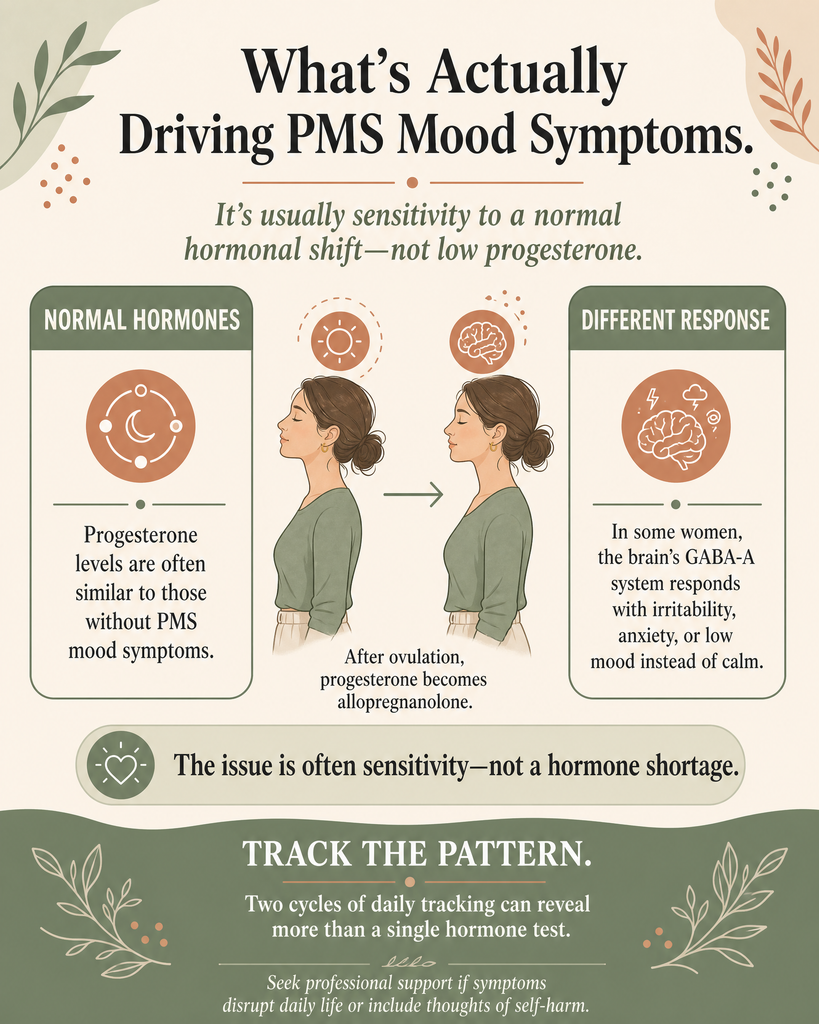
| Conventional Approach | Root-Cause Approach | |
|---|---|---|
| First step | Suppress the cycle, or told it’s normal | Two cycles of daily symptom tracking to confirm the pattern |
| Framing | “Your hormones are off” | Sensitivity to a normal hormonal shift |
| Focus | Remove the fluctuation | Raise the threshold: sleep, blood sugar, stress load, targeted nutrients |
| Timeline | Immediate suppression | Two to three cycles to see a real shift |
1. Track daily for two full cycles before anything else. This is the single most valuable step. A simple 1-to-5 daily rating of mood, irritability, and physical symptoms establishes whether symptoms are truly confined to the luteal phase — which is what distinguishes premenstrual disorders from mood symptoms that are present all month and simply worsen premenstrually. The distinction changes the entire approach.
2. Consider calcium. Of all the vitamins, minerals, and herbs studied for PMS, calcium has the best-quality evidence. A systematic review of natural products for PMS concluded that only calcium had good-quality evidence to support its use.[4] Food sources first, and supplementation discussed with your provider — women with high dietary calcium may need less.[4]
3. Chasteberry and vitamin B6 are reasonable second considerations. The same review found evidence of possible effectiveness for chasteberry, supported by two good-quality trials, and for vitamin B6.[4] Chasteberry acts on the hormonal axis, so it’s worth discussing with your provider rather than starting on your own.
4. Protect blood sugar through the luteal phase. Cravings rise in the second half of the cycle for real physiological reasons, and riding blood sugar swings on top of a GABA system that’s already struggling makes everything sharper. Protein at every meal, and eating before you’re desperate.
5. Guard sleep in the week before your period. Sleep loss and premenstrual irritability amplify each other. Protecting the last hour before bed during that week does more than it does at any other point in the month.
6. Move, and lay off alcohol in the luteal week. Regular aerobic exercise has consistent support for premenstrual symptoms, and alcohol both disrupts sleep and worsens mood in the days it matters most.
Book a visit if premenstrual symptoms are interfering with your work, your parenting, or your relationships — that’s the threshold, not how “bad” it seems compared with anyone else. Also worth evaluating: symptoms that don’t fully resolve after your period starts (which points toward an underlying mood condition with premenstrual worsening rather than PMS), symptoms that started or worsened after a pregnancy, or premenstrual symptoms alongside heavy bleeding or cycles that have become irregular.
If premenstrual mood symptoms ever include thoughts of harming yourself, that’s a same-day conversation with a provider or crisis line, not something to track through another cycle.
Doesn’t PMS mean my progesterone is low? This is the most common thing we correct. Research consistently finds that women with severe premenstrual mood symptoms have progesterone concentrations similar to women without them.[2] The difference is in the response, not the level.
Then would taking progesterone fix it? The evidence doesn’t support that as a reliable answer. A Cochrane review of progesterone for PMS found the trials too flawed and inconsistent to conclude that it helps, and no subgroup of women who clearly benefited could be identified.[1] It’s a conversation to have with a provider, not a self-directed experiment.
Why do my hormone tests keep coming back normal? Because for this condition, they usually are. That result rules things out and points toward sensitivity as the mechanism. It is not evidence that nothing is wrong.
What’s the difference between PMS and PMDD? Severity and impairment. Premenstrual dysphoric disorder is the more severe form, with prominent irritability, anger, and mood symptoms that meaningfully disrupt functioning, affecting roughly 5% of women of reproductive age.[2] Both are diagnosed by pattern over time, which is why tracking matters.
PMS mood swings aren’t a hormone level problem to correct. It’s a sensitivity to a normal monthly shift — and sensitivity has a threshold you can move.
“Two cycles of tracking will tell you more than any single blood draw.”
Whether this is your first visit or your next one, bring the tracking. It’s where the real conversation starts.