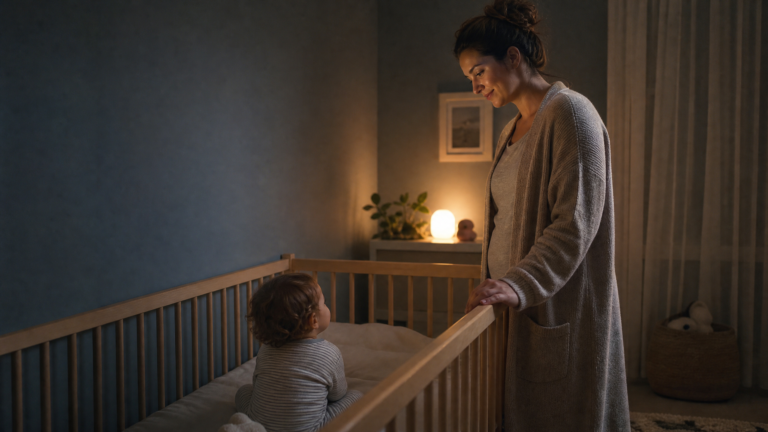
Toddler night waking is not a sign you’re an outlier. Roughly 36% of preschool-aged children signal a night waking at least once a night, and it’s one of the most common concerns parents bring to pediatricians. Everyone wakes briefly between sleep cycles — adults included. The question isn’t whether your toddler wakes, it’s whether they can get themselves back down. Behavioral sleep difficulties affect an estimated 10% to 30% of children and respond well to consistent, structured approaches. Some night waking isn’t behavioral at all. Low iron stores and disrupted breathing are two treatable causes that get missed because everyone assumes it’s a habit.
They slept through for three glorious months. Now they’re up at 1 a.m., wide awake, calling for you — and everyone has an opinion about what you’re doing wrong. Before you accept that verdict,it’s worth knowing that toddler night waking has several distinct causes.
Sleep isn’t one continuous block for anyone. Your toddler cycles between lighter and deeper stages all night, surfacing briefly at each transition. So do you — you just roll over and go back down without registering it.
The difference is what your child needs in order to fall asleep in the first place. If they fall asleep while being rocked, fed, or with you lying beside them, those conditions become the signal their brain expects. When they surface at 1 a.m. and the conditions have changed, they can’t recreate them alone — so they call for you. Sleep researchers describe this as a sleep-onset association, and it’s the most common single reason for repeated night waking in children under five.
That’s not a discipline problem or a bonding failure. It’s a learned expectation, and expectations can be changed gently.
Common signs of the pattern:
Falls asleep only with feeding, rocking, or a parent present Wakes at roughly the same times each night Settles quickly once you arrive, then wakes again later Wakes multiple times rather than once Sleeps well in a car or stroller, where motion does the work
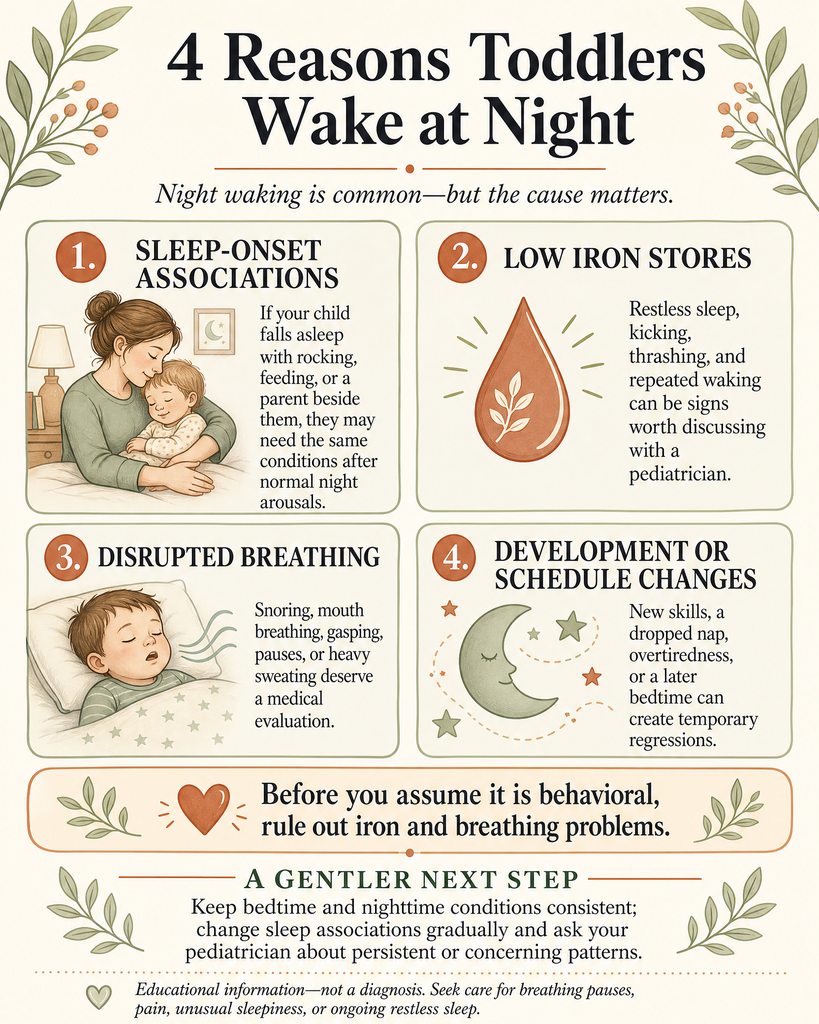
Sleep-onset associations. The most common driver. Children who fall asleep independently return to sleep after normal arousals without signaling; children who don’t, can’t.
Low iron stores. This one gets missed constantly. You may already know iron matters for energy and development — what’s less well known is that iron is required for the brain’s dopamine system, which regulates nighttime motor activity. Pediatric sleep specialists routinely check ferritin in restless sleepers, and research suggests that for sleep-related movement problems the target is considerably higher than the standard “normal” cutoff. Children under about five often can’t describe the uncomfortable leg sensations driving the restlessness — parents just see thrashing, tossing, and repeated waking.
Disrupted breathing during sleep. Obstructive sleep apnea affects an estimated 1% to 5% of children, and history and physical exam alone aren’t adequate to diagnose it — a sleep study is required. Enlarged tonsils and adenoids are the usual cause, and adenotonsillectomy is the first-line treatment.
Developmental leaps and schedule drift. New skills, a dropped nap taken too early, or a bedtime that has crept later all produce genuine, temporary regressions. These resolve — the others don’t, without intervention.
“Every toddler wakes at night. The ones who ‘sleep through’ are the ones who can get themselves back down.”
| Conventional Approach | Root-Cause Approach | |
| First step | Sleep training, or “they’ll grow out of it” | Rule out iron and breathing before assuming it’s behavioral |
| Assessment | Bedtime routine only | Ferritin, snoring and breathing history, schedule review |
| Focus | Stop the waking | Build independent sleep onset, and fix anything physical underneath |
| Timeline | Days, with frequent relapse | One to three weeks, more durable |
1. Rule out the physical causes first. If your child snores most nights, breathes through their mouth, sweats heavily in their sleep, or thrashes and kicks all night, no amount of sleep coaching will fix it. Ask your pediatrician about a ferritin level and, if breathing is noisy, a sleep evaluation.
2. Change where they fall asleep, not just how you respond at 2 a.m. This is the whole game. If they fall asleep in your arms at bedtime, the 2 a.m. wake-up is already determined. Move toward putting them down drowsy but awake, in the place they’ll wake up in.
3. Keep the environment identical from bedtime to morning. Same darkness, same white noise, same light level. A room that’s dark at bedtime and lit by a hallway at 2 a.m. gives their brain a reason to fully wake.
4. Fade your presence gradually rather than disappearing. Sitting beside the crib, then near the door, then in the hallway over a week or two is a gentler path to the same destination, and it’s well within what pediatric sleep guidance supports.
5. Look at the daytime schedule. An overtired child wakes more, not less. Check that the nap isn’t ending too late, that awake windows are age-appropriate, and that bedtime hasn’t drifted past the point where they get a second wind.
6. Be cautious with melatonin. This is worth saying plainly. Pediatric melatonin ingestions reported to poison control centers rose 530% between 2012 and 2021, and pediatric emergency visits for melatonin ingestion rose 421% between 2009 and 2020. Beyond safety, reaching for it first can bypass the evaluation that would have found the iron deficiency or the breathing problem. Talk to your pediatrician before using it.
Book a visit for snoring most nights, gasping, or pauses in breathing; mouth breathing day and night; heavy sweating during sleep; constant restless thrashing or kicking; or night waking with pain.
Also worth a conversation: night waking that started abruptly with no schedule change, waking accompanied by daytime behavioral changes or unusual sleepiness, or a pattern that has gone on for months and isn’t responding to consistent bedtime changes. Restless sleep in particular is a specific, evaluable complaint — not just an unlucky temperament.
Is toddler night waking a sign I’ve done something wrong? No. It’s a near-universal stage, and the associations that produce it form through completely normal, loving caregiving. What changes it is adjusting how sleep starts, not how much you comfort your child.
Do I have to let my child cry it out? No. The evidence-supported approaches include gradual, parent-present methods. Consistency is what matters more than which specific method you choose.
Could this be teeth? Teething causes a few rough nights, not months of nightly waking. If it’s been weeks, look elsewhere.
How much sleep should my toddler get? Most toddlers need roughly 11 to 14 hours in 24, including naps. But if your child is waking repeatedly despite adequate total hours, quality is the issue — and that’s what points toward iron or breathing.
Toddler night waking is one of the most exhausting things parents deal with, and one of the most commonly misattributed. The behavioral piece is real. So are the physical causes underneath it, and those deserve to be checked first.
“Before you sleep train, make sure there isn’t something physical keeping your child awake.”
Whether this is your first visit or your next one, we’d rather look at the whole picture than guess.