Toddler separation anxiety is a normal developmental stage that nearly every child moves through, typically emerging around 6 to 12 months. It’s tied to a cognitive leap: your child now understands you exist when you’re out of sight, but can’t yet be certain you’ll come back. Pediatricians describe it as an important developmental milestone and a completely healthy one — it reflects a strong attachment, not a fragile one. Most children become comfortable with separation by around age 3, and flare-ups around big changes are normal even after that.
Last month they toddled off happily at daycare drop-off. This week they’re wrapped around your leg, sobbing, and you’re the only acceptable person in the building — not their other parent, not the grandparent they adore. Nothing happened. Nothing changed. And it feels like a step backward.
That sudden shift is toddler separation anxiety, and it almost always arrives for a reason.
Clinginess usually shows up right after a developmental gain, not a loss.
Early on, babies don’t fully grasp that things continue to exist when out of sight. As object permanence develops, your child works out that you still exist somewhere when you leave the room — but they don’t yet have the sense of time or experience to be confident you’re coming back. That gap between knowing you exist and trusting you’ll return is exactly where the distress lives.
It also tends to arrive alongside mobility. Once a child can crawl and walk away from you, they discover that the two of you aren’t physically connected. That’s a significant realization for a small person, and some anxiety in response to it is a reasonable reaction, not a problem.
You may already know that clinginess reflects attachment. What’s less obvious is the direction of the relationship: this behavior is a sign of secure attachment, not evidence that something has gone wrong in it.
What it commonly looks like:
Crying when you leave the room or step out of sight Clinging or refusing to be put down Distress at daycare or a caregiver’s drop-off Suddenly refusing people they were previously fine with Wanting you present at bedtime again Checking back to find you while playing
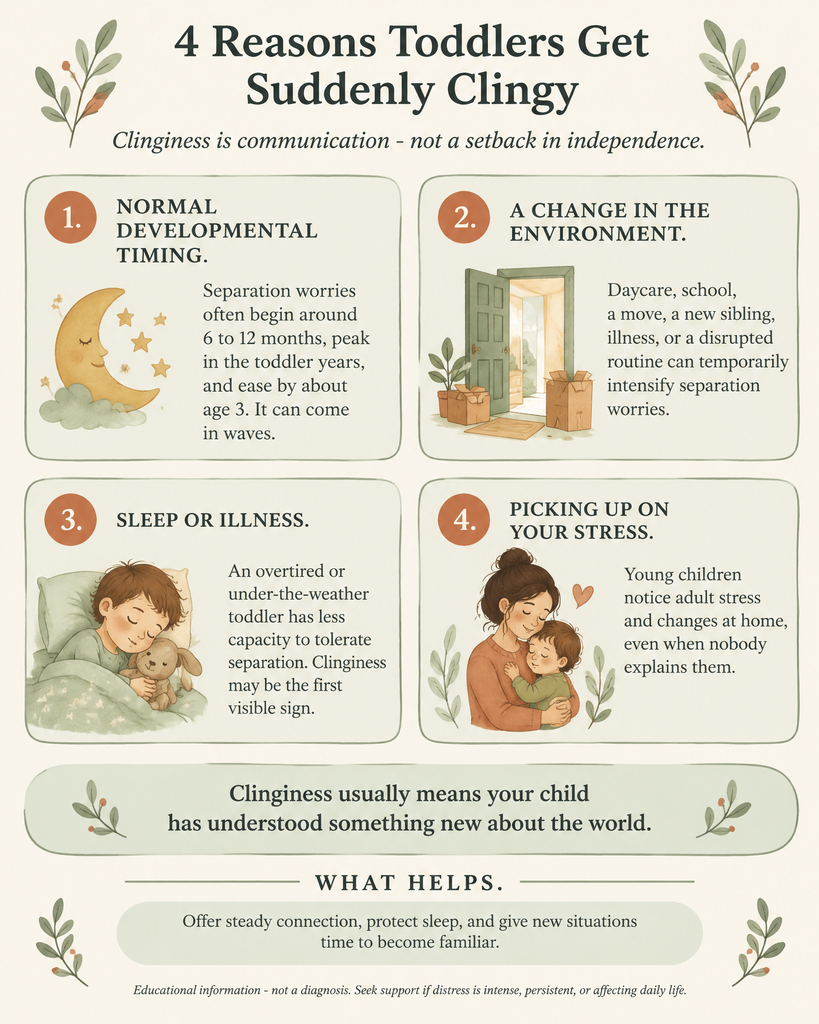
Normal developmental timing. Toddler separation anxiety typically from around 6 to 12 months of onset, with distress often peaking in the toddler years and easing by about age 3. It’s uneven — most children have a second or third round rather than one clean phase.
A change in the environment. Separation worries reliably flare around a new daycare or school, a move, a new sibling, a stretch of illness, or a disrupted routine. A temporary uptick tied to a clear cause usually settles as the new situation becomes familiar.
Sleep and being unwell. An overtired or under-the-weather toddler has far less capacity to tolerate separation. Clinginess is often the first visible sign that sleep has slipped or something is brewing.
Picking up on your stress. Small children read adult states with uncomfortable accuracy. A stressful stretch at home frequently shows up as increased clinging, without anyone saying a word about it.
“Clinginess isn’t a setback in your child’s independence. It’s usually the evidence they’ve just understood something new about the world.”
| Conventional Approach | Root-Cause Approach | |
|---|---|---|
| Framing | A behavior to correct | A developmental stage to support |
| Advice | “Just leave, they’ll stop crying” | Predictable goodbyes that build the return expectation |
| Focus | End the clinging | Build the child’s confidence that you come back |
| Timeline | Varies | Usually eases within weeks; the stage resolves for most by age 3 |
1. Always say goodbye. Slipping out while they’re distracted avoids one hard moment and costs you many more — it teaches your child that you might vanish at any time, so they have to monitor you constantly. A short, warm, confident goodbye is the harder choice and the better one.
2. Keep goodbyes brief and consistent. The same few words, the same hug, the same exit, every time. Extending the goodbye to soothe the crying tends to raise the tension rather than resolve it. Predictability is what builds trust here.
3. Practice small separations at home. Step into another room and call back to them, then return. Playing peekaboo and hide-and-seek does genuine developmental work — it rehearses the core lesson that things which disappear come back.
4. Name what’s happening and what comes next. Even before they can respond in full sentences, toddlers understand far more than they can say. “I’m going to work. Grandma will give you lunch. I’ll be back after your nap.” The sequence gives them an anchor.
5. Let the other caregiver take over fully. The handoff is smoother when you go rather than hover. Most children settle within minutes of a parent actually leaving — and it’s worth asking the caregiver to tell you how long it really took, because it’s usually much shorter than you’d guess.
6. Protect sleep and routine while it lasts. This phase is much harder on a tired child. If clinginess spiked at the same time sleep got worse, start there.
Most toddler separation anxiety needs patience, not intervention. Bring it up if the distress is severe and persistent well past the usual developmental window, if it’s clearly out of proportion to the situation, or if it’s genuinely interfering with daily family functioning.
Other things worth a conversation: frequent physical complaints like stomachaches or headaches before an anticipated separation, panic or prolonged tantrums at every separation, refusing to sleep unless a parent is present after previously doing so, or a sudden change in a child who had been comfortably separating for a long time.
Also mention it if the clinginess arrived alongside a loss of previously acquired skills, a change in speech or social engagement, or new physical symptoms — those are a different conversation, and a worthwhile one to have early.
Am I making it worse by comforting them? No. Responding to distress is what builds the security that eventually makes separation easy. What tends to prolong things is unpredictability — inconsistent goodbyes, sneaking out, or a routine that changes daily.
Why do they only do this with me? Because you’re the safest person in the room. Children generally save their biggest feelings for whoever they trust most to handle them. It’s a compliment, delivered in the least convenient possible format.
How long does toddler separation anxiety last? Most children become comfortable with separations by around age 3, though the timing varies and separation worries can resurface with big changes afterward. A flare tied to an identifiable cause usually settles as the new normal sets in.
Is separation anxiety the same as separation anxiety disorder? No. Ordinary separation anxiety in babies and toddlers is a healthy developmental milestone. Separation anxiety disorder is a distinct, recognized, and treatable condition that generally applies to children beyond toddlerhood, where the fear is excessive for the child’s developmental stage and interferes with daily life. Going through the normal stage doesn’t make a later disorder more likely.
The clingy phase is genuinely exhausting, and it tends to arrive right when you have the least capacity for it. It’s also, developmentally, good news.
“They’re not clinging because they feel unsafe with everyone else. They’re clinging because they’ve just realized you’re a separate person who leaves.”
Whether this is your first visit or your next one, if it feels bigger than a phase, that’s worth talking through rather than waiting out.
Are You Struggling With Toddler Separation Anxiety?