
PMS symptoms are common, but “common” and “nothing can be done” are two different statements. About 12% of women meet the clinical criteria for PMS, and roughly 4% have symptoms severe enough to disrupt daily life. The single most useful diagnostic tool costs nothing: prospective daily tracking across two cycles. Looking back and estimating is notoriously inaccurate. Exercise, calcium, and structured behavioral approaches all have real supporting evidence — this isn’t a condition with nothing but endurance on offer.
PMS symptoms get waved off more than almost anything else we see. A week of irritability, bloating, sore breasts, headaches, and exhaustion gets filed under “that’s just my cycle” — often by the woman experiencing it, because she’s been told some version of that her whole life.
Here’s the part that gets lost: PMS being normal doesn’t make it untreatable. There’s a real evidence base here, and most women have never been walked through it.
PMS symptoms appear in the second half of your cycle — after ovulation — and resolve shortly after your period starts. That timing is the defining feature. Symptoms that are present all month and simply get worse premenstrually are a different pattern, with a different treatment approach.
You may already know that estrogen and progesterone shift in the luteal phase. What surprises most women is that the research consistently finds those hormone levels are typically normal in women with significant premenstrual symptoms. The difference appears to be in sensitivity — how the brain responds to an ordinary hormonal shift, particularly through the GABA system that normally keeps the nervous system calm.
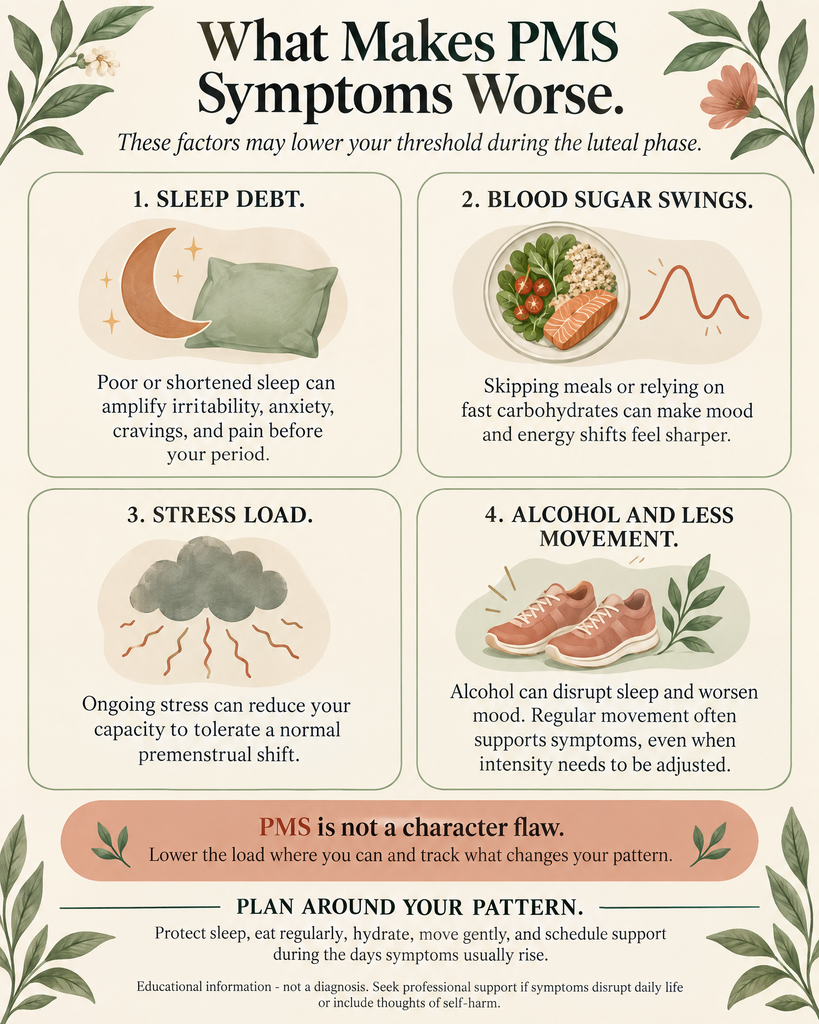
This matters practically. If the problem were simply “low hormones,” the fix would be replacing them. Because it’s largely a sensitivity and threshold issue, the leverage is in raising the threshold: sleep, blood sugar, movement, nutrient status, and stress load.
Common PMS symptoms:
Irritability, tearfulness, or anxiety in the days before your period Bloating and fluid retention Breast tenderness or fullness Headaches Fatigue and low motivation Food cravings and appetite changes Sleep that worsens in the luteal week Joint or muscle aches Trouble concentrating
Your baseline before the luteal phase starts. This is the piece conventional advice skips. The same hormonal shift lands very differently on a woman who is well-slept, well-fed, and iron-replete than on one running on five hours of sleep and skipped meals. Low ferritin, an underactive thyroid, and chronic sleep debt all lower the floor you’re starting from.
Blood sugar instability. Appetite and cravings genuinely increase in the luteal phase. Riding glucose spikes and crashes on top of an already-sensitized nervous system amplifies irritability, fatigue, and headaches.
Inflammatory and stress load. Unrelieved stress, poor sleep, and alcohol all intensify premenstrual symptoms, and alcohol in particular disrupts sleep during the exact week you need it most.
Something else wearing a PMS costume. Thyroid dysfunction, iron deficiency, and an underlying mood or anxiety condition can all masquerade as “bad PMS.” The tracking test sorts this out: true PMS symptoms disappear after your period starts. Symptoms that merely improve were present all along.
“PMS is common. Being miserable for a quarter of every month is not something you have to accept as the cost of having a cycle.”
| Conventional Approach | Root-Cause Approach | |
|---|---|---|
| First step | Reassurance, or suppress the cycle | Two cycles of daily tracking to confirm the pattern |
| Testing | Usually none | Thyroid, ferritin, and a look at sleep and blood sugar |
| Focus | Reduce the symptom in the moment | Raise the threshold the hormonal shift lands on |
| Timeline | Immediate but unchanged month to month | Two to three cycles for a meaningful shift |
1. Track daily for two full cycles before changing anything. Prospective daily ratings are the most accurate way to diagnose PMS, because looking back at the month overestimates how cyclical symptoms really were. Rate mood, physical symptoms, and energy from 1 to 5 each day. The pattern that emerges tells you whether this is PMS, something present all month, or the more severe premenstrual dysphoric disorder.
2. Move, specifically in a structured way. A systematic review of 15 randomized trials found exercise reduced global PMS symptoms, with substantial improvements in psychological, physical, and behavioral symptoms. Worth being straight about the caveat: most of those trials carried a high risk of bias, so the true effect is probably smaller than the numbers suggest. It’s still one of the best-supported, lowest-risk things you can do.
3. Prioritize calcium. Of all the vitamins and minerals studied for PMS, calcium has the strongest evidence. Clinical reviews report meaningful reductions in depressive symptoms, appetite changes, and fatigue at roughly 1,000 to 1,200 mg daily. Food sources first — dairy, sardines, fortified foods, leafy greens — with supplementation a conversation for your provider, since women with high dietary intake may not need it.
4. Steady your blood sugar through the luteal week. Protein at every meal, eating before you’re ravenous, and not white-knuckling the cravings. Fighting your appetite in the luteal phase tends to backfire; feeding it well works better than restricting it.
5. Guard sleep in the week before your period. Sleep loss and premenstrual symptoms amplify each other, and this is the week where protecting the last hour before bed pays the highest return.
6. Reconsider alcohol in the luteal week. It fragments sleep and worsens mood during the precise days you’re most sensitive. Many women find this single change does more than any supplement they’ve tried.
7. Consider structured behavioral support. Cognitive behavioral approaches have reasonable supporting evidence for premenstrual symptoms, particularly for the irritability and overwhelm piece. This isn’t “it’s all in your head” — it’s a skills-based approach to a real physiological vulnerability.
Book a visit if PMS symptoms are interfering with your work, your parenting, or your relationships — that’s the threshold, not how severe it sounds compared to anyone else.
Also worth evaluating: symptoms that don’t fully resolve after your period starts, which points toward an underlying condition with premenstrual worsening rather than PMS; symptoms that started or changed sharply after a pregnancy; premenstrual symptoms alongside heavy bleeding, cycles shorter than 21 or longer than 35 days, or new fatigue; and period pain that keeps you home from work or school, which deserves evaluation in its own right.
If premenstrual symptoms ever include thoughts of harming yourself, that’s a same-day conversation with a provider or crisis line — not something to track through another cycle.
Are PMS symptoms just something I have to live with? No. A meaningful share of women improve substantially with exercise, calcium, sleep and blood sugar changes, and addressing an underlying thyroid or iron issue. “Common” doesn’t mean “untreatable.”
How do I know if it’s PMS or PMDD? Severity and impairment. Premenstrual dysphoric disorder involves at least five symptoms including prominent mood disturbance, and it meaningfully disrupts functioning. It affects an estimated 1.3% to 5.3% of women. Both are diagnosed by tracked pattern, not a blood test.
Why were my hormone tests normal? Because for PMS, they usually are. That result points toward sensitivity as the mechanism rather than a deficiency — which changes what actually helps.
Does my PMS get worse with age? Many women notice symptoms intensifying in their late thirties and forties as ovulation becomes less consistent. That shift is worth evaluating as perimenopause rather than assuming it’s the same PMS you’ve always had.
The most useful reframe we can offer: PMS symptoms aren’t a verdict on your hormones. They’re the result of a normal monthly shift landing on a particular threshold — and thresholds can be moved.
“Track two cycles. Bring the data. That’s where this stops being ‘just your period’ and starts being a plan.”
Whether this is your first visit or your next one, two months of tracking makes the first conversation dramatically more productive.
Are You Struggling With PMS Symptoms Every Month? Our team would love to meet with you.
Click this link to schedule a time to meet with our team.