
Low desire is one of the most common things women bring up — and one of the last things they bring up, usually at the end of an appointment about something else. It isn’t only a hormone question. Thyroid function, iron stores, sleep, stress, pain, and medications all shape desire, and several are measurable on a blood test. In women with thyroid disorders, sexual dysfunction is substantially more common — a 2024 meta-analysis found it in roughly 45% overall. Iron matters more than people expect. Women with iron deficiency anemia scored significantly lower across every dimension of sexual function in a controlled comparison.
Why is my libido so low? Often for reasons that have nothing to do with sex hormones. It’s a question most women ask the internet long before they ask a person, usually with some version of “what’s wrong with me” attached.
Here’s the short answer: if you’re asking ‘why is my libido so low?’, almost certainly nothing is wrong with you. Desire is downstream of a lot of things — energy, pain, sleep, stress, hormones, nutrient status, relationship context — and when it drops, it’s usually reporting on one of those rather than failing on its own.
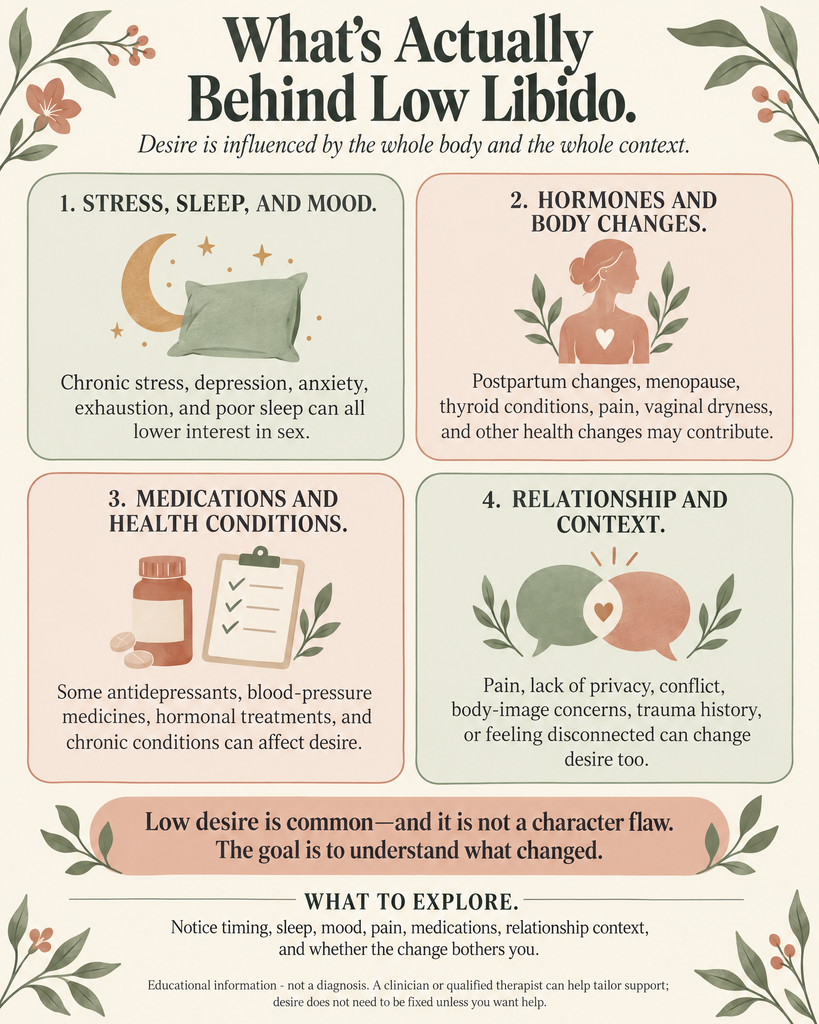
Sexual desire isn’t a single switch. It responds to physical inputs (hormones, energy, pain), psychological ones (stress, mood, body image), and relational ones (safety, resentment, exhaustion, privacy). Any one of those can pull it down, and they frequently stack.
The clinical distinction worth knowing: low desire only becomes a diagnosis when it causes personal distress. If your desire has decreased and it genuinely doesn’t bother you or your relationship, that’s a variation, not a disorder. If it does bother you, that’s reason enough to look into it — you don’t need to justify it further.
You may already know that estrogen and testosterone influence desire. What gets far less attention is how much of low libido traces back to things that have nothing to do with sex hormones at all.
What this often looks like:
Desire that’s declined noticeably from your own baseline Rarely or never thinking about sex spontaneously Being able to enjoy sex once it starts, but never initiating Avoiding intimacy because you’re exhausted rather than uninterested Pain or dryness that’s made sex something to dread Feeling guilty or broken about it — which then makes it worse
Thyroid dysfunction. A 2024 meta-analysis of nine studies found sexual dysfunction in about 45% of women with thyroid disorders — roughly 42% with hypothyroidism and 60% with hyperthyroidism. Thyroid affects energy, mood, and cycle regularity all at once, and it’s a simple blood test.
Low iron stores. In a controlled study of 129 women, those with iron deficiency anemia scored significantly lower across every dimension of sexual function and satisfaction than women without it. Iron deficiency is extremely common in menstruating women, and ferritin is often not checked.
Chronic stress and the cortisol curve. Desire requires a nervous system that feels safe enough to prioritize something other than survival. Sustained stress reliably suppresses it, and this is the most common contributor we see when women ask why is my libido so low — particularly in women carrying a heavy mental load.
Sleep debt. Short, fragmented sleep lowers energy, raises irritability, and reduces desire directly. If you’re waking at 3 a.m. most nights or sleeping six hours, that may answer why is my libido so low on its own.
The postpartum window. Sexual changes after birth are close to universal. In a study following first-time mothers, 46% reported loss of interest in sex at six months postpartum and about 40% at twelve months. Estrogen is low in the months after birth, which commonly causes vaginal dryness and pain — and that pain, rather than desire itself, is frequently the actual problem. Worth saying clearly: this is not a reason to stop breastfeeding. It’s a reason to treat the dryness, which is very treatable. A systematic review found postpartum sexual changes occurred across all feeding methods, so this is about the postpartum period, not about how you feed your baby.
Perimenopause. Falling and fluctuating estrogen causes vaginal dryness and tissue thinning, which makes sex uncomfortable. Desire often drops as a sensible response to anticipated discomfort — not as a primary hormonal event.
Pain. Endometriosis, pelvic floor tension, and vaginal dryness all make sex painful. Desire reasonably declines when the body expects pain. This one deserves direct evaluation rather than being treated as a desire problem.
Medications. Several common medication classes affect desire, including some antidepressants and hormonal contraceptives. If you’re asking why is my libido so low and it changed within a few months of starting something that timeline is worth raising with your prescriber — never stop a prescribed medication on your own.
“Desire isn’t a character trait. It’s a readout — and when it drops, it’s usually reporting on something else.”
| Conventional Approach | Root-Cause Approach | |
|---|---|---|
| First step | “It’s normal at your age” or “try to relax” | Separate desire, arousal, and pain — they have different causes |
| Testing | Rarely any | Thyroid panel, ferritin, and a look at sleep, stress, and medications |
| Pain | Often not asked about | Asked about directly, since pain is frequently the real issue |
| Timeline | No change | Weeks to a few months once a specific driver is addressed |
1. Get the labs that actually bear on this. A full thyroid panel and ferritin, at minimum. Both are common, both are treatable, and both are frequently skipped when the presenting complaint is libido.
2. Name whether it’s desire, arousal, or pain. These get collapsed into “low libido” and they need completely different approaches. If sex hurts, that’s the thing to treat first — and it usually responds well.
3. Treat dryness as a physical problem with a physical solution. A good vaginal moisturizer used regularly, plus a quality lubricant during sex, resolves a great deal of what gets labeled low desire. This is not a workaround; it’s appropriate treatment for low-estrogen tissue changes.
4. Protect sleep before you try anything else. Desire is one of the first things to go with sleep debt and one of the first to return. If you’re sleeping six hours, that’s the highest-yield intervention available to you.
5. Lower the baseline stress load where you can. Not a spa day — the actual load. For many women the mental load of running a household is the relevant variable, and it responds to redistribution far better than to relaxation techniques.
6. Build back physical energy. Regular movement, enough protein, and adequate calories support energy, mood, and body confidence. Under-eating suppresses desire the way it suppresses ovulation — the body deprioritizes reproduction when resources feel scarce.
7. Address the relational piece honestly. Desire responds to feeling appreciated, rested, and not touched-out. If resentment or disconnection is part of the picture, no supplement will outrun it, and a couples therapist is a legitimate medical referral rather than a last resort.
Book a visit if low desire bothers you — that’s the whole threshold. Also worth evaluating: pain with sex at any stage; vaginal dryness that isn’t responding to a moisturizer; libido that dropped sharply rather than gradually; low desire alongside fatigue, hair shedding, cold intolerance, or heavy periods, which points toward thyroid or iron; a change that followed starting a new medication; and persistent low mood or anxiety, which both affect desire and deserve care in their own right.
Seek care promptly for pain with sex accompanied by bleeding, fever, or pelvic pain, or for new pain that’s severe.
Why is my libido so low when my hormones tested normal? Because sex hormones are only one input. Thyroid function, iron stores, sleep, stress, pain, and medications all shape desire, and none of them show up on an estrogen or testosterone level.
Is it normal for libido to drop after having a baby? Yes, and it’s close to universal. Loss of interest was reported by 46% of first-time mothers at six months postpartum. Low estrogen in that window commonly causes dryness and pain, which is treatable — and that treatment often restores more than desire alone.
Does low libido mean something is wrong with my relationship? Not necessarily. It can be entirely physiological. But relationship context is a genuine input, and it’s worth considering honestly alongside the medical picture rather than instead of it.
Should I ask about testosterone? It’s a reasonable conversation to have with a provider who treats this regularly. It’s worth knowing that evidence and prescribing practices vary considerably, and that thyroid, iron, sleep, and pain should be addressed first — they’re more commonly the answer.
Why is my libido so low? Usually because something upstream is depleted, uncomfortable, or unsustainable — and desire is the first thing the body drops when resources are short.
“you’re allowed to bring up ‘why is my libido so low?’ as the actual reason you came.”
This is a common reason for a visit, and a much less awkward conversation than most women expect. Whether this is your first visit or your next one, you’re allowed to bring it up as the actual reason you came.
Are You Struggling With Low Libido? Our team would love to meet with you.
Click this link to schedule a time to meet with our team.