
Most natural remedies for hot flashes have been studied, and the results are not what the supplement aisle implies. Two non-drug approaches have the strongest evidence behind them: cognitive behavioral therapy and clinical hypnosis. Both are recommended by the North American Menopause Society at its highest evidence level. The herbal products most commonly sold for hot flashes — black cohosh, evening primrose, dong quai, maca, soy extracts, vitamin E — are specifically not recommended, based on negative or insufficient evidence. This matters because hot flashes last longer than most women are told. In the SWAN study, frequent hot flashes lasted a median of 7.4 years, and up to 11.8 years when they began before periods stopped.
Natural remedies for hot flashes are a crowded, confusing market, and most of what’s marketed hardest has the least evidence behind it. We’d rather tell you what the research actually supports than sell you a longer list.
The honest summary: a small number of approaches genuinely work, several popular supplements don’t, and the comfort measures everyone recommends are worth doing even though they don’t reduce how often hot flashes happen.
A hot flash is a temperature-regulation event, not a heat problem. As estrogen fluctuates and declines, the brain’s thermostat in the hypothalamus becomes more sensitive. The range of core temperature it tolerates narrows, so a small rise that previously went unnoticed now triggers a full cooling response: flushing, sweating, a racing heart.
That’s why hot flashes feel disproportionate to the room you’re in. The room didn’t change. The threshold did.
You may already know hot flashes are common in menopause. What often surprises women is the duration. The SWAN study followed 1,449 women and found frequent hot flashes and night sweats lasted a median of 7.4 years — and for women whose symptoms started while they still had regular periods, a median of 11.8 years. For women whose symptoms only began after periods stopped, the median was 3.4 years.
Knowing that changes the calculation. If this is a seven-to-twelve-year window rather than a few difficult months, it’s worth investing in approaches that actually work.
What hot flashes typically look like:
Sudden heat starting in the chest, neck, or face Flushing, sweating, and sometimes a racing heart Lasting one to five minutes Often followed by a chill Night sweats that fragment sleep Triggered in some women by alcohol, caffeine, spicy food, stress, or warm rooms
The North American Menopause Society reviewed the non-hormone options in 2023 and sorted them by evidence. Here’s what came out on top.
1. Cognitive behavioral therapy. Recommended at the highest evidence level. CBT for hot flashes doesn’t claim to stop the flash — it changes how much the flash disrupts you, which in practice reduces the distress, the sleep disruption, and the daily impact substantially. It’s typically short, structured, and can be delivered in groups or online.
2. Clinical hypnosis. Also recommended at the highest evidence level, and the one most women have never heard of. In trials, clinical hypnosis has reduced hot flash frequency and severity meaningfully. It requires a trained practitioner, and it’s a legitimate, evidence-backed option rather than a fringe one.
3. Weight loss, where it applies. Recommended at a moderate evidence level. Higher body weight is associated with more frequent and more severe hot flashes, and weight reduction has reduced symptoms in trials.
That’s the recommended list. It’s short, and the shortness is the point.
This is the part most articles leave out. In the same 2023 review, the following were specifically not recommended for hot flashes, on the basis of negative or insufficient evidence:
Herbal and supplement products — including black cohosh, evening primrose oil, dong quai, maca, ginseng, chasteberry, milk thistle, rhubarb, wild yam, pollen extract, omega-3s, and vitamin E.
Soy foods, soy extracts, and the soy metabolite equol.
Paced respiration, mindfulness-based interventions, and relaxation.
Yoga, exercise, cooling techniques, trigger avoidance, and dietary modification — for the specific purpose of reducing hot flashes.
Acupuncture and cannabinoids.
Two things worth saying about that list. First, “not recommended for hot flashes” is not the same as “worthless.” Exercise, yoga, and a good diet have excellent evidence for sleep, mood, bone density, and cardiovascular health during menopause — they just haven’t been shown to reduce hot flash frequency. Keep doing them for the reasons that hold up.
Second, supplements aren’t free of risk. Herbal products interact with medications and vary in what they actually contain. If you’re taking one, your provider should know about it.
“Most of what’s sold for hot flashes hasn’t earned its shelf space. The things that work are less profitable and more effective.”
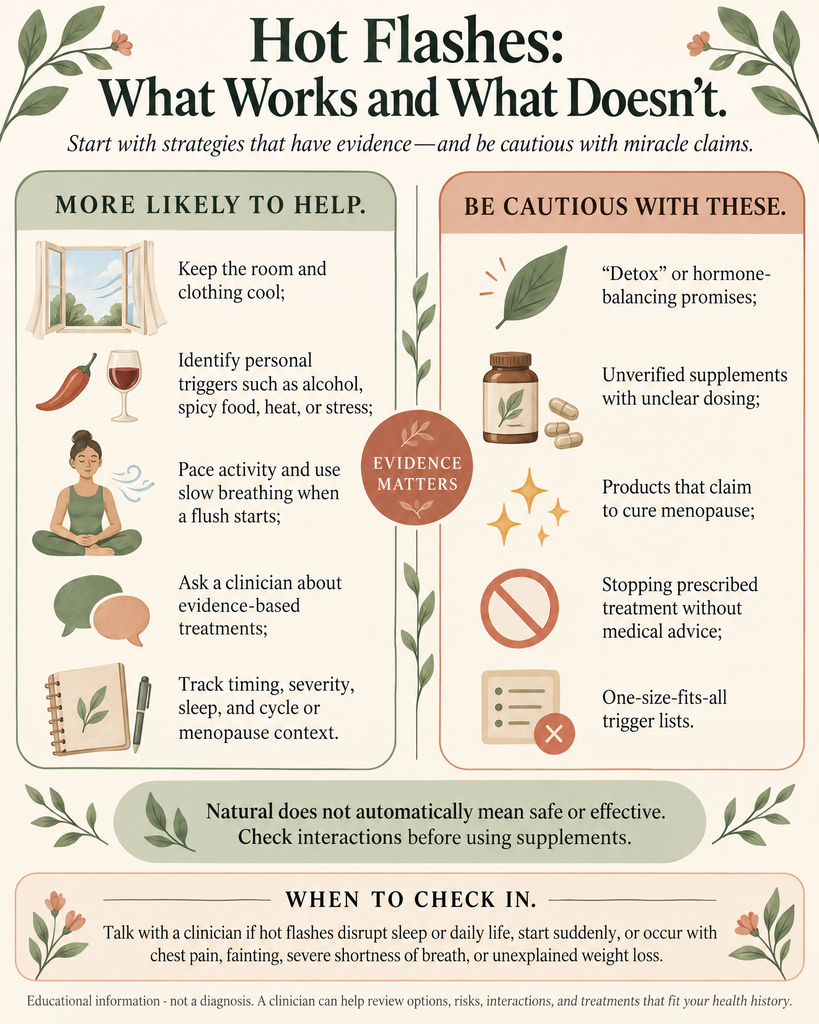
| Conventional Approach | Root-Cause Approach | |
| First step | “It’s menopause” and a supplement suggestion | Map severity, sleep impact, and duration expectations |
| Evidence | Whatever’s popular | Sorted by what has actually been tested |
| Sleep | Treated separately, if at all | Treated as central, since night sweats drive most of the damage |
| Timeline | Wait it out | Plan for a multi-year window with approaches that hold up |
These haven’t been shown to reduce how often hot flashes occur, but they make the ones you have more manageable — and several help sleep, which is often the bigger problem.
1. Build for layers and airflow. Light layers you can shed, breathable natural fibers, a cool bedroom, and a fan within reach. Comfort measures, honestly labeled.
2. Know your own triggers. Trigger avoidance isn’t proven to reduce frequency overall, but individual women reliably identify their own — commonly alcohol, caffeine, spicy food, and hot drinks. If yours are consistent, acting on them is reasonable.
3. Protect sleep aggressively. Night sweats fragment sleep, and the resulting exhaustion makes everything about this harder. A cool room, moisture-wicking bedding, a consistent wake time, and limiting alcohol in the evening all matter — alcohol in particular both triggers flashes and fragments the second half of the night.
4. Keep training for everything else. Resistance training and regular movement protect bone density, muscle mass, metabolic health, and mood through the menopause transition. Do it for those reasons.
5. Eat for the decade, not the symptom. Adequate protein, fiber, and calcium support bone and metabolic health during a period of accelerated bone loss. This is foundational work regardless of what it does for flashes.
6. Ask about the full range of options. There are effective non-hormone prescription options, and hormone therapy remains the most effective treatment for hot flashes for women who are candidates. Both are conversations worth having with a provider who treats menopause regularly, rather than questions to settle alone.
Book a visit if hot flashes are disrupting your sleep, work, or quality of life; if night sweats are waking you repeatedly; or if you want a clear conversation about which treatments actually have evidence behind them.
Seek evaluation promptly for drenching night sweats accompanied by fever, unexplained weight loss, or swollen lymph nodes — those are not menopausal symptoms and need a different workup. Also get evaluated for any vaginal bleeding after menopause, new chest pain or palpitations, or hot flashes that started before age 40, which warrants investigation in its own right.
Do any natural remedies for hot flashes actually work? Yes — cognitive behavioral therapy and clinical hypnosis have the strongest evidence among non-hormone options, and weight loss helps where relevant. Most herbal supplements marketed for hot flashes do not have evidence behind them.
What about black cohosh? It’s everywhere. It’s specifically among the products not recommended, based on negative or insufficient evidence. It’s also not risk-free, so it should be discussed with your provider rather than taken on a shelf recommendation.
Why isn’t exercise on the recommended list? Because trials haven’t shown it reduces hot flash frequency. That’s a narrow finding about one symptom — exercise remains one of the most valuable things you can do during menopause for bone, heart, mood, and sleep.
How long will this last? Longer than most women are told. The median for frequent symptoms was 7.4 years, and nearly 12 years for women whose symptoms began before their periods stopped.
Is hormone therapy worth considering? It remains the most effective treatment for hot flashes, and whether it’s appropriate depends on your health history and timing. It’s a conversation to have with a provider who manages menopause regularly.
Natural remedies for hot flashes get marketed as a long list of options. The evidence supports a short one — and knowing which is which saves you both money and years of trial and error.
“The shelf is full of things that haven’t been shown to work. Start with the two approaches that have.”
Whether this is your first visit or your next one, a plan built on what actually works beats another supplement.
Looking for Natural Remedies for Hot Flashes? that work Our team would love to meet with you.
Click this link to schedule a time to meet with our team.
Related: Why Can’t I Sleep Through the Night Anymore? | Signs of Estrogen Dominance | Signs of Low Progesterone