Choosing safe cleaning products with kids in the house starts with a label that means something: the EPA’s Safer Choice certification, rather than the words “natural” or “green,” which aren’t regulated. The most dangerous moment usually isn’t a product — it’s a combination. Bleach mixed with ammonia produces chloramine gas; bleach mixed with an acid, including vinegar, produces chlorine gas. Most household surfaces don’t need a disinfectant. Soap and water handles routine cleaning; disinfecting is for specific situations, like after someone’s been sick. Poison control centers saw a roughly 20% increase in calls about cleaning products during the pandemic, when households were disinfecting far more than usual.
This is the highest-stakes item in the whole article: even safe cleaning products with kids in the house can become dangerous in the wrong combination.
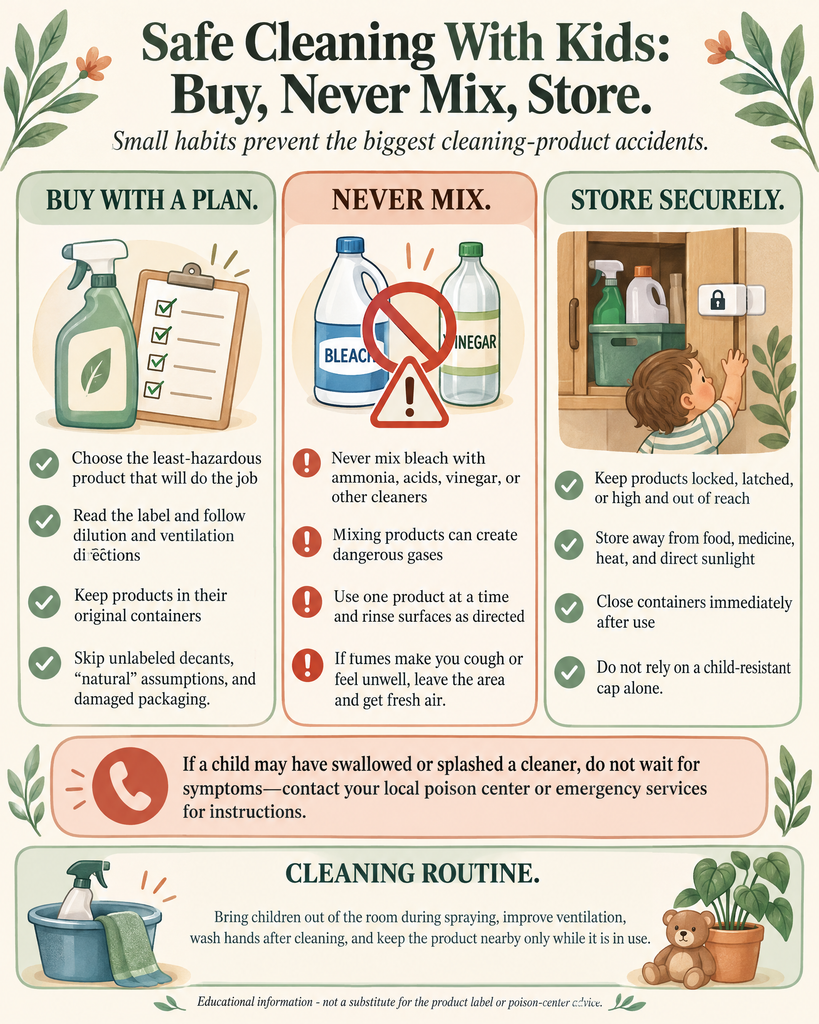
When it comes to safe cleaning products with kids in the house, three things actually protect your kids: what you buy, what you never combine, and where you keep it.
Here’s the part that surprises people: manufacturers aren’t required to list every ingredient on a cleaning product label. “Green,” “natural,” and “non-toxic” have no standardized legal definition in household cleaning, and a product carrying those words can still contain ingredients that irritate airways and skin.
Essential-oil-based cleaners aren’t automatically gentle either. Concentrated essential oils can irritate skin and eyes, some are genuinely toxic if swallowed, and citrus-based compounds can react with indoor air to form additional pollutants.
The label that does carry a standard is the EPA’s Safer Choice certification, which evaluates each ingredient in a product against health and environmental criteria. The American Lung Association points to the Safer Choice list as a reliable starting point precisely because voluntary marketing language isn’t one.
What to look for in safe cleaning products with kids in the house:
The EPA Safer Choice label Fragrance-free rather than “unscented,” which can mean masking fragrance was added A full ingredient list voluntarily disclosed Liquids or wipes rather than aerosol sprays, which put more product into the air you breathe The fewest products that will do the job
This is the highest-stakes item in the whole article, and it’s about combinations rather than products.
Bleach plus ammonia produces chloramine gas. Exposure can cause watering eyes, a runny nose, sore throat, coughing, and chest congestion — sometimes after only a few breaths, and symptoms can last up to 24 hours. Ammonia is in many glass, floor, and jewelry cleaners, and it isn’t always obvious on the front label.
Bleach plus an acid — including vinegar, and many toilet bowl, oven, and drain products — produces chlorine gas, which causes more severe and longer-lasting effects than chloramine. Some exposures require medical treatment.
Two cleaners in the same bucket or on the same surface, even separated by a few minutes, can combine. The mixing people regret usually isn’t deliberate.
Two practical rules: never combine products, and never reuse a bottle for a different cleaner. Keeping everything in its original labeled container is what makes the first rule possible.
“Most cleaning injuries at home aren’t from one product used as directed. They’re from two products meeting in a poorly ventilated bathroom.”
| Conventional Approach | Root-Cause Approach | |
| Product choice | Trust “natural” on the front label | Look for EPA Safer Choice and a disclosed ingredient list |
| Routine cleaning | Disinfect everything, often | Soap and water routinely; disinfect when there’s a reason |
| Air quality | Not considered | Ventilation, fragrance-free, no aerosols or air fresheners |
| Storage | Under the sink | High or locked, original containers, never unattended |
1. Separate cleaning from disinfecting. Cleaning with soap and water physically removes germs and dirt, and it’s enough for most household surfaces most of the time. Disinfecting is for specific moments — after a stomach bug, around raw meat prep, during an illness in the house. Treating every surface as though it needs a disinfectant increases chemical exposure without a matching benefit.
2. Use plain soap and water as the default. It’s effective, inexpensive, and the least irritating of all safe cleaning products with kids in the house.
3. Ventilate every time. Open a window, run the exhaust fan, and leave the room if you start to feel eye or throat irritation. Serious exposures usually happen when strong products are used for a long time in a small, closed space — bathrooms especially.
4. Skip air fresheners and aerosols. Air fresheners undo the work of choosing safe cleaning products with kids in the house — they add volatile compounds…
5. Clean when kids aren’t in the room. Keep children out while you’re using products and for several minutes afterward, especially in bathrooms and kitchens with the door closed.
6. Store high, locked, and labeled. Even safe cleaning products with kids in the house belong up high or in a locked cabinet always in the original container, never left open on a counter mid-job. The most common exposures happen in the few minutes a bottle is sitting out unattended.
7. Treat specific products as higher risk. Laundry pods, dishwasher detergent, oven cleaner, drain opener, and toilet bowl cleaner are the ones that cause the most serious injuries in children. Pods in particular are brightly colored and squeezable. Hand sanitizer belongs on this list too — most is at least 60% alcohol, and small amounts can cause alcohol poisoning in a young child.
8. Put the Poison Control number where you can see it. 1-800-222-1222. On the fridge, and in your phone.
Call Poison Control at 1-800-222-1222 immediately if your child swallows or is splashed by any cleaning product. Don’t wait for symptoms to appear, and don’t make your child vomit unless you’re told to.
Call 911 if your child stops breathing, collapses, has a seizure, or is struggling to breathe.
Seek medical care for persistent coughing, wheezing, or chest tightness after a fume exposure; burns or blistering on the skin, mouth, or lips; eye exposure with ongoing pain or vision changes after rinsing; or drooling and refusing to swallow, which can indicate a caustic injury to the throat.
Book a regular visit if your child has recurrent coughing, wheezing, or nighttime symptoms that seem to flare around cleaning — airway irritation from household products is a real and underrecognized contributor in children with asthma or sensitive airways.
What are safe cleaning products with kids in the house? Soap and water for most surfaces, plus a Safer Choice-certified product where you need something more. Fragrance-free, not aerosol, and as few products as will do the job.
Is vinegar a safe all-purpose cleaner? It’s fine for glass and general wiping, and it’s a reasonable low-irritant option. It’s not a disinfectant, so it isn’t the right choice after a stomach bug. And it must never be mixed with bleach.
Are essential oil cleaners safer for kids? Not automatically. Concentrated essential oils can irritate skin and airways and can be toxic if swallowed, and “natural” isn’t a regulated safety claim. Store them with the same care as any other cleaner.
Do I need to disinfect every day? For most households, no. Soap and water for routine cleaning, with disinfecting reserved for illness in the house, raw meat prep, and similar situations.
What if my child just swallowed something? Call Poison Control at 1-800-222-1222 right away, with the container in hand so you can read the ingredients. Call 911 for breathing difficulty, collapse, or seizure.
Safe cleaning products with kids in the house comes down to three habits rather than a shopping list: choose products with a label that means something, never combine them, and store them where small hands can’t reach.
“Fewer products, more ventilation, nothing mixed, everything locked up. That’s most of the risk gone.”
Whether this is your first visit or your next one, if your child has coughing or wheezing that flares at home, it’s worth looking at what’s in the air.
Do You Have Questions About Keeping Your Home Safe for Your Kids? Our team would love to meet with you.
Click this link to schedule a time to meet with our team.
Related: Why Does My Kid Get So Many Stomach Bugs? | Allergies or a Cold? | Why Won’t My Child’s Rash Go Away?