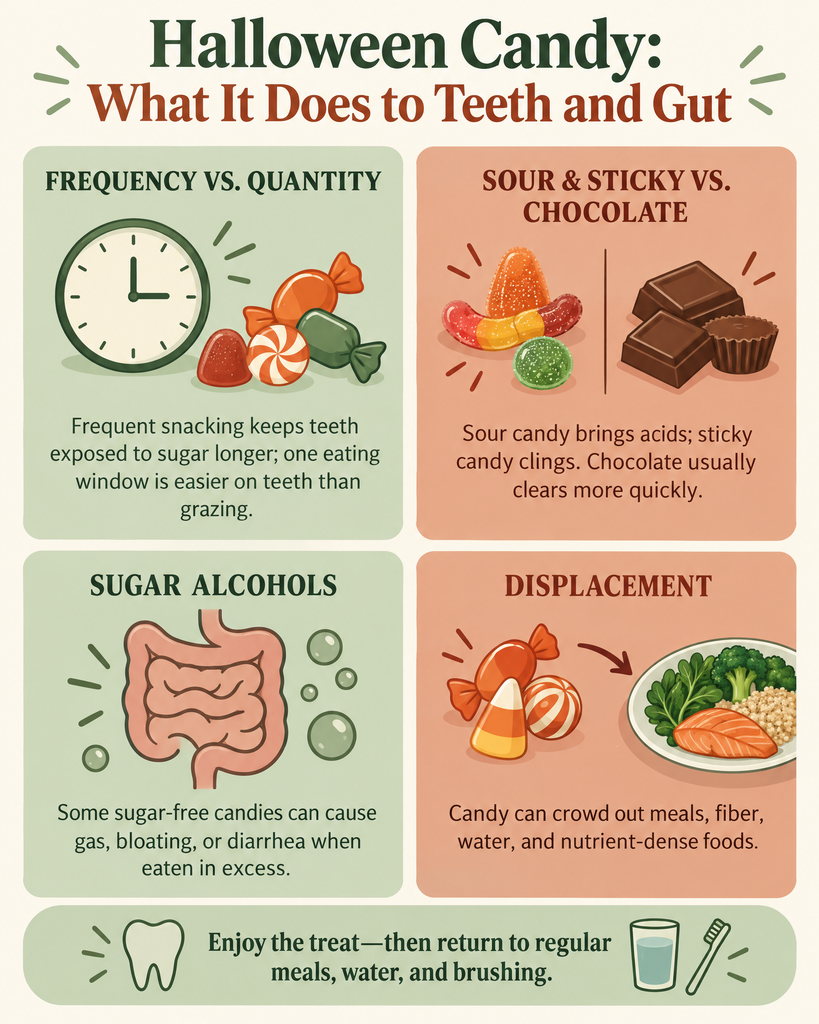
With Halloween candy, how often your child eats it matters more than how much. Frequent snacking raises cavity risk, because each exposure restarts the acid attack on enamel. Sour candy is the worst offender. The American Dental Association describes sour candies as high in dietary acids that attack tooth enamel, and names them among the worst candies for tooth decay. Chocolate is the better pick. It doesn’t cling to teeth as readily as other candies, and dark or semisweet has less sugar than milk chocolate. “Sugar-free” isn’t automatically gentler on the gut. The FDA notes sugar alcohols can produce abdominal gas, bloating and diarrhea, and foods with sorbitol or mannitol must carry a warning that excess consumption may have a laxative effect.
Every year around this time I get the same question from parents, usually phrased as a confession: how bad is it, really?
Here’s my honest answer. One night of Halloween candy is not what causes cavities or digestive trouble. What causes problems is the three weeks afterward, when a pillowcase of candy sits on the counter and gets grazed from morning to bedtime. The dose matters far less than the pattern — and the pattern is the part you can actually change without being the parent who confiscates the whole bag.
What Halloween Candy Actually Does to Teeth
The mechanism is worth understanding, because it explains why the usual advice is backwards.
Cavities don’t form because sugar touches a tooth. They form because bacteria in the mouth metabolize sugar and produce acid, and that acid pulls minerals out of enamel. Saliva then neutralizes the acid and helps rebuild the surface — but that takes time. Every new exposure restarts the clock.
Which means a child who eats ten pieces in one sitting after dinner does less damage than a child who eats one piece every hour for ten hours. Same candy. Very different outcome.
Sour candy is in a category of its own. The ADA is direct about this: sour candies are high in dietary acids that attack enamel, and are among the worst offenders for tooth decay. The acid skips the bacterial middleman entirely and goes straight at the enamel. If you’re going to pull one thing out of the bag, make it the sour candy.
Sticky, gummy, and hard candy linger. Gummies cling to tooth surfaces and hard candy dissolves slowly, so both extend the exposure well past the moment of eating. The ADA’s advice is to skip these unless they’re sugar-free.
Chocolate is the one to keep. It doesn’t stick to teeth as readily, it clears quickly, and dark or semisweet chocolate carries less sugar than milk chocolate.
Timing changes the math. The ADA recommends eating candy with a meal or shortly after, because of the extra saliva your mouth produces while eating a full meal — saliva that rinses away leftover candy and helps neutralize acid. Candy as dessert is meaningfully better than candy as an afternoon snack, which is the single most useful thing in this article.
I want to be careful here, because this is where seasonal health content tends to overreach. A few days of candy is not going to permanently alter your child’s microbiome, and anyone telling you otherwise is selling something.
What does happen is more mundane and more immediate.
Sugar alcohols are the most common culprit behind actual symptoms. They’re in most “sugar-free” candy — sorbitol, maltitol, mannitol, xylitol, isomalt, lactitol, erythritol. The FDA notes they can produce abdominal gas, bloating and diarrhea in some people, because they aren’t fully absorbed and get fermented by bacteria in the large intestine. Sorbitol and mannitol are a strong enough laxative that foods containing them are required to carry a warning that excess consumption may have a laxative effect. A child who eats a handful of sugar-free gummies and then has stomach pain and diarrhea isn’t reacting to the holiday — they’re reacting to the sweetener.
Displacement is the quieter issue. A child grazing candy all afternoon arrives at dinner without an appetite. Do that for three weeks and you’ve replaced a meaningful amount of fiber, protein and produce with sugar. The fiber loss is the part that actually shows up as constipation, which is the complaint I see most in November.
Large sugar loads can loosen stools on their own, independent of sugar alcohols, by drawing water into the intestine.
“One night of candy isn’t the problem. Three weeks of grazing is, and the fix is about timing rather than restriction.”
Parents ask about this constantly, and the honest answer is that it’s a real question rather than a settled one.
In 2021, California’s Office of Environmental Health Hazard Assessment published a two-year review of seven FDA-approved synthetic dyes and concluded that consumption of synthetic food dyes can result in hyperactivity and other neurobehavioral problems in some children. Two findings matter for parents. First, sensitivity varies considerably between children — challenge studies showed some children were affected noticeably more than others. Second, the federal acceptable daily intake levels were set using studies that are now 35 to 70 years old, and the review suggested updated safe levels for some dyes would be substantially lower.
What I tell families: if you’ve noticed your own child gets dysregulated after brightly colored candy, you’re not imagining it, and you don’t need a study’s permission to act on your observation. If you haven’t noticed it, there’s no reason to go looking for a problem.
| Conventional Approach | Root-Cause Approach | |
| Framing | Limit how much candy | Change when and how often it’s eaten |
| Teeth | Brush more | Cluster exposures, pull the sour candy, pair with meals |
| Gut symptoms | Assume it’s “too much sugar” | Check for sugar alcohols first, then look at fiber displacement |
| Dyes | Not discussed | Worth tracking in your own child, not assumed |
| Appetite | Hope they still eat dinner | Protect meals so fiber and protein don’t get displaced |
1. Make candy a dessert, not a snack. This one change does more than anything else on the list. After a meal, saliva is already flowing and the exposure is clustered into one window rather than spread over the day.
2. Let your child pick favorites and let the rest go. Have them choose ten or fifteen pieces they actually love. Kids are surprisingly reasonable about this when they’re the one choosing, and it ends the three-week grazing window without a confrontation.
3. Pull the sour candy out first. If you only remove one category, remove this one. The dietary acid works on enamel directly.
4. Water after, not brushing immediately. Rinsing with water helps clear sugar and dilute acid. Brushing while enamel is still acid-softened can do more harm than waiting a bit, so water first and brush at the usual time.
5. Offer sugar-free gum after candy, for older kids. The ADA points to chewing gum as a way to increase saliva flow — look for the ADA Seal of Acceptance, and skip it for younger children who might swallow it.
6. Read the label on anything “sugar-free.” If sorbitol, maltitol or mannitol is high on the ingredient list, expect gas and loose stools if your child eats more than a couple.
7. Protect dinner. Keep meals on schedule with protein and fiber. The constipation I see in November is usually a fiber story, not a sugar story.
8. Don’t make candy a moral issue. Restriction tends to make a food more compelling, not less. Neutral and structured beats are forbidden.
Book a visit for tooth pain, sensitivity to cold, or visible white or brown spots on teeth; for constipation that doesn’t resolve within a week of returning to normal eating; for diarrhea lasting more than a few days; or for recurring stomach pain after eating specific foods, which is worth sorting out properly rather than guessing at.
Seek care promptly for severe abdominal pain, blood in the stool, signs of dehydration, vomiting that won’t stop, or any swelling of the lips, face or throat, difficulty breathing, or widespread hives after eating — which suggest an allergic reaction and need immediate attention.
How much Halloween candy is too much? The quantity question is less useful than the timing question. A larger amount eaten in one sitting after a meal is easier on teeth than a smaller amount grazed across the whole day.
Should I just throw the candy out? It rarely works the way parents hope. Letting your child choose a set of favorites gets you the same reduction in exposure without turning candy into a forbidden prize.
Is chocolate really better? For teeth, yes — it doesn’t cling the way gummies and hard candy do, and it clears the mouth faster. Dark and semisweet also carry less sugar than milk chocolate.
My child got diarrhea from “healthy” candy. Why? Almost certainly sugar alcohols. The FDA notes they can cause gas, bloating and diarrhea, and sorbitol and mannitol are required to carry a laxative warning.
Do food dyes cause hyperactivity? California’s 2021 review concluded synthetic dyes can cause hyperactivity and other neurobehavioral problems in some children, with sensitivity varying between children. If you see it in your child, that observation is worth acting on.
Halloween candy is one of those things where the conventional advice — eat less of it — is less useful than it sounds. Frequency is what damages enamel. Displacement is what shows up as constipation. Sugar alcohols are what cause the acute stomach ache. None of those is solved by a smaller pile.
Make it dessert, let your child pick their favorites, pull the sour stuff, and protect dinner. That’s the whole plan, and it doesn’t require you to be the villain.
“Candy after dinner, favorites only, and dinner still happens. That handles most of it.”
Whether this is your first visit or your next one, we’re glad to look at the bigger picture if your child’s digestion has been off for a while.
Is Halloween Candy Leaving Your Child With Ongoing Symptoms? Our team would love to meet with you.
Click this link to schedule a time to meet with our team.
Related: Why Is My Toddler So Constipated? | Why Does My Child’s Breath Smell Bad? | Fun-Size, Hidden Ingredients: A Parent’s Guide to Allergens in Halloween Candy
Report Links Synthetic Food Dyes to Hyperactivity and Other Neurobehavioral Effects in Children, California Office of Environmental Health Hazard Assessment, April 16, 2021. https://oehha.ca.gov/risk-assessment/press-release/report-links-synthetic-food-dyes-hyperactivity-and-other-neurobehavioral-effects-children (two-year evaluation of seven FDA-approved synthetic food dyes concluded that consumption of synthetic food dyes can result in hyperactivity and other neurobehavioral problems in some children; children vary in their sensitivity, with challenge studies showing some children more adversely affected than others; federal acceptable daily intake levels were based on studies 35 to 70 years old and newer studies suggest updated safe levels for some dyes would be much lower)
Halloween Candy Survival Guide, MouthHealthy, American Dental Association. https://www.mouthhealthy.org/all-topics-a-z/halloween-tips (sour candies are high in dietary acids that attack tooth enamel and are among the worst offenders for tooth decay; sticky, gummy and hard candies cling to teeth and should be skipped unless sugar-free; chocolate does not stick to teeth as readily and dark or semisweet has less sugar than milk chocolate; eating candy with or shortly after a meal benefits from the extra saliva produced during a full meal, which rinses away leftover candy and acids; frequent snacking raises cavity risk; sugar-free gum increases saliva flow — look for the ADA Seal of Acceptance)
Sugar Alcohols, Interactive Nutrition Facts Label, US Food and Drug Administration. https://www.accessdata.fda.gov/scripts/interactivenutritionfactslabel/assets/InteractiveNFL_SugarAlcohols_October2021.pdf (examples include erythritol, hydrogenated starch hydrolysates, isomalt, lactitol, maltitol, mannitol, sorbitol and xylitol; sugar alcohols “can also produce abdominal gas, bloating, and diarrhea in some individuals” because they are not fully absorbed and are fermented by bacteria in the large intestine; foods containing sorbitol or mannitol must carry a warning that “excess consumption may have a laxative effect”)