
The afternoon energy crash has been measured, and sugar makes it worse rather than better. A meta-analysis of 31 studies in nearly 1,300 adults found carbohydrate consumption reduced alertness and increased fatigue within an hour. There is no measurable “sugar rush.” The same analysis found sugar had virtually no beneficial effect on mood, regardless of how much was consumed or what people did afterward. Part of your afternoon energy crash isn’t food at all. There’s a genuine circadian dip in the early afternoon that happens whether or not you eat lunch. Which means the candy bowl is doing the opposite of what you reach for it to do — it’s being eaten to fix fatigue, and it is measurably adding to it.
Somewhere around 2:30, the thinking gets harder. You read the same paragraph twice. And there’s a bowl of fun-size chocolate bars by the printer that has been quietly solving this problem for everyone on your floor since the first week of October.
I’m not going to tell you to throw it out. But it’s worth knowing what the research actually shows about sugar and the afternoon energy crash, because the candy bowl isn’t a neutral crutch — it’s a measurable contributor to the exact feeling you’re using it to fix.
What the Research Says About Sugar and Your Afternoon Energy Crash
This is one of the few nutrition questions with a clean answer.
Researchers at the University of Warwick and Lancaster University pooled 31 published studies covering almost 1,300 adults, looking at what carbohydrate consumption does to mood, alertness and fatigue. They published it in Neuroscience & Biobehavioral Reviews under a title that gives away the finding: “Sugar Rush or Sugar Crash?”
What they found: sugar had virtually no beneficial effect on any aspect of mood — not at low doses, not at high doses, not when people performed demanding mental or physical tasks afterward. What it did do was reduce alertness within an hour of consumption and increase fatigue within an hour, compared with people who hadn’t consumed it.
So the “sugar rush” that the whole concept rests on didn’t show up in the data. The crash did.
That’s a useful thing to know at 3 PM, because the intuition driving your hand toward the bowl — that this will help you push through the next hour — is the part the evidence doesn’t support.
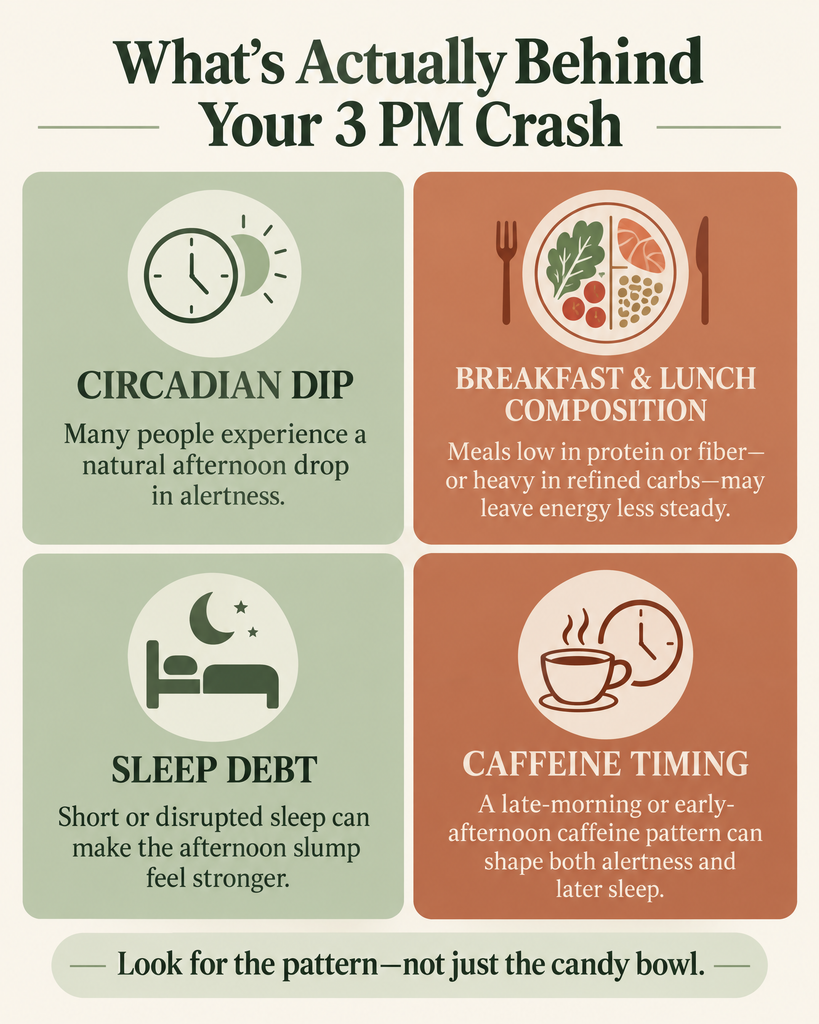
Here’s where I’d push back on the standard version of this article, which blames the candy for everything. The afternoon slump has several inputs, and sugar is only one.
There’s a real circadian dip. Human alertness drops in the early-to-mid afternoon as part of the normal daily rhythm. It happens independently of what you ate, which is why people who skip lunch entirely still feel it. Some of your 3 PM is simply biology, and the goal is to work with it rather than medicate it.
What you did at breakfast matters more than what you do at 3. A breakfast that’s mostly refined carbohydrate, or no breakfast followed by a large lunch, sets up a bigger afternoon swing than the candy does.
Lunch composition. A large, carbohydrate-heavy lunch produces exactly the alertness drop the meta-analysis describes, on a bigger scale than a fun-size bar.
Sleep debt is the loudest input and the least discussed. If you’re running on six hours, no food choice fixes 3 PM. The candy is treating a symptom whose cause is in bed.
Caffeine timing. A large coffee at 7 AM has substantially worn off by mid-afternoon, and the dip you feel at 3 is partly that. Another coffee then is what interferes with tonight’s sleep, which feeds tomorrow’s slump.
Dehydration and not moving. Both are mundane, both are real, and both are easier to fix than anything else on this list.
“The candy bowl is being used to treat fatigue, and the measured effect of candy is more fatigue. That’s the whole problem in one sentence.”
An occasional slow afternoon is normal. A daily afternoon energy crash that needs sugar and caffeine to get through is a pattern worth investigating, and there are a handful of things we check that routine visits often skip.
Ferritin, not just hemoglobin. Iron stores drop well before a complete blood count looks abnormal. Fatigue that’s been building for months with normal “blood work” is frequently a ferritin story, particularly in women who menstruate.
Full thyroid panel. TSH alone can look acceptable while the rest of the picture explains the fatigue.
B12 and vitamin D.
Fasting glucose, A1C, and fasting insulin. Not to diagnose diabetes, but to see whether you’re handling glucose well. Insulin resistance frequently shows up as afternoon fatigue years before anything appears on a standard glucose reading.
Sleep quality, honestly assessed. Including snoring, which points at the airway and is one of the most commonly missed causes of daytime fatigue in adults.
| Conventional Approach | Root-Cause Approach | |
| The 3 PM crash | “Cut out sugar” | Look at breakfast, sleep, caffeine timing and the circadian dip |
| Testing | CBC and TSH, called normal | Ferritin, full thyroid panel, A1C and fasting insulin, B12, vitamin D |
| Caffeine | Not discussed | Timing reviewed, since afternoon coffee feeds tomorrow’s slump |
| Candy | Framed as a willpower problem | Framed as a signal that something upstream isn’t working |
| Goal | Get through the afternoon | Not need to get through the afternoon |
1. Eat a real breakfast with protein. This is the highest-leverage change, and it works in the afternoon rather than the morning. Twenty-five to thirty grams of protein at breakfast flattens the whole day’s curve.
2. Rebalance lunch rather than shrinking it. Protein, vegetables, and some fat, with carbohydrate present but not the centerpiece. A big bowl of pasta at noon produces exactly the alertness drop the research describes.
3. If you’re going to have the candy, have it after lunch rather than instead of it. Eaten alongside protein and fiber, the glucose curve is gentler. Eaten alone at 3 PM on an empty stomach, it’s the scenario the studies measured.
4. Walk for ten minutes at the dip. Daylight and movement do more for afternoon alertness than sugar does, and you can combine it with something you were going to do anyway.
5. Set a caffeine cutoff. Early afternoon at the latest. Caffeine has a long half-life, and the afternoon cup that rescues today is often what shortens tonight’s sleep.
6. Drink water before you reach for the bowl. Mild dehydration reads as fatigue remarkably often, and it costs nothing to rule out.
7. Move the bowl. Not throw it out — move it. Proximity drives most of this, and a bowl two rooms away gets eaten from far less without anyone having to announce a policy.
8. Treat persistent fatigue as a question, not a personality trait. If you’ve needed sugar every afternoon for a year, that’s data worth bringing to an appointment.
Book a visit for fatigue that’s persisted more than a few weeks despite adequate sleep, for fatigue alongside hair loss, feeling cold, constipation or heavy periods, for new or worsening brain fog, or if you’ve been told your bloodwork is normal and you still feel noticeably off.
Seek care promptly for fatigue with shortness of breath or chest pain, significant unintentional weight change, excessive thirst with frequent urination, or fainting.
Is the sugar rush a myth? As a boost, largely yes. The meta-analysis of 31 studies found no beneficial effect on mood, and measured reduced alertness and increased fatigue within an hour of consumption.
So is one piece of candy actually bad for me? No. One piece of candy is one piece of candy. The issue is a daily habit layered on top of a skipped breakfast and short sleep, where the thing you’re using as a fix is contributing to the problem.
What should I eat at 3 PM instead? Something with protein and fat — nuts, Greek yogurt, cheese and an apple, leftover chicken. The goal is to not produce the swing in the first place.
Why do I get an afternoon energy crash even on days I eat well? Because food is only one input. The circadian dip is real, and sleep debt, caffeine timing, and iron or thyroid status all sit upstream of it.
Could this be more than a diet? It can be, and it’s worth checking if it’s constant. Low ferritin, thyroid dysfunction, insulin resistance, B12 deficiency and disrupted sleep breathing all present as afternoon fatigue, and several of them look fine on a standard panel.
The candy bowl is not a moral failing. It’s a reasonable response to a real feeling, built on an assumption about sugar that the research doesn’t support.
If your afternoon energy crash has been a daily event for a long time, the more interesting question isn’t what to eat at 3 PM. It’s why you need anything at all.
“If you need sugar to finish every afternoon, the candy isn’t the problem to solve. It’s the symptom pointing at one.”
Whether this is your first visit or your next one, persistent fatigue with normal bloodwork is one of the most common things we untangle.
Tired Every Afternoon No Matter What You Do? Our team would love to meet with you.
Click this link to schedule a time to meet with our team.
Related: Why Do I Have No Energy After Eating? | Why Your Annual Bloodwork Can Look “Normal” and You Still Feel Off | Why Am I Always Cold?
Mantantzis K, Schlaghecken F, Sünram-Lea SI, Maylor EA, “Sugar Rush or Sugar Crash? A Meta-Analysis of Carbohydrate Effects on Mood,” Neuroscience & Biobehavioral Reviews, 2019. DOI: 10.1016/j.neubiorev.2019.03.016. https://pubmed.ncbi.nlm.nih.gov/30951762/ and University of Warwick summary at https://warwick.ac.uk/news/pressreleases/no_such_thing (31 published studies, almost 1,300 adults; sugar had virtually no effect on any aspect of mood regardless of dose or subsequent mental or physical activity; sugar reduced alertness within an hour of consumption and increased fatigue within an hour, compared with people who had not consumed it)