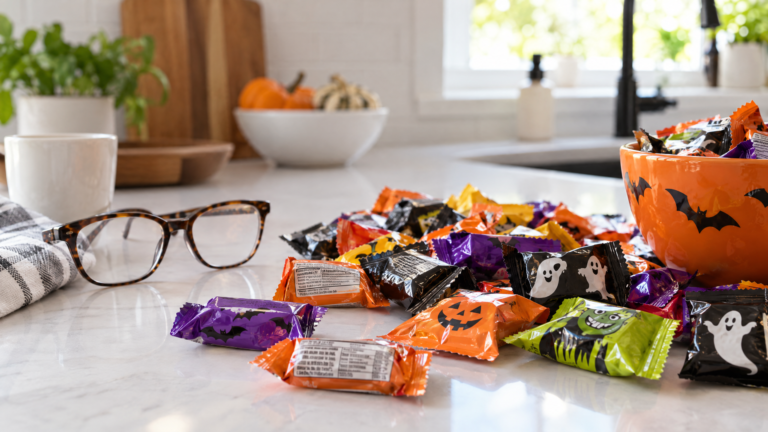
Halloween candy allergens are harder to check than they look, because fun-size and mini candies may contain different ingredients than the full-size version of the same product. FARE advises checking minis separately rather than assuming. The “Contains” statement doesn’t cover everything. The FDA states that allergens present due to cross-contact are not declared in the ingredient list or the “Contains” statement, and that federal allergen labeling requirements don’t apply to those unintentional allergens. There are nine major allergens now. Sesame became the ninth under the FASTER Act, signed April 23, 2021, with labeling required from January 1, 2023. No candy is allergy-free. The top nine allergens account for over 90% of reactions, but more than 200 allergens have been reported.
If your child has a food allergy, Halloween is the one night a year when the usual system breaks down. You can’t read a label in the dark on someone’s porch, your child is handed food by strangers, and the pieces they come home with are often versions of products you’ve never actually inspected.
That last part is the one most parents don’t know about, and it’s the most important thing in this article. Checking Halloween candy allergens properly means checking the exact item in the bag — not the product you think it is.
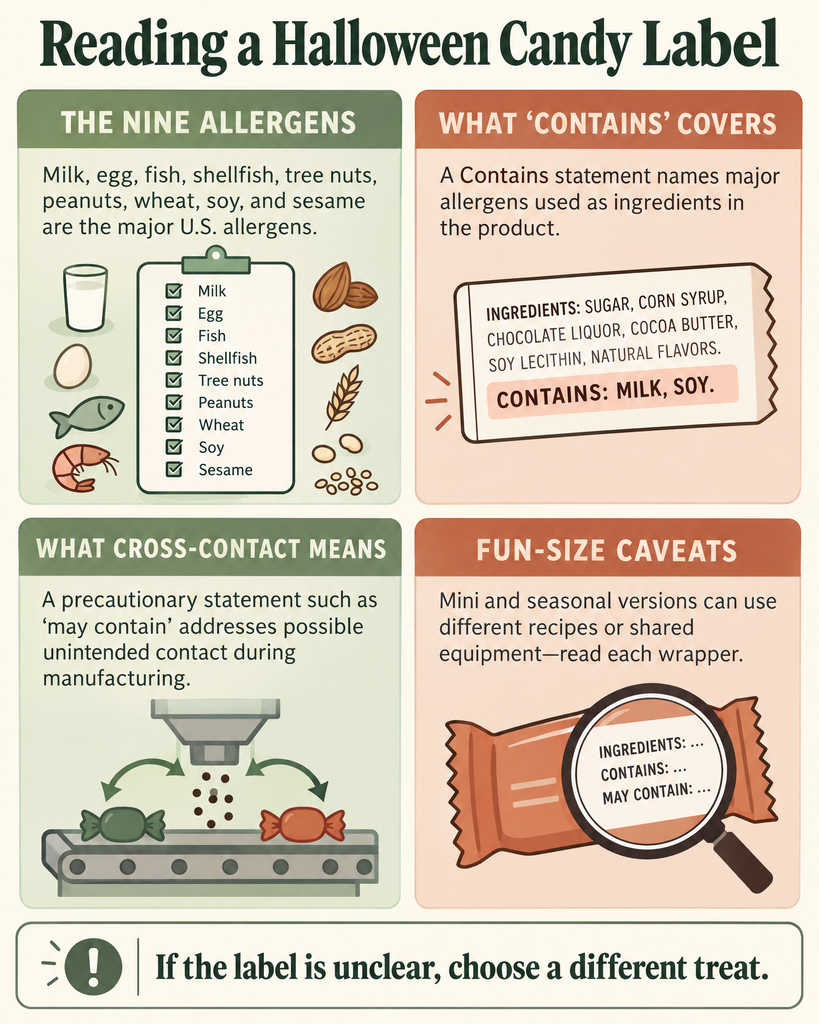
Here’s the piece of Halloween candy allergens that catches careful parents off guard: the mini version of a candy is not necessarily the same recipe as the full-size bar.
FARE — Food Allergy Research & Education — is explicit that candy in “mini” sizes may have different ingredients than its larger counterparts, and advises double-checking the ingredients on minis specifically. Different production lines, different formulations, sometimes different facilities. The full-size bar you’ve cleared a hundred times tells you nothing definitive about the fun-size one in the pillowcase.
Two more things in the same category:
Ingredients change from year to year. FARE’s guidance is not to assume last year’s safe candy is still safe. Read the label every time, every season.
Some minis come in bags with no individual labeling at all. If you can’t identify a product clearly, FARE’s advice is to discard it or trade it out.
This distinction matters more than anything else on a wrapper, and almost nobody explains it.
What’s required? Nine major allergens must be declared: milk, eggs, fish, crustacean shellfish, tree nuts, peanuts, wheat, soybeans and sesame. The food source has to appear at least once — either in parentheses after the ingredient, like “whey (milk),” or in a “Contains” statement next to the ingredient list.
What isn’t. The FDA states that allergens present due to cross-contact are not to be declared in the ingredients list or the “Contains” statement, and that federal allergen labeling requirements don’t apply to these unintentional allergens.
Read those two together and you get the point: a clean “Contains” statement tells you what was deliberately put in. It does not tell you what may have arrived from shared equipment. “May contain” advisory statements are a separate category of information, and their absence doesn’t guarantee anything either.
Common Halloween candy allergens that surprise people, per FARE:
Candy corn often contains egg whites, and some versions are made with sesame oil
Licorice often contains wheat as a binding ingredient
Dark chocolate often has traces of milk — which may be fine for lactose intolerance but is generally considered unsafe with a milk allergy
Products labeled free of one allergen may substitute another
“The full-size bar you’ve cleared for years tells you nothing definitive about the fun-size version in the bag.”
With Halloween candy allergens, allergy and sensitivity get used interchangeably,, and conflating them causes real problems in both directions — families treating a true allergy too casually, and families treating a sensitivity as an emergency.
A true food allergy is an immune response that can be rapid and life-threatening. It needs a diagnosis, an action plan, and epinephrine.
Non-allergic reactions to Halloween candy are mostly two things in my experience.
Sugar alcohols, in anything labeled sugar-free — sorbitol, maltitol, mannitol, xylitol, isomalt, lactitol, erythritol. The FDA notes these can produce abdominal gas, bloating and diarrhea in some people because they aren’t fully absorbed and get fermented in the large intestine. Sorbitol and mannitol are enough of a laxative that products containing them must carry a warning that excess consumption may have a laxative effect. A child doubled over with cramps an hour after sugar-free gummies is usually reacting to the sweetener.
Synthetic food dyes. California’s Office of Environmental Health Hazard Assessment reviewed seven FDA-approved dyes over two years and concluded in 2021 that consumption of synthetic food dyes can result in hyperactivity and other neurobehavioral problems in some children, with sensitivity varying considerably from child to child. If you’ve noticed a pattern in your own child, that’s worth taking seriously.
What neither of these is: anaphylaxis. Knowing which category you’re dealing with changes what you do.
| Conventional Approach | Root-Cause Approach | |
| Labels | Check the “Contains” line | Understand that it covers intentional ingredients only |
| Fun-size | Assumed same as full-size | Checked separately, every year |
| Stomach aches | Blamed on “too much sugar” | Sugar alcohols checked first |
| Behavior changes | Dismissed | Tracked against dyes in your own child |
| Testing | IgG sensitivity panels | Proper allergy evaluation; IgG panels not recommended |
1. Feed your child before they go out. A full child grazes less, and grazing from the bag while walking is where most accidental exposures happen.
2. Make the rule “nothing until we sort it.” Not “be careful.” A clear, simple rule works better in the dark with friends around.
3. Carry epinephrine, and carry two. If your child has a diagnosed allergy, auto-injectors go with you on the walk, not in the kitchen drawer. Know the signs and know you call 911 after using one.
4. Sort at the table under good light. Three piles — safe, unsafe, unknown. The unknown pile is the one that matters, and unknown gets treated as unsafe.
5. Run a trade system. Your child hands over the unsafe pile and gets something they actually want — a safe candy you bought ahead, a toy, screen time, cash. This turns the worst part of the night into the best part.
6. Check minis against minis. When you look up Halloween candy allergens, look up the fun-size product specifically. If you’re unsure, the manufacturer’s consumer line will tell you. FARE’s advice is to contact the manufacturer with questions rather than guess.
7. Brief the adults. Grandparents, carpool drivers, the parent hosting the party. The most common failure point isn’t a label — it’s a well-meaning adult who didn’t know.
8. Put a teal pumpkin out. The Teal Pumpkin Project signals that you’re offering non-food treats, so every trick-or-treater can take something. It costs nothing and it changes the night for the family down the street.
Book a visit if your child has had a reaction you’ve never had properly evaluated, if you’re managing a suspected allergy without a diagnosis or an action plan, if your child’s epinephrine prescription needs renewing before Halloween, or if you’ve been avoiding foods based on an IgG sensitivity panel — those aren’t recommended for diagnosing food reactions, and children end up on unnecessarily narrow diets because of them.
Also book a visit for recurring stomach pain, loose stools or reflux after specific foods, which is worth sorting out properly rather than guessing at.
Call 911 immediately for swelling of the lips, tongue or throat; difficulty breathing, wheezing or a hoarse voice; widespread hives with vomiting, dizziness or faintness; or any reaction that comes on fast and is getting worse. Use epinephrine first and call second — not the other way around.
Are fun-size candies really different from full-size? FARE says mini sizes may have different ingredients than their larger counterparts and advises checking minis specifically. Don’t rely on your knowledge of the full-size product.
If the label doesn’t say “Contains peanuts,” is it safe? Not necessarily. The FDA states that allergens from cross-contact aren’t declared in the ingredient list or the “Contains” statement, and the labeling requirements don’t apply to unintentional allergens. A clean Contains line covers intentional ingredients only.
Is sesame on the label now? Yes. The FASTER Act added sesame as the ninth major allergen, with labeling required from January 1, 2023.
Is any candy allergy-free? No. FARE notes the top nine allergens account for over 90% of reactions, but more than 200 allergens have been reported, so no product is safe for everyone.
My child reacted but the allergy testing was negative. What now? That usually points to a non-allergic reaction, and the two most common culprits in candy are sugar alcohols and synthetic dyes. Both are worth tracking, and neither is an allergy — which is good news for how you manage it.
What’s the Teal Pumpkin Project? A teal pumpkin on the doorstep signals that you have non-food treats available, so children with allergies can participate like everyone else.
The hardest part of Halloween with a food allergy isn’t the candy. It’s that the normal system — reading the label, making a decision — gets suspended for one night, in the dark, with your child holding food from strangers.
The fix is structure. Feed them first, nothing until it’s sorted, sort under good light, treat the unknown as unsafe, and make the trade genuinely worth it. And when you check Halloween candy allergens, check the minis specifically — they may not be what you think they are.
“Unknown counts as unsafe. That one rule does most of the work.”
Whether this is your first visit or your next one, if you’re managing a suspected allergy without a real diagnosis and action plan, that’s worth fixing before next Halloween.
Still Guessing About Halloween Candy Allergens? Our team would love to meet with you.
Click this link to schedule a time to meet with our team.
Related: What Halloween Candy Does to Your Child’s Teeth and Gut | Why Does My Kid Get Hives? | Why Won’t My Child’s Rash Go Away?