
The link between sugar and PMS is more specific than most writing on it admits. The luteal-phase craving is real and measurable. A 2024 systematic review and meta-analysis in Nutrition Reviews found energy intake averaged about 168 calories per day higher in the luteal phase than the follicular phase. That means the craving isn’t a willpower problem. It’s a documented metabolic shift, and fighting it tends to backfire. The problem with answering it with candy: a meta-analysis of 31 studies in nearly 1,300 adults found carbohydrate consumption reduced alertness and increased fatigue within an hour, with no benefit to mood. So candy meets a genuine appetite increase while measurably worsening the fatigue that’s already a core PMS symptom.
Halloween lands at an awkward moment for roughly a quarter of women every year. The bowl of leftover candy appears on the counter at precisely the week when your appetite is genuinely higher, your sleep is lighter, and your tolerance for everything is thinner.
What I want to do here is separate two things that get collapsed together in most writing about sugar and PMS: the craving, which is real physiology and not a character flaw, and what you do with it, which is where there’s actually some leverage.
Let me be straight about the evidence, because this is a topic where confident claims outrun the data.
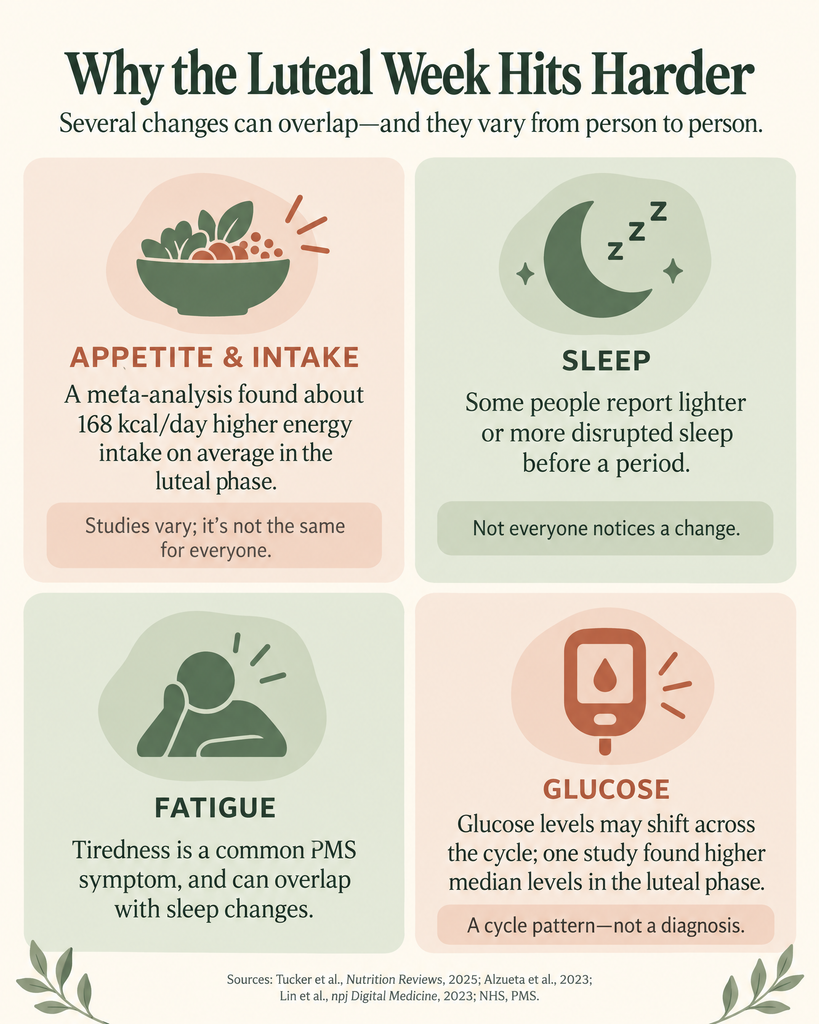
What’s well established: energy intake genuinely rises in the luteal phase. A 2024 systematic review and meta-analysis published in Nutrition Reviews pooled 15 datasets covering 330 women and found intake averaged roughly 168 calories per day higher in the luteal phase than the follicular phase — a moderate effect, statistically significant, though with considerable variation between studies.
That’s the single most useful fact in this article. You are not imagining the craving, and you are not failing at discipline in the week before your period. Your body is asking for more food because it is, metabolically, in a different state.
Also well established: carbohydrate makes alertness and fatigue worse in the short term. The meta-analysis of 31 studies in nearly 1,300 adults found sugar reduced alertness within an hour of consumption and increased fatigue within an hour, with virtually no beneficial effect on mood at any dose.
What is not well established: that sugar intake directly causes more severe PMS. The studies pointing that way are mostly small cross-sectional surveys, and I’m not going to present them as more than they are.
So the honest version of the sugar and PMS connection is this. Your appetite is genuinely up. Fatigue and irritability are already among your symptoms. And the food most readily available to answer that appetite — a bowl of fun-size chocolate on the counter — has a measured effect of reducing alertness and increasing fatigue within the hour. It’s not that sugar creates PMS. It’s that it’s a poor answer to a real question, at the worst possible week.
PMS symptoms track less with hormone levels than most people expect. Research consistently finds that women with significant PMS don’t have abnormal hormone levels — what differs is sensitivity to normal hormonal shifts.
That reframing matters for sugar and PMS, because it means the leverage isn’t in replacing a hormone. It’s in lowering everything else that’s loading the system during that week.
Appetite and cravings rise, as above. Restricting here usually produces a worse outcome than feeding it well.
Sleep is often lighter in the luteal phase, which independently worsens mood, pain sensitivity and glucose handling.
Fatigue is already one of the most common PMS symptoms, which is exactly the thing the carbohydrate research shows gets worse within an hour of a sugar load.
Irritability sits on a nervous system that’s already more reactive. Riding glucose swings on top of that amplifies it.
And the candy is physically in the house, which is the most underrated variable of all. Proximity drives intake more reliably than intention does.
“Your appetite is genuinely higher that week. The question isn’t whether to feed it — it’s what you feed it with.”
| Conventional Approach | Root-Cause Approach | |
| The craving | Willpower problem; eat less | Real metabolic shift; feed it deliberately |
| Framing | “Cut out sugar” | Change what answers the craving, and when |
| Fatigue | Treated as inevitable | Treated as partly food-timing driven |
| Testing | Usually none | Ferritin, thyroid, and a look at sleep and glucose handling |
| Goal | Get through the week | Lower the total load so the week is milder |
1. Eat more in the luteal week, on purpose. This is the one that surprises people. If intake is naturally up by well over a hundred calories a day, planning for that with real food beats white-knuckling it until 9 PM and then eating the candy bowl. Restriction in this week reliably backfires.
2. Put protein in front of the craving, not instead of it. Twenty-five to thirty grams at breakfast and a solid protein source at lunch flattens the whole day. The craving arrives smaller when you’re not already running on a deficit.
3. Pair rather than avoid. If you want the chocolate, have it after a meal with protein and fiber rather than alone at 3 PM on an empty stomach. Same candy, much gentler curve, and no sense of deprivation to rebel against later.
4. Choose dark chocolate when it’s the craving you’re answering. Less sugar than milk chocolate, and most people are satisfied with less of it.
5. Move the bowl out of sight. Not a willpower intervention — an environmental one. Freeze it, send it to an office, put it in an opaque container on a high shelf. This does more than any amount of resolve.
6. Mind caffeine in that week. It compounds the irritability and the lighter sleep, and the afternoon cup that gets you through is often what shortens the night.
7. Consider calcium. Of the nutrients studied for PMS, calcium has the most consistent supporting evidence. Worth discussing with your provider rather than adding blindly.
8. Protect sleep harder than usual that week. Sleep is upstream of mood, pain sensitivity and glucose handling all at once, which makes it the highest-value thing to defend.
Book a visit if PMS symptoms are interfering with work, relationships or daily function; if your mood changes in the luteal phase feel severe rather than irritating, which may point to PMDD and is treated differently; if you have fatigue that persists through the whole cycle rather than just that week; or if symptoms have changed noticeably in the past year.
Also worth a visit: cycles shorter than 21 or longer than 35 days, bleeding heavy enough to cause fatigue or require hourly pad changes, or new severe pelvic pain.
Seek care promptly for thoughts of harming yourself. That’s not PMS to manage at home, and support is available.
Does sugar actually make PMS worse? On sugar and PMS specifically, the honest answer is that the direct evidence is weaker than the internet suggests. What’s well documented is that carbohydrate reduces alertness and increases fatigue within an hour, and that fatigue is already a core PMS symptom. So it worsens a symptom you have, rather than causing the syndrome.
Why did I crave sugar so badly before my period? Because energy intake genuinely rises in the luteal phase — about 168 calories a day on average in the 2024 meta-analysis. The craving is a metabolic signal, not a failure of discipline.
Should I just cut out sugar in the second half of my cycle? I’d rather you ate enough. Restricting during a phase when appetite is physiologically elevated tends to produce a bigger swing later. Pair it, time it with meals, and make sure the rest of your intake is adequate.
Is dark chocolate better? For this purpose, generally yes — less sugar, and most people find a smaller amount satisfying.
My PMS is severe. Is sugar and PMS really the main issue? No, and I wouldn’t want food framed as the whole answer. Severe premenstrual mood symptoms deserve a proper evaluation, including for PMDD, thyroid function and iron status. Food timing lowers the load; it isn’t the full picture.
The leftover candy on the counter isn’t a test of your character. It’s a convenient answer to a real physiological question, arriving in the week when you’re least equipped to negotiate with it.
The practical version of everything known about sugar and PMS comes down to three things: feed the luteal week properly, pair the candy with a meal instead of eating it instead of one, and move the bowl. That’s most of what’s available here — and it works better than deciding to want it less.
“Your body asks for more that week. Answer it with a meal, and the candy stops being the answer.”
Whether this is your first visit or your next one, PMS that’s interfering with your life is worth a real workup rather than another month of managing it.
Is PMS Taking Over a Week of Every Month? Our team would love to meet with you.
Click this link to schedule a time to meet with our team.
Related: PMS Isn’t Something You Just Have to Live With | Signs of Low Progesterone | The Office Candy Bowl: Why Sugar Wrecks Your 3 PM Energy