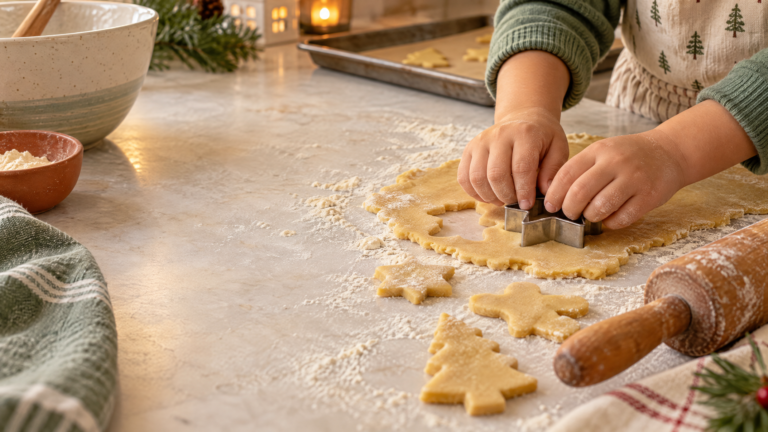
Holiday baking with kids is worth doing — and worth knowing the numbers behind. The American Heart Association recommends children ages two to 18 limit added sugar to less than 25 grams, about six teaspoons, per day, and that children under two have none at all. Sugar does more in a recipe than sweeten.
It holds moisture, browns the crust, tenderizes the crumb and helps baked goods rise, which is why cutting all of it produces something nobody wants to eat. The useful target is a reduction, not an elimination. Cutting a third of the sugar in most cookie, muffin and quick-bread recipes is close to unnoticeable once spices do some of the work. Be careful with “sugar-free.” The FDA notes sugar alcohols can produce abdominal gas, bloating and diarrhea, and products containing sorbitol or mannitol must carry a warning that excess consumption may have a laxative effect.
Holiday baking with kids is one of the few food traditions I’d never tell a parent to scale back. It’s time together, it builds real skills, and a child who helps make something is more interested in food generally — which is worth more over a childhood than the sugar in one batch of cookies costs.
What I would do is bake differently. Not sugar-free, which produces disappointment and resentment in equal measure, but genuinely lower-sugar in ways children don’t notice. Here’s what works, what doesn’t, and why.
A batch of holiday cookies is not the problem. December is.
The AHA’s recommendation is less than 25 grams of added sugar a day for children two to 18 — roughly six teaspoons — plus no more than eight ounces of sugary beverages a week, and no added sugar at all before age two. For scale, a single frosted sugar cookie can approach half that daily limit, and the holidays tend to serve them alongside hot chocolate, candy canes and a tin from a neighbor.
So the goal isn’t to make the baking virtuous. It’s to make the baking lower in sugar so that it fits inside a month where sugar is arriving from six directions at once.
One more thing worth knowing from the dental side: the American Dental Association points out that frequency of exposure drives cavity risk more than total quantity, and that eating treats with or shortly after a meal is better because of the extra saliva a full meal produces. A baking afternoon followed by cookies at dinner is genuinely easier on teeth than the same cookies grazed over four days.
This is the part most lower-sugar advice skips, and it’s why so many substitutions fail.
It sweetens, obviously. But also:
It holds moisture. Sugar is hygroscopic — it attracts and retains water, which is what keeps a muffin from going dry by the next morning.
It browns. Caramelization and the Maillard reaction give cookies their edges and quick breads their color. Cut too much sugar and you get something pale and oddly flat-tasting.
It tenderizes. Sugar interferes with gluten development, which is what makes a cookie short and crumbly rather than chewy and tough.
It helps with lift. Creaming sugar into butter whips air into the batter, and in some recipes that aeration is most of the rise.
It spreads. Cookie spread depends heavily on sugar melting in the oven. Less sugar means a cookie that holds its shape more — sometimes a feature, sometimes a puck.
Which means the question isn’t “how little sugar can I use.” It’s “how much can I remove before I lose the thing I actually wanted.”
“Sugar isn’t just the sweetness. It’s the moisture, the browning and the texture — which is why going to zero makes something nobody finishes.”
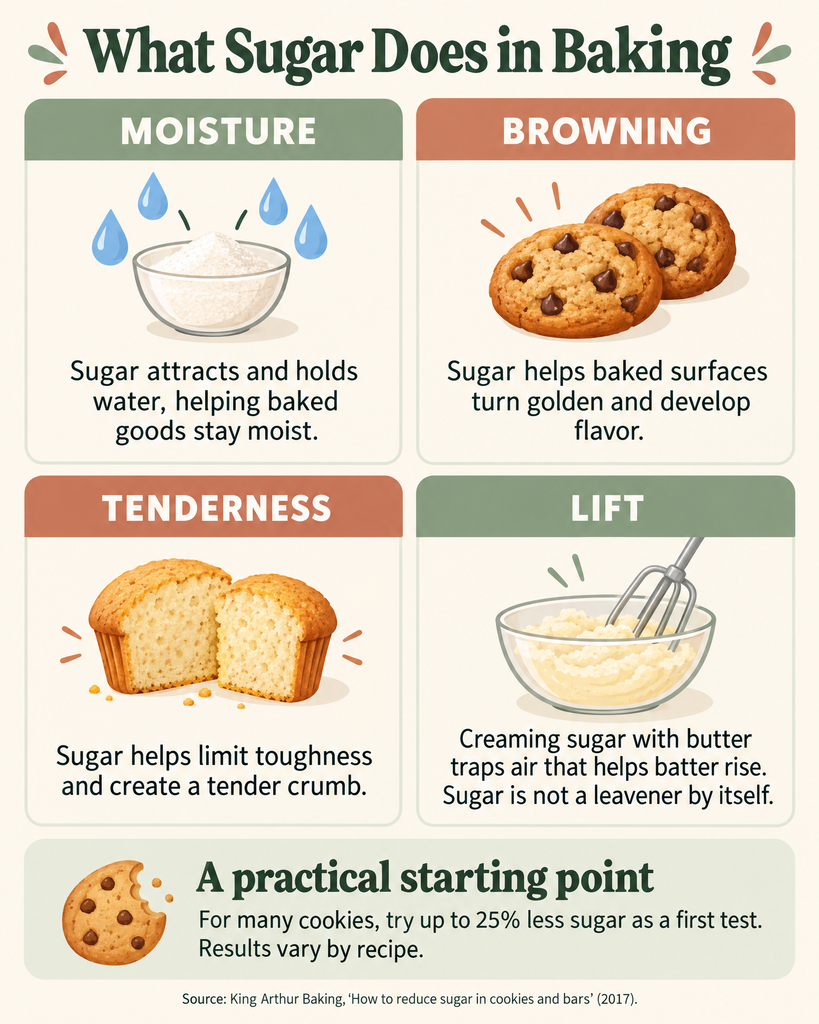
1. Cut a third, and don’t tell anyone. The single most reliable move. In most cookie, muffin, quick-bread and cake recipes, reducing sugar by about a third is barely detectable. Half is usually detectable but acceptable in spiced recipes. Beyond that, texture starts to go.
2. Let spices carry the sweetness. Cinnamon, nutmeg, cardamom, ginger, allspice and clove all increase perceived sweetness without adding any sugar. Double the spice when you cut the sugar — this is the trick that makes a one-third reduction invisible, and holiday recipes are already built for it.
3. Use more vanilla than the recipe says. Vanilla reads as sweet. A teaspoon and a half where the recipe says one costs nothing.
4. Don’t skip the salt. Salt suppresses bitterness and makes sweetness more pronounced. A reduced-sugar cookie with properly measured salt tastes considerably sweeter than one without.
5. Swap part of the sugar for fruit purée — and adjust the liquid. Unsweetened applesauce, mashed banana, or puréed dates can replace some of the sugar while contributing moisture and fiber. The catch: they add water, so reduce other liquid by a few tablespoons, and expect a denser, more cake-like result. Works well in muffins and quick breads; less well in crisp cookies.
6. Lean on fruit as the sweetener. Baked apples with cinnamon, pear crumble, roasted-fruit galette. These start sweet and need far less added sugar than the recipe assumes.
7. Choose dark chocolate over milk chocolate. Less sugar per ounce, more flavor per chip, and most children adapt quickly if you move gradually rather than all at once.
8. Make smaller things. Mini muffins, thumbprint cookies, bite-sized shortbread. A child who gets three small cookies feels better treated than one who gets one large one, and the sugar total is lower.
9. Put the sugar where it’s tasted — on top. A thin dusting of coarse sugar on top of a reduced-sugar muffin hits the tongue first and makes the whole thing read sweeter than stirring that same sugar into the batter.
Honey, maple syrup and coconut sugar are still added sugar. They may bring trace minerals and a better flavor, but as the AHA puts it, added sugar is added sugar no matter what it is called. Use them because you like them, not because they’re a health swap.
Sugar alcohols deserve genuine caution with children.
Erythritol, xylitol, maltitol, sorbitol and the rest are common in “sugar-free” baking products. The FDA notes they can produce abdominal gas, bloating and diarrhea, because they aren’t fully absorbed and get fermented in the large intestine — and foods containing sorbitol or mannitol must carry a warning that excess consumption may have a laxative effect. A child who eats four sugar-free cookies can have a genuinely bad evening. If you use them, use them sparingly and tell your kids what they’re eating.
One important safety note: xylitol is highly toxic to dogs even in small amounts. If you bake with it, keep everything well away from the dog.
Replacing all the sugar with fruit purée gives you something closer to a dense bread than a cookie. Fine if that’s what you want; disappointing if you promised cookies.
Artificial sweeteners bake inconsistently — many don’t brown, don’t provide bulk, and leave an aftertaste children notice faster than adults do. I’d rather reduce real sugar than substitute.
| Common Approach | What Works Better | |
| Goal | Sugar-free baking | A third less sugar, undetectably |
| Method | Substitute sweeteners | Reduce sugar, increase spice and vanilla |
| “Healthy” sweeteners | Honey, maple, coconut sugar | Treated as sugar, because they are |
| Sugar-free products | Assumed gentler | Checked for sugar alcohols and GI effects |
| Timing | Treats available all week | Baked and eaten around a meal |
| The real win | Restricting the treat | The hours spent cooking together |
I want to be careful not to oversell this, because the research on children and cooking is more suggestive than conclusive. But the practical case is strong.
A child who measures flour learns fractions. A child who cracks eggs learns to recover from mistakes. A child who waits for something to come out of the oven practices a skill that is genuinely in short supply. And a child who helps make dinner is, in my experience, markedly less suspicious of what’s on their plate.
That’s the part of holiday baking with kids worth protecting. The sugar is a detail you can quietly adjust.
Book a visit for recurring stomach pain, gas or loose stools after specific foods, which is worth sorting out rather than guessing at; for constipation that doesn’t resolve with normal eating; or for tooth pain, cold sensitivity, or white or brown spots on teeth.
Also book a visit if your child has a known food allergy and you’re uncertain about baking ingredients, or if you’re managing a suspected allergy without a diagnosis and an action plan.
Seek care promptly for swelling of the lips, face or throat, difficulty breathing, or widespread hives after eating — and use epinephrine first if it’s prescribed.
How much can I cut the sugar before a recipe fails? About a third in most cookies, muffins, quick breads and cakes, and children rarely notice if you increase the spices at the same time. Half is often workable in heavily spiced recipes. Past that, you lose moisture, browning and texture.
Is honey better than white sugar for kids? Not meaningfully, from a sugar standpoint — the AHA’s position is that added sugar is added sugar regardless of the name. Note also that honey should not be given to infants under one year because of botulism risk.
Are sugar-free treats a good option for children? Use them sparingly. Sugar alcohols can cause gas, bloating and diarrhea, and sorbitol and mannitol carry a required laxative warning. A few are fine; a plateful often isn’t.
How much added sugar should my child have in a day? The AHA recommends less than 25 grams — about six teaspoons — for ages two to 18, and none before age two.
When should we schedule holiday baking with kids so the treats land better? Timing matters more than most people expect. The ADA notes frequency of exposure drives cavity risk, and eating treats with or just after a meal is better because of the saliva a full meal produces. One sitting beats grazing.
Holiday baking with kids doesn’t need to be reformed. It needs about a third less sugar, twice the cinnamon, and the cookies eaten after dinner rather than from an open tin all week.
Do that and you’ve cut the sugar meaningfully, kept the thing your kids will actually remember, and spared yourself an argument about dessert.
“Cut a third, double the cinnamon, and let them crack the eggs. That’s the whole recipe.”
Whether this is your first visit or your next one, if your child’s digestion or appetite has been off, we’re glad to look at the bigger picture.
Questions About Your Child’s Nutrition or Digestion? Our team would love to meet with you.
Click this link to schedule a time to meet with our team.
Related: What Halloween Candy Does to Your Child’s Teeth and Gut | Why Is My Toddler So Constipated? | Fun-Size, Hidden Ingredients: A Parent’s Guide to Allergens in Halloween Candy