
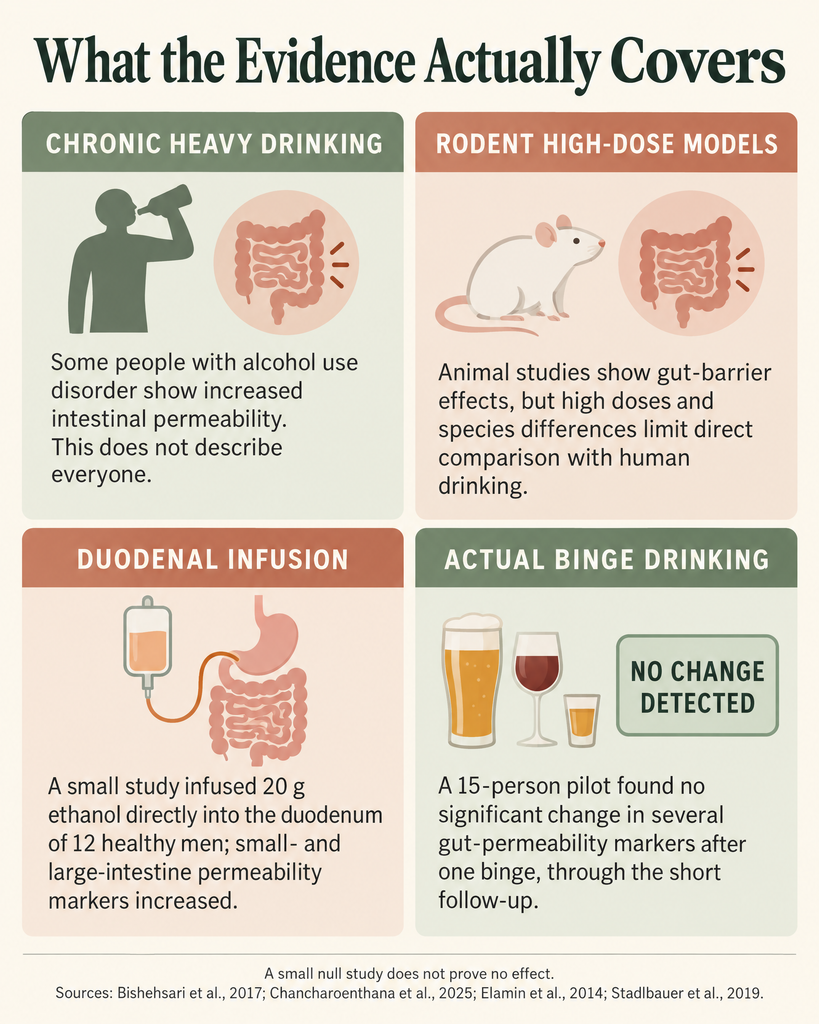
Alcohol and your gut is a topic where the popular claims run well ahead of the data. The one study that gave healthy people an actual binge dose by mouth found no change in intestinal permeability, zonulin, calprotectin, LBP or endotoxin — measured through four hours and the next day. The study most often cited to prove “moderate alcohol causes leaky gut” infused ethanol directly into the duodenum, bypassing the stomach, in 12 men. That’s a different thing from drinking. The strong barrier evidence comes from people drinking roughly 13 to 14 standard drinks a day for about 30 years — and even in that group, endotoxin was at control level in 24 of 37 patients.
What is reliable after a real night: beer and wine stimulate stomach acid while distilled spirits don’t, gastric irritation shows up within 30 minutes, reflux risk rises with frequency, and REM sleep gets suppressed from about two to three drinks.
Alcohol and your gut gets written about every December with unusual confidence, and most of it extrapolates from research on chronic alcoholism and high-dose rodent studies to a work party.
The accurate version is more useful, because it points at things you can actually do something about — and several of them are the opposite of the standard advice.
“A few drinks” covers an enormous range, so the definitions matter.
A standard drink in the US contains 0.6 fluid ounces, or 14 grams, of pure alcohol — about 12 oz of regular beer, 5 oz of wine, or 1.5 oz of spirits.
Binge drinking, per the NIAAA, is a pattern that brings blood alcohol concentration to 0.08% or above: roughly five or more drinks for men or four or more for women in about two hours.
Heavy drinking is five or more drinks on any day or 15 or more per week for men, and four or more on any day or eight or more per week for women.
A generous pour of wine is often closer to two standard drinks than one, which is how most holiday parties land in binge territory without anyone deciding to.
Worth knowing that the NIAAA’s current position is that harms may be associated with any amount of drinking, with risk rising as the amount rises.
This is the claim that gets stretched furthest, so let me be precise about what each study actually did.
The binge study nobody quotes. In 2019, researchers gave 15 healthy volunteers 2 mL of 40% vodka per kilogram of body weight — about 0.6 g of ethanol per kilo, a genuine binge dose — in juice, drunk within 30 minutes after an overnight fast. They then measured gut permeability by sugar probes, plus fecal and serum zonulin, calprotectin, diamine oxidase, sCD14, LBP, serum endotoxin, peptidoglycan and bacterial DNA, through four hours and into the next day.
Nothing changed. No permeability shift, no barrier marker change, and no microbiome change either — no difference in diversity, taxonomy or predicted function. What did change was transient: neutrophils were primed at one hour and back to baseline by four.
The study that gets quoted instead. A 2014 paper is routinely cited as proof that moderate alcohol causes leaky gut. It did find increased small and large intestinal permeability — but it delivered 20 g of ethanol as a 5% solution infused directly into the duodenum over 15 minutes, deliberately bypassing the stomach, in 12 men, with a urinary sugar ratio as the outcome. That’s a useful mechanistic experiment. It is not a description of drinking a glass and a half of wine.
Where the barrier evidence is real. In people with alcohol use disorder, increased permeability is documented — and importantly, only in a subset, who are the ones more likely to have liver disease. One 2021 study of 37 patients with alcohol-related liver disease recorded mean intake of 191 grams of ethanol per day — about 13 to 14 standard drinks — sustained for an average of nearly 30 years. Even there, endotoxin was at control level in 24 of the 37. And the markers improved within a week of stopping.
Where the dose numbers come from. The dose-response work is in rodents, on ethanol-saturated diets: 8 g/kg/day in rats for ten weeks, around 40% of calories in mice, single 5 g/kg binges. Those aren’t scalable to a human evening.
So: chronic heavy drinking is a genuine gastrointestinal problem with real evidence behind it. A holiday party has not been shown to measurably affect your gut barrier, and the articles claiming otherwise are importing findings from alcoholics, rats, and one duodenal infusion.
“The one study that gave healthy people a real binge by mouth found no change in a single barrier marker. That’s the study worth knowing about.”
None of the above means a heavy evening is free. The acute effects are well documented — they’re just more specific than “leaky gut.”
Beer and wine stimulate stomach acid. Spirits don’t. This one surprises everyone. Ethanol at concentrations up to about 5% increases acid secretion, largely by stimulating gastrin. Above 5%, the effect disappears — and distillation removes it entirely, with the stimulant attributed to maleic and succinic acids in undistilled drinks. So beer, wine and champagne drive acid; vodka and whiskey don’t.
Gastric irritation is fast and dose-dependent. Visible changes appear as early as 30 minutes after drinking and peak around an hour. At 24 hours, only drinks above about 10% ethanol had caused hemorrhagic mucosal damage — beer and wine, being weaker, may also contain protective compounds. Worth noting what alcohol has not been shown to do: cause peptic ulcers or impair the healing of existing ones.
Reflux, and it tracks with frequency. Both small and large acute doses lower resting pressure at the lower esophageal sphincter, which is the mechanism behind holiday heartburn. A meta-analysis of 29 studies found drinkers had an odds ratio of 1.48 for GERD overall — and frequency mattered: 1.29 for fewer than three to five drinking days a week versus 2.12 for more frequent drinking, with each 12.5 g per day increase associated with an odds ratio of 1.16.
Altered motility and loose stools. Lower doses appear to stimulate gastric motility while higher concentrations delay emptying, which is where the epigastric fullness and nausea come from. The next-morning diarrhea is attributed to reduced disaccharidase activity plus increased permeability — and unabsorbed sugars from mixers add an osmotic load on top.
Blood sugar, and this is the part with real safety stakes.
Alcohol inhibits the liver’s production of glucose — hepatic gluconeogenesis has been reported to fall by up to 45%. The consequence is delayed: in one study, five of six participants with type 1 diabetes had symptomatic hypoglycemia requiring treatment between 10 a.m. and midday the day after moderate evening drinking, despite eating breakfast. Risk may persist up to 24 hours. Alcohol also impairs your ability to recognize hypoglycemia, and the symptoms — dizziness, confusion, sleepiness — look like being drunk. If you use insulin or a sulfonylurea, that combination is the single most important thing in this article.
Sleep, more precisely than usual.
A 2025 meta-analysis of 27 studies found the reliable effects are REM suppression — about 11 minutes less REM, and REM onset delayed by around 18 minutes — starting from roughly 0.35 to 0.50 g/kg, which is about two to three drinks for a smaller adult. Notably, it did not find a significant reduction in time to fall asleep at low or moderate doses, and total sleep time, sleep efficiency and night waking weren’t significantly changed on average. So the familiar “alcohol knocks you out then wrecks your sleep” story is only half right: the knocking-out part only showed up at around five or more drinks.
| Common Claim | What the Evidence Supports | |
| One party | “Damages your gut barrier” | An actual binge dose by mouth changed no barrier marker |
| Chronic heavy drinking | Discussed vaguely | Documented in a subset, at ~13 drinks/day for decades |
| Acid | “Alcohol raises acid” | Beer and wine do; distilled spirits don’t |
| Sleep | “Helps you fall asleep, ruins the rest” | REM suppression is the reliable effect; faster sleep onset isn’t |
| Water between drinks | Prevents hangover | It doesn’t — hangover and dehydration are independent |
| Diet mixers | The healthier choice | Produced higher peak breath alcohol than sugared mixers |
1. Eat a protein-forward meal about 30 minutes before you drink. This is the best-quantified mitigation in the literature. In a controlled study, a 1,000-calorie high-protein meal eaten half an hour before drinking cut peak blood alcohol by about 45%, high carbohydrate by about 39%, and high fat by only about 11%. Note that this is the reverse of the folk advice about lining your stomach with something fatty.
2. Don’t eat within two to three hours of bed. This is the American College of Gastroenterology’s actual graded recommendation for reflux — and notably, ACG rates “avoid alcoholic beverages” as weak evidence and doesn’t recommend it universally. Meal timing is the better-supported and easier ask. Elevating the head of the bed helps too.
3. Finish drinking a few hours before bed. Reasoned from mechanism rather than tested as a protocol, but two independent lines point the same way: less alcohol on board at sleep onset, and less overlap with the reflux window.
4. Drink water because you’re thirsty — not to prevent a hangover. A 2024 review concluded that water during or directly after drinking is not effective at preventing hangovers, and that hangover and dehydration are two co-occurring but independent consequences of drinking. Water is harmless and thirst is real. It just isn’t the protective measure it’s sold as.
5. Be careful with the “switch to diet mixers” advice. The one head-to-head trial found diet mixers produced a higher peak breath alcohol than regular Coke — 38.3 versus 34.8 μg/100 mL — apparently because the sugar slowed gastric emptying. It was 12 people, so don’t over-read it. But if you have diabetes, your clinician’s advice to avoid sugary mixers stands for glucose reasons; just know the trade-off runs in two directions.
6. Count in standard drinks, not glasses. A heavy pour is often nearly two, and this is most of what separates a moderate evening from a binge one.
7. If you have diabetes, treat this as the main event. Eat carbohydrate-containing food when you drink, never let a drink replace a meal, check your glucose before bed, and tell whoever you’re with — because hypoglycemia can look exactly like intoxication, and alcohol blunts your ability to notice it yourself.
8. Skip the pre-drinking “gut protection” protocols. A systematic review of 21 randomized placebo-controlled trials of hangover remedies — including a probiotic — found all the evidence was very low quality, no two studies tested the same remedy, and no result has been independently replicated. There is no human trial showing a probiotic or supplement taken before drinking protects your intestinal barrier.
9. If you have reflux, IBS or a known gut condition, treat alcohol as your trigger. This is where moderation genuinely pays, and where “one night won’t hurt” is less reliable.
It would be incomplete to write about alcohol and only discuss digestion.
The 2025 US Surgeon General’s Advisory describes alcohol as a cause of at least seven cancers — breast, colorectal, esophageal, liver, oral cavity, pharynx and larynx — and attributes an estimated 96,730 US cancer cases in 2019 and roughly 20,000 deaths a year to it. The lifetime risk figures it gives are concrete: for women, the risk of an alcohol-related cancer by age 80 runs 16.5% at under one drink a week, 19.0% at one drink a day, and 21.8% at two. For men, 10.0%, 11.4% and 13.1%. The advisory also notes fewer than half of US adults are aware of the link.
The WHO’s position is that no level of alcohol consumption is safe for health, and that available evidence can’t identify a threshold below which the carcinogenic effect begins.
That doesn’t mean a glass of wine at Christmas is a crisis. It does mean that “is it bad for my gut” is a smaller question than the one worth asking, and a post that only answered the small one would be doing you a disservice.
Book a visit for persistent heartburn or reflux, for recurring diarrhea or abdominal pain after drinking, for digestive symptoms that have become constant rather than occasional, or if you’re using alcohol to fall asleep.
Also worth a visit: if you have diabetes and want to understand how alcohol interacts with your medication, or if you’d like an honest conversation about your drinking without being lectured at.
Seek care promptly for vomiting blood or material resembling coffee grounds, black or tarry stools, severe abdominal pain, yellowing of the skin or eyes, confusion, or persistent vomiting with inability to keep fluids down.
Does alcohol cause leaky gut? In chronic heavy drinking there’s documented increased permeability, in a subset of patients, at intakes around 13 drinks a day sustained for decades. At social drinking levels, the one study that gave healthy people a real binge dose by mouth found no change in any barrier marker through the next day.
But I’ve read studies showing moderate alcohol increases permeability. The study usually cited infused ethanol directly into the duodenum, bypassing the stomach, in 12 men. It’s a legitimate mechanistic experiment that doesn’t describe drinking.
Which drink is easiest on my stomach? For acid specifically, distilled spirits — beer, wine and champagne stimulate acid secretion while distillation removes the stimulant. For mucosal irritation the picture reverses, since higher-concentration drinks caused more damage. There’s no clean winner.
Does drinking water between drinks help? Not for hangover. The 2024 review found water during or after drinking isn’t effective at preventing it, and concluded hangover and dehydration are independent consequences. Drink water because you’re thirsty.
Is alcohol’s effect on blood sugar immediate? No, and that’s what catches people out. Hypoglycemia has been documented the following morning after evening drinking, and risk may persist up to 24 hours. If you take insulin or a sulfonylurea, this deserves a conversation with your provider.
What’s the single best thing I can do for alcohol and your gut concerns? Eat a protein-forward meal half an hour before, and finish drinking a few hours before bed.
Alcohol and your gut deserves a more careful account than it usually gets. The barrier claims are built on alcoholics, rats and a duodenal infusion. The real effects of a heavy night are more specific — acid, reflux, motility, and the REM sleep you won’t get — and the real risk sits in a different category altogether.
Eat first, with protein. Count in standard drinks. Stop a few hours before bed. Don’t bother with the supplement. And if you have diabetes, the next morning is the part to plan for.
“Eat protein first, finish early, and skip the pill that claims to protect you. That’s the whole protocol.”
Whether this is your first visit or your next one, digestive symptoms that have become constant are worth sorting out properly.
Have Holiday Parties Started Costing You More Than They’re Worth? Our team would love to meet with you.
Click this link to schedule a time to meet with our team.
Related: The Gut-Brain Connection: When Anxiety Starts in Your Digestive System | Why Am I Always Bloated? | Histamine Intolerance: Why You React to Foods That Never Bothered You Before