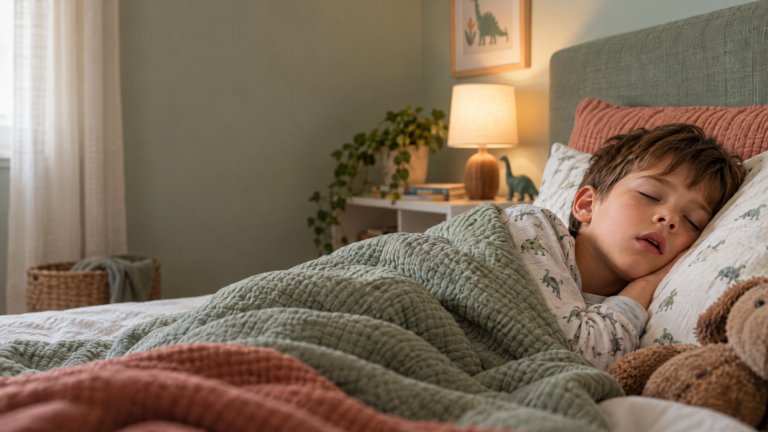
Snoring in kids is common, and obstructive sleep apnea is much less so. Pooled estimates put habitual snoring around 7% to 8% of children, while OSA affects roughly 1% to 5%. Which means most children who snore don’t have apnea — and you cannot tell which is which from the bedroom door. The American Academy of Pediatrics is explicit that history and physical exam alone cannot establish the diagnosis.
The AAP asks every clinician to screen for it. At routine health maintenance visits, clinicians should ask whether the child snores, and frequent snoring means three or more nights a week. Snoring without apnea isn’t automatically harmless either. A 2022 review of 77 studies found cognitive differences in children with primary snoring, not only in those with OSA.
Snoring in kids gets filed under “noisy sleeper” in most households, somewhere between a quirk and a punchline. Some children snore. Some sleep with their mouths open. It seems like personality rather than physiology.
Sometimes it is. But snoring in kids has a well-defined set of things worth checking, a clear guideline on who should be evaluated, and — importantly — a body of research that contradicts several claims you’ll find in the first page of search results. I’d rather give you the accurate version, because it leads somewhere more useful.
Occasional snoring with a cold is unremarkable. The threshold that matters is frequency.
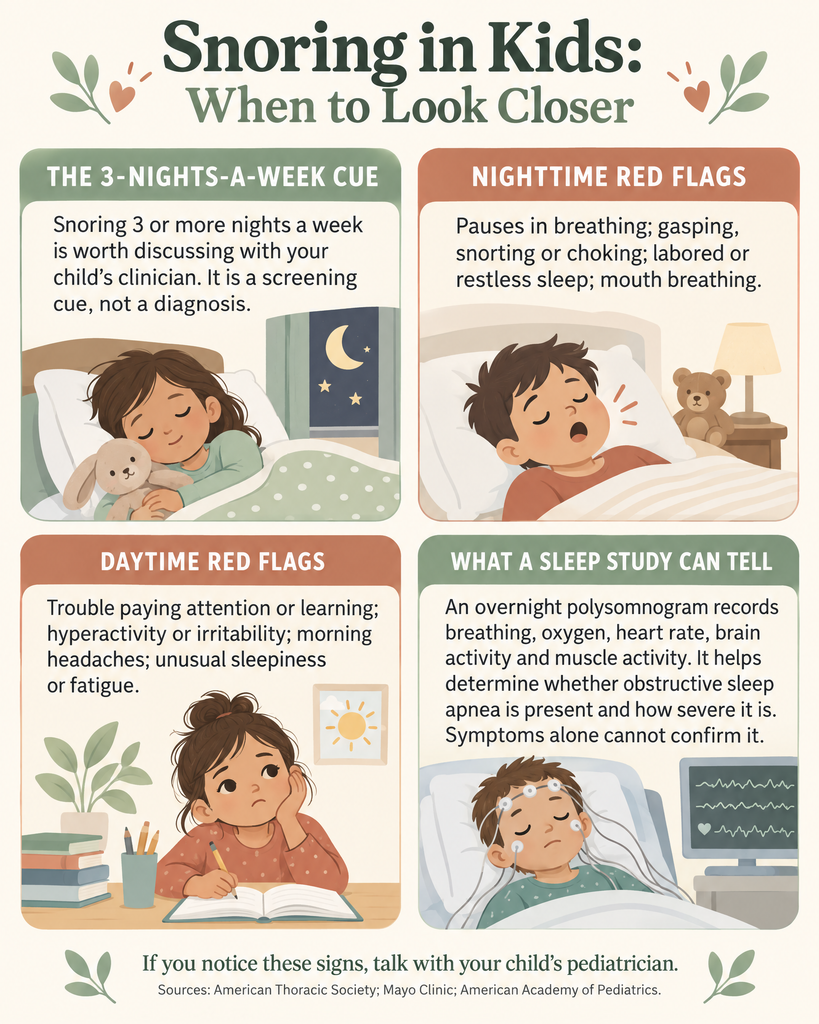
The AAP’s guideline uses frequent snoring — three or more nights a week — as the signal that warrants a closer look. Its first key action statement is that clinicians should ask about snoring as part of routine health maintenance visits, and that if a child snores regularly or has other associated signs, a more focused evaluation follows.
That’s worth knowing because it means asking about this isn’t being a difficult parent. It’s what the guideline asks your clinician to do.
The distinction underneath it:
Primary snoring is snoring without significant breathing pauses, oxygen dips, or sleep disruption.
Obstructive sleep apnea involves prolonged partial or complete airway obstruction with measurable consequences during sleep.
Here’s the part that matters most, and it’s the thing most parent-facing content gets wrong in one direction or the other. You cannot tell these apart by listening. The AAP’s position on this carries its strongest evidence grade: clinical history and examination alone cannot establish the diagnosis. A sleep study — polysomnography — is what separates them.
So two common statements are both wrong. “He snores, so he probably has sleep apnea” is wrong, because snoring is roughly twice as common as apnea at minimum. And “it’s just snoring, nothing to worry about” is also wrong, because a 2022 review covering 77 studies found cognitive differences in children with primary snoring as well as those with OSA.
The honest position is that frequent snoring is a reason to be evaluated, not a diagnosis and not a non-event.
These come from the AAP guideline’s own list rather than from general internet consensus, which matters because some of the most widely repeated signs didn’t survive validation.
At night:
Frequent snoring, three or more nights per week
Labored breathing during sleep
Gasping, snorting, or witnessed pauses in breathing
Sleeping in unusual positions — sitting up, or with the neck extended back
New bedwetting in a child who had been reliably dry
Blue coloring of the lips or face
During the day:
Morning headaches
Daytime sleepiness
Mouth breathing and a dry mouth on waking
Attention difficulties, hyperactivity, or learning problems
What a clinician looks for on exam: enlarged tonsils, a small or receded jaw, a high-arched palate, being significantly underweight or overweight, poor growth, and elevated blood pressure.
A note on two signs you’ll see everywhere: restless sleep and night sweating are frequently listed as red flags, but they were tested during validation of the best-established pediatric sleep questionnaire and were not retained as discriminating items, and they don’t appear in the AAP’s list. Plenty of clinicians still ask about them, and they’re reasonable to mention — they’re just not in the same tier as witnessed pauses and frequent snoring.
“Frequent snoring is a reason to be evaluated. It is not a diagnosis, and it is not nothing.”
This is where I want to be careful, because the gap between what the evidence shows and what gets claimed is unusually wide in this topic.
Well supported by randomized trials: treating pediatric sleep apnea improves symptoms, sleep quality, quality of life, and caregiver- and teacher-rated behavior. In the Childhood Adenotonsillectomy Trial, symptom scores improved with a large effect size, and quality of life and behavior ratings both improved significantly. The more recent PATS trial, in children with mild sleep-disordered breathing, found improvements in quality of life, sleepiness, symptoms, and — notably — both systolic and diastolic blood pressure percentiles.
Moderately supported: growth. A meta-analysis of 20 studies in otherwise healthy children found gains in height and weight after adenotonsillectomy, along with increases in growth factors. All of these were before-and-after studies without control groups, so the effect size is less certain than the direction.
Associated, causality unestablished: bedwetting. A systematic review of 15 studies covering over 11,000 children found enuresis in about 40% of children with OSA, with roughly 2.3 times the odds compared with children without it. The heterogeneity across studies was very high and the authors state plainly that causality, and whether treating OSA resolves the bedwetting, still need to be established.
Associated, frequently overstated: ADHD. Sleep-disordered breathing is reported in 25% to 57% of children with ADHD — a striking overlap. But the research is cross-sectional, and the authors of the largest recent cohort say directly that it’s unclear whether children with OSA are predisposed to ADHD or whether their symptoms stem from the breathing problem. The defensible version is the one the AAP already endorses: attention problems belong on the list of findings that should prompt asking about snoring. Not “your child’s ADHD is actually sleep apnea.”
the one that gets claimed most and is supported least: objectively measured attention and executive function. The CHAT trial’s primary outcome was a neuropsychological measure of attention and executive function, and surgery did not significantly improve it. PATS had two primary outcomes in the same territory, and neither reached significance. So: children with sleep-disordered breathing are rated as more inattentive by parents and teachers, and those ratings improve with treatment. Objective testing hasn’t shown the same thing in two large trials. Anyone telling you surgery will fix your child’s focus is ahead of the evidence.
| Conventional Approach | Root-Cause Approach | |
| Snoring | “Lots of kids snore” | Frequency established; three nights a week triggers evaluation |
| Diagnosis | Decided on symptoms | Sleep study, because exam alone can’t tell |
| Airway inputs | Tonsils only | Tonsils, adenoids, nasal allergy, weight, jaw structure |
| Bedwetting and attention | Treated separately | Checked against the sleep picture |
| After treatment | Assumed resolved | Reassessed, because it frequently persists |
Adenotonsillar hypertrophy is the most common cause in otherwise healthy children, which is why the AAP recommends adenotonsillectomy as first-line treatment when tonsils and adenoids are enlarged and there’s no contraindication. The peak years, roughly two to eight, line up with when that tissue is largest.
Weight. Obesity substantially increases risk, and it also predicts treatment failure — up to around three-quarters of children with obesity have persistent apnea after surgery, compared with a much smaller share of non-obese children.
Nasal obstruction and allergic rhinitis. Allergic rhinitis is reported about twice as often in children with sleep-disordered breathing. That’s a correlation rather than a demonstrated cause, but a blocked nose is a treatable contributor and worth addressing.
Craniofacial structure. A small or receded jaw, a narrow or high palate, midface differences.
Underlying conditions. Down syndrome, Prader-Willi, Pierre Robin sequence, neuromuscular conditions and sickle cell disease all change the picture substantially. Worth knowing: the AAP guideline covers uncomplicated sleep apnea in otherwise healthy children over one year old. Children with these conditions sit outside its scope and belong with a sleep specialist.
Mouth breathing deserves its own section because the claims made about it are so much stronger than the evidence behind them.
What’s reasonable to say: mouth breathing is a recognized symptom of sleep-disordered breathing, it appears on the validated pediatric sleep questionnaire, and it’s worth mentioning to your clinician. There’s also reasonable support linking chronic mouth breathing to reduced salivary protection and higher rates of cavities and gum inflammation.
What isn’t established:
that mouth breathing causes lasting changes to facial structure. A 2022 review of this literature states directly that there is no high-quality evidence on the effects of mouth breathing on dentofacial development, that there are no strict diagnostic criteria for mouth breathing in the research, and that no consensus can currently be reached. The best quantitative work — a meta-analysis of 19 cephalometric studies — did find measurable differences in facial proportions on average, but every included study was cross-sectional, only two blinded the person taking the measurements, heterogeneity was high, and the authors explicitly declined to make a causal claim. It also failed to confirm the commonly repeated claim about a particular bite pattern.
So the accurate statement is: children who habitually mouth-breathe have somewhat different facial measurements on average than nasal breathers, and researchers have not established that the mouth breathing caused it rather than both resulting from the same obstruction. Which is still a reason to get the obstruction evaluated — just not a reason to believe your child’s face is being permanently reshaped while you wait for an appointment.
And on tongue tie: the American Academy of Otolaryngology’s consensus statement on ankyloglossia in children is unambiguous — ankyloglossia does not cause sleep apnea. The panel noted only one small retrospective study linking them, and raised the possibility that release could theoretically worsen obstruction in some infants. If your child snores, the structures to evaluate are the tonsils, adenoids and nasal airway.
1. Count the nights. Before an appointment, track how many nights a week your child snores, and whether you’ve seen pauses, gasping, or struggling. Three or more nights is the threshold that triggers evaluation.
2. Film thirty seconds. A phone video of your child’s breathing during sleep is genuinely useful to a clinician and far better than a description. The AAP lists nocturnal video among the alternatives when a sleep study isn’t immediately available.
3. Ask for the sleep study when the picture fits. If your child snores frequently and has any of the red flags, the guideline supports obtaining polysomnography, or referral to a sleep specialist or ENT. “Let’s wait and see” is reasonable for mild cases, but it should be a decision rather than a default.
4. Treat the nose. Allergic rhinitis and nasal congestion are modifiable, and reducing nasal obstruction is worth doing on its own merits. Intranasal corticosteroids are an option in the AAP guideline for mild cases when surgery isn’t appropriate — not first-line, and the Cochrane review of them found uncertain evidence. Montelukast has somewhat better trial data for mild cases, but it carries an FDA boxed warning for serious neuropsychiatric effects including suicidal thoughts, and the FDA advises reserving it for patients who can’t use other options. That’s a conversation with your prescriber, not a supplement-aisle decision.
5. Address weight where it’s a factor, knowing the AAP positions this as an addition to other treatment rather than a replacement, because weight loss is slow and unreliable as a sole strategy.
6. Know that watchful waiting is a legitimate option for mild cases. In the CHAT trial, 46% of children in the watchful-waiting arm had their sleep studies normalize over seven months with no treatment and no cognitive decline. In PATS, only about 13% of untreated mild cases progressed over a year. That’s real information to weigh against surgery, which carries genuine risks — PATS recorded serious adverse events in a small number of children, mostly postoperative bleeding.
7. Reassess after treatment. The AAP recommends clinical reassessment roughly six to eight weeks after therapy. Persistence is common — somewhere between 13% and 40% depending on the population — and the otolaryngology guideline specifically recommends counseling families that it may persist or recur.
8. Consider myofunctional therapy. Orofacial myofunctional therapy is one of the tools we recommend most often. It uses targeted exercises to retrain how the tongue, lips and face rest and move. Research shows a meaningful drop in apnea severity in children with mild-to-moderate OSA. It also works on the habits behind the problem, like mouth breathing and low tongue posture, which can help results last. The research is still growing, and it works best as part of a full airway evaluation.
Book a visit for snoring three or more nights a week, for mouth breathing day and night, for morning headaches, for daytime sleepiness in a child who sleeps enough hours, for new bedwetting in a previously dry child, for attention or learning difficulties alongside any of the above, or for poor growth.
Seek care promptly for witnessed pauses in breathing, gasping or choking during sleep, labored or struggling breathing, blue coloring of the lips or face, or a child who is difficult to rouse in the morning.
Is snoring in kids normal? Occasional snoring in kids with a cold is. Habitual snoring affects roughly 7% to 8% of children and is the threshold the AAP uses — three or more nights a week warrants a focused evaluation.
Does snoring mean my child has sleep apnea? Usually not. Snoring is considerably more common than apnea, which affects about 1% to 5% of children. But only a sleep study can distinguish them, because exam and history alone cannot.
Will removing the tonsils fix it? It’s the recommended first-line treatment when tonsils and adenoids are enlarged, and it reliably improves symptoms, sleep quality and quality of life. It doesn’t always resolve the apnea — persistence rates run from roughly 13% to 40%, and considerably higher in children with obesity.
Is mouth breathing ruining my child’s face? The honest answer is that nobody has established this. Facial measurements do differ on average between mouth breathers and nasal breathers, but the studies are cross-sectional, mixed in quality, and the researchers themselves decline to claim causation. Get the airway evaluated — that’s the useful part.
Could this be causing my child’s attention problems? It’s associated, and attention difficulties are on the AAP’s list of reasons to ask about snoring. But two large randomized trials found no significant improvement in objectively measured attention and executive function after surgery, so I wouldn’t promise that treating the airway fixes focus.
Could a tongue tie be the cause? The otolaryngology consensus statement says ankyloglossia does not cause sleep apnea. The tonsils, adenoids and nasal airway are where to look.
Snoring in kids sits in an awkward middle. It’s far more common than sleep apnea, so most snoring children don’t have it — and snoring on its own isn’t entirely benign either. The way out of that ambiguity is a frequency count, a thirty-second video, and a real evaluation rather than a guess in either direction.
The parts of snoring in kids worth treating are genuinely worth treating: symptoms, sleep quality, behavior, quality of life, growth, blood pressure. The parts that get oversold — facial development, focus, tongue ties — are where I’d spend your attention last.
“Count the nights, film thirty seconds, and ask for a real evaluation. That’s the whole first step.”
Whether this is your first visit or your next one, if your child snores most nights, that’s worth a proper look at the airway.
Does Your Child Snore Most Nights? Our team would love to meet with you.
Click this link to schedule a time to meet with our team.
Related: Why Does My Child Have Dark Circles Under Their Eyes? | Bedwetting in Kids: What’s Normal and What Root-Cause Care Looks At | Tongue and Lip Ties: When They Actually Matter for Feeding and Sleep