
Ovarian cysts are common and usually uneventful. Significant cysts are found in about 8% of premenopausal women and 14 to 18% of postmenopausal women. Watch-and-wait is right more often than it feels. In a prospective study of 1,919 women with benign-appearing cysts managed conservatively, 20.2% resolved on their own within two years and invasive malignancy was found in 0.4%. The guidelines have actually moved toward less follow-up, not more — because unnecessary surveillance of simple cysts leads to unnecessary surgery. But there are three situations where watching genuinely isn’t enough, and one of them is a medical emergency most women have never heard of.
Ovarian cysts put a lot of women in an uncomfortable position. You’ve been told you have one, you’ve been told it’s probably nothing, and you’ve been told to come back in a few months. Meanwhile something hurts.
I want to do two things here. First, be honest that “watch and wait” is the correct answer far more often than the internet suggests — and that the trend in specialist guidance is toward watching less, not more. Second, be specific about the three situations where it genuinely isn’t enough, because the reassurance is only useful if you know where it stops.
Most are byproducts of a working ovary. Every cycle you grow a follicle and then a corpus luteum, and both are fluid-filled structures. If the follicle doesn’t rupture, or the corpus luteum persists, you get what’s called a functional cyst.
How normal is this? The radiology classification system used to grade these — O-RADS — categorizes a simple cyst up to 3 cm in a premenopausal woman, and a corpus luteum up to 3 cm, as a normal ovary. Not a mild abnormality. Normal.
Other types are distinct: hemorrhagic cysts, endometriomas, dermoids, cystadenomas, and paraovarian cysts that sit beside the ovary rather than in it. Each has a recognizable appearance on ultrasound, which is what makes risk stratification possible.
How often they resolve on their own: functional cysts under 50 mm usually resolve over two to three menstrual cycles. The best prospective data comes from a study across 36 sites in 14 countries, where 1,919 women with newly diagnosed benign-appearing cysts were followed instead of operated on. Over two years, 20.2% resolved spontaneously, 16.1% had surgery, and invasive malignancy was found in 0.4%.
Postmenopausal cysts behave differently — 30 to 54% persist for years. But persistence isn’t the same as danger: in one series of 2,763 postmenopausal women, over two-thirds of unilocular cysts up to 10 cm resolved spontaneously, with no cancers over a mean 6.3 years.
This surprises people, so it’s worth stating plainly.
In 2019, a Society of Radiologists in Ultrasound consensus panel reduced recommended follow-up for simple cysts. The reason given: no increased risk of malignancy in women with simple cysts, irrespective of size. In a study of 43,606 women, the cancer risk associated with a simple cyst of any size ran 0.1 to 0.2%.
Their current thresholds:
Premenopausal — report cysts over 3 cm, but no follow-up imaging unless larger than 5 to 7 cm. An ovary with simple cysts up to 3 cm can be reported as normal.
Postmenopausal — report cysts over 1 cm, but no follow-up unless larger than 3 to 5 cm.
Simple paraovarian cysts need no follow-up at all.
And the panel said why this matters: “Unnecessary follow-up of simple cysts increases the chance of surgical intervention.” They cited three deaths among 1,500 adnexal mass surgeries and complication rates of 3.1 to 15%.
The O-RADS system did the same thing in its 2022 update — capping surveillance at two years and allowing short-interval ultrasound where it previously called for MRI.
So if you’ve been told your simple cyst doesn’t need re-scanning, that’s current specialist practice rather than someone brushing you off.
“Unnecessary follow-up of a simple cyst increases the chance of unnecessary surgery. That’s the radiologists’ own stated reason for scanning less.”
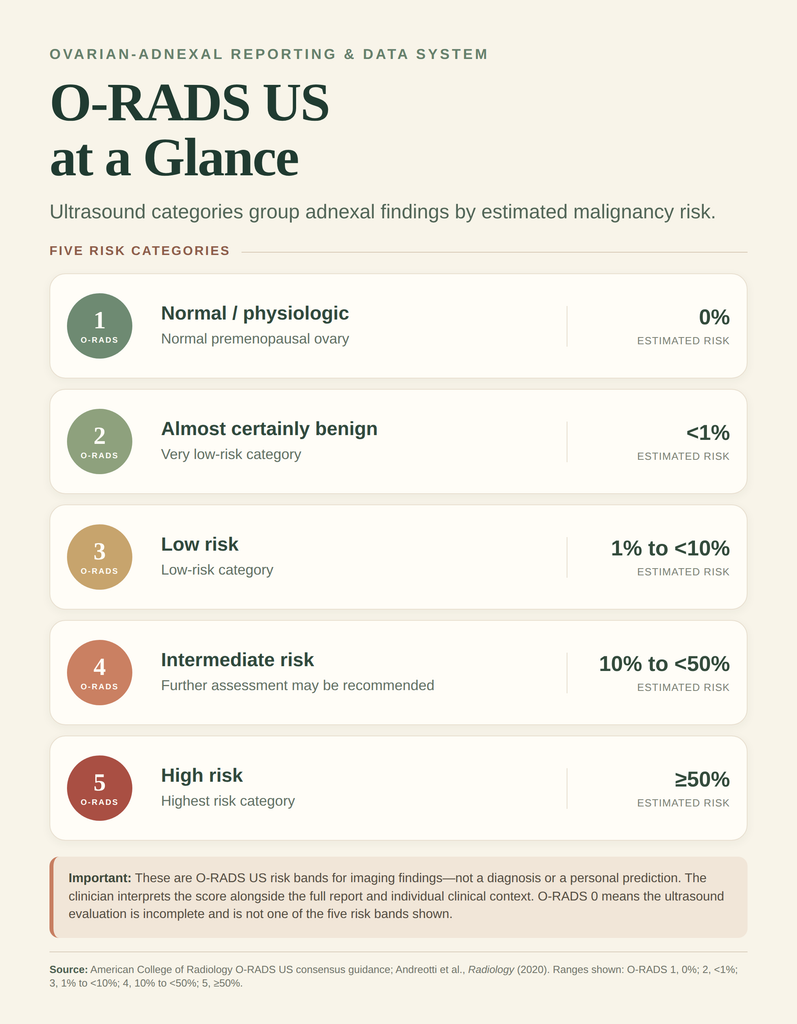
O-RADS assigns a score from standardized ultrasound features, and the bands are worth knowing because they turn “probably fine” into a number.
| Category | Meaning | Risk of malignancy |
| 1 | Normal ovary | 0% |
| 2 | Almost certainly benign | Under 1% |
| 3 | Low risk | 1 to under 10% |
| 4 | Intermediate risk | 10 to under 50% |
| 5 | High risk | 50% or more |
In a six-institution US validation of 913 women, observed malignancy rates tracked closely: 0.5% for category 2, 4.5% for 3, 11.6% for 4, and 65.6% for 5. At a cutoff of category 4 or above, sensitivity was 90.6% and the negative predictive value was 99.0%.
Features that read as benign: a round or oval anechoic collection with smooth thin walls and no solid component or septation; the fine intersecting lines of a resolving hemorrhagic cyst; the homogeneous ground-glass appearance of an endometrioma; the shadowing and hyperechoic lines and dots of a dermoid.
Features that escalate it: an irregular inner wall, septations, papillary projections, solid components, an irregular solid contour, strong internal blood flow, size at or above 10 cm, and — most significantly — unexplained ascites or peritoneal nodules.
One honest caveat about all of this: it depends entirely on who is holding the probe. The investigators behind that large conservative-management study said their results might lead to less surgery for benign cysts — explicitly “on condition that trained ultrasound examiners reliably exclude cancer.” The reassurance is only as good as the scan.
This is the one I most want women to know about, because it’s time-critical and the presentation can be misleading.
Torsion is when the ovary twists on its blood supply. It’s described in the clinical literature as a true surgical emergency — not usually life-threatening, but organ-threatening, and the longer blood flow is cut off, the lower the chance of saving the ovary.
The main risk factor is an ovarian mass 5 cm or larger. Other risk factors include pregnancy and fertility treatment.
What makes it dangerous is how easily it’s missed. Abdominal pain occurs in about 95% of cases and nausea or vomiting in about 90% — but up to a third of patients have no abdominal tenderness on examination. Ultrasound with Doppler is the test of choice, and its sensitivity is roughly 70 to 84%, which means a normal scan does not rule it out. Torsion can be intermittent, so the ovary may not be twisted at the moment of the scan.
The reassuring part: at surgery, 89% of the masses found are benign, and detorsion preserves a functional ovary in over 90% of cases when it’s done promptly. In one recent emergency series, 94.7% kept a viable ovary.
So: sudden, severe, unrelenting pelvic pain — especially with nausea or vomiting, especially with a known cyst of 5 cm or more — is an emergency room visit, not a wait-and-see. During routine conservative management, torsion risk was only 0.4% over two years. But if it happens, hours matter.
Any category 4 or 5 finding changes the conversation: irregular walls or septations, papillary projections, solid components, strong vascularity, ascites, or peritoneal nodules. So does growth or a change in appearance in something previously called benign, and so does a cyst that persists past two or three cycles when it was assumed functional.
ACOG and the Society of Gynecologic Oncology publish referral thresholds worth knowing:
Premenopausal — CA-125 above 200 U/mL, ascites, evidence of metastasis, or a first-degree relative with breast or ovarian cancer.
Postmenopausal — CA-125 above 35 U/mL, ascites, a nodular or fixed pelvic mass, evidence of metastasis, or that same family history.
Here’s the real “watch and wait isn’t enough” story, and it isn’t about cancer at all.
Every threshold above exists to answer one question: is this malignant? None of them answers the question you actually came in with, which is this hurts, what now? The American Family Physician review on adnexal masses concedes it directly — for apparently benign masses in reproductive-age women, “guidance on timing is lacking.”
That’s the gap. You can be fully, correctly reassured about cancer risk and still be in pain, with no protocol covering what happens next. If that’s where you are, you’re not imagining the gap and you’re not being unreasonable to push.
What’s worth knowing going into that conversation:
Cyst size and symptoms correlate poorly. A small cyst can hurt and a large one can be silent.
Pain often isn’t coming from the cyst. In women with endometriomas, pain recurred in 12.6% over five years after surgical removal — and, critically, recurrence of the cyst was not related to recurrence of the pain. Pain frequently reflects coexisting deep endometriosis or adenomyosis, which removing a cyst doesn’t address.
Which means surgery is a genuine trade-off, not a default. Removing an endometrioma measurably reduces ovarian reserve. Across 14 prospective studies in 650 women, AMH fell an average of 44.4% early after surgery, 35.1% at two to six months, and 54.2% at nine to eighteen months. Notably, antral follicle count didn’t change significantly, so how much that translates into real fertility loss is less certain than the AMH numbers suggest — but it’s a real conversation to have before an operation, especially with bilateral disease or cysts over 7 cm.
Hormonal suppression helps pain more than it helps size. In one cohort on continuous progestin therapy, endometriomas shrank about 9% at six months and 22% at twenty-four, while pain scores improved meaningfully. Side effects were common though — weight gain in 81%, reduced libido in 31%.
This section matters because the vacuum left by that guidance gap gets filled with things that don’t help.
The birth control pill does not dissolve cysts. This is the best-documented negative in the whole field, and it’s in the Cochrane library: eight randomized trials, and none found a significant benefit of oral contraceptives over simply waiting. The conclusion is blunt — “Oral contraceptives are not an effective treatment for ovarian cysts.” They remain useful for preventing new functional cysts and for managing endometriosis pain. They don’t shrink what’s already there.
That finding is the right lens for everything else. A potent hormonal medication was properly tested and failed to beat doing nothing.
Diet and supplements have no trial evidence for cyst resolution. None. I looked specifically for trials, systematic reviews or guideline statements on DIM, cruciferous vegetables, flaxseed, chasteberry, castor oil packs, selenium or cycle-syncing protocols for shrinking cysts, and there is no randomized trial, no systematic review, and no guideline statement in ACOG, RCOG, NICE, ESHRE, the ultrasound consensus or the international PCOS guideline. The absence isn’t an oversight — the studies don’t exist.
And there’s a specific reason uncontrolled claims here are unreliable: most functional cysts resolve on their own within two to three months. Anything taken during that window will appear to have worked. That’s precisely why the Cochrane comparator was expectant management rather than placebo.
On “estrogen dominance” as the cause: no major guideline attributes functional cysts to an estrogen excess state. Functional cysts are products of the normal ovulatory cycle — a follicle that didn’t rupture, or a corpus luteum that persisted — and the classification systems treat those structures up to 3 cm as a normal ovary. Hormonal signalling obviously governs the cycle, so it governs cyst formation in that sense. But that’s different from an excess state causing them.
Aspiration doesn’t beat waiting. Aspirated and expectantly managed cysts showed the same resolution rate at six months, and routine aspiration isn’t recommended.
If one test gets over-interpreted here, it’s this one.
It misses cancer. CA-125 is elevated in about 80% of epithelial ovarian cancers, but only about 50% of stage I disease. More than half of early-stage cases have a normal value, which is why ACOG and SGO state that a normal CA-125 does not rule out cancer.
It flags things that aren’t cancer, especially before menopause. Positive predictive value is 98% postmenopausally but only 49% premenopausally. Levels above 35 U/L occur in 24% of endometriosis, 10% of fibroids, 10% of benign ovarian tumours, 40% of acute salpingitis, 32% of acute pancreatitis — and 100% of cirrhosis with ascites. Pregnancy and menstruation raise it too.
The RCOG’s conclusion is direct: CA-125 is unreliable for distinguishing benign from malignant ovarian masses in premenopausal women, and doesn’t need to be measured in every premenopausal woman when a simple cyst is clearly seen on ultrasound. One useful nuance: rapidly rising levels are more concerning than high but static ones.
This confusion is so common that the condition was renamed over it.
In May 2026, following an international consensus process, polycystic ovary syndrome was officially renamed Polyendocrine Metabolic Ovarian Syndrome (PMOS). The stated reason was that the old name inaccurately suggested the presence of ovarian cysts, when the condition isn’t defined by them at all.
What polycystic ovarian morphology actually describes is a count of small immature follicles — normal ovarian structures — with the current threshold set at 20 or more follicles per ovary, or an ovarian volume of 10 ml or more. Those are not cysts in the sense this article has been using.
So if you’ve been told you have “cysts on your ovaries” in the context of irregular cycles, that’s likely follicle count rather than cysts needing monitoring. Worth clarifying which one you’re actually dealing with.
| Conventional Approach | Root-Cause Approach | |
| Benign-looking cyst | Repeat scans indefinitely | Follow current thresholds; stop scanning when guidance says to |
| Symptoms | “It’s benign, so it shouldn’t hurt” | Treated as a separate question from cancer risk |
| Pain source | Assumed to be the cyst | Deep endometriosis, adenomyosis, pelvic floor also assessed |
| CA-125 | Used as reassurance | Understood as poor in premenopausal women |
| Surgery | Offered, or withheld, without the trade-off | Ovarian reserve cost discussed before deciding |
| Supplements | Suggested informally | Named as untested, since the pill itself failed in trials |
1. Find out your O-RADS category and the exact measurements. “A cyst” isn’t information. Category, size, whether it’s simple or has septations or solid areas, and whether there’s blood flow — that’s information, and it tells you what follow-up is appropriate.
2. Get the scan done by someone who does this often. The entire case for watchful waiting rests on skilled interpretation. If your imaging was equivocal, a specialist gynecologic ultrasound is a reasonable ask.
3. Know your emergency signs cold. Sudden severe pelvic pain with nausea or vomiting, especially with a cyst of 5 cm or more. Severe pain with dizziness, fainting, a racing pulse or breathlessness. These are emergency room presentations.
4. Track symptoms against your cycle for two or three cycles. Pain timing, bowel and bladder symptoms, pain with intercourse, spotting. If pain is cyclical and predates the cyst, the cyst probably isn’t the whole story.
5. Have the endometriosis conversation if pain is the main problem. Painful periods, pain with deep intercourse, painful bowel movements and cyclical bloating point there, and endometriosis-associated pain has real treatment options that don’t begin with removing an ovary.
6. Ask about ovarian reserve before any surgery you’re choosing rather than needing. Especially with bilateral endometriomas or cysts over 7 cm, and especially if you may want to conceive.
7. Don’t let “benign” end the conversation about how you feel. The guidelines genuinely don’t cover this. Saying “I accept it’s not cancer, and I still need a plan for the pain” is the most useful sentence you can bring to an appointment.
8. Treat the bloating overlap seriously but calmly. Persistent bloating, early satiety, pelvic pain and urinary urgency are the symptoms that should prompt evaluation — and the positive predictive value of that cluster for ovarian cancer is only about 1%. Get it checked; the overwhelming likely answer is something else.
Seek emergency care for sudden severe pelvic or abdominal pain, particularly with nausea or vomiting or with a known cyst of 5 cm or larger; for severe pain with dizziness, fainting, a rapid pulse or shortness of breath; or for pain with fever.
Book a visit promptly for new pelvic pain, for persistent bloating or early satiety lasting a month or more or occurring around twelve times a month, for unexplained weight loss, for a change in bowel or bladder habits, for any postmenopausal bleeding, or for a cyst that has grown or changed appearance.
Book a routine visit for cyclical pelvic pain, pain with intercourse, difficulty conceiving, or a cyst you’ve been told to monitor without ever being told what category it is or what would change the plan.
Do ovarian cysts need to be removed? Usually not. The guidance has moved toward less intervention precisely because unnecessary follow-up leads to unnecessary surgery. In two years of conservative management, invasive malignancy was found in 0.4% and surgery for suspected malignancy in 2%.
Can diet or supplements shrink a cyst? There’s no trial evidence that any diet or supplement resolves ovarian cysts. The sharpest context: the birth control pill was tested in eight randomized trials and did not beat simply waiting.
Will the pill make it go away? No. Cochrane’s conclusion is that oral contraceptives are not an effective treatment for existing cysts. They can help prevent new functional cysts and manage endometriosis pain, which is a different thing.
My CA-125 was normal. Does that mean I’m fine? Not by itself. More than half of early-stage ovarian cancers have a normal CA-125. And before menopause the test’s positive predictive value is only 49%, so a raised result often means endometriosis or fibroids rather than cancer. It’s one piece of information in both directions.
Is PMOS the same as having ovarian cysts? No — and that confusion is why the condition was renamed from PCOS in May 2026. What’s being counted is small immature follicles, which are normal structures, not cysts requiring monitoring.
Why does it still hurt if it’s benign? Possibly because the cyst isn’t what’s hurting. After endometrioma surgery, cyst recurrence and pain recurrence were unrelated — pain often reflects coexisting deep endometriosis or adenomyosis. That’s worth investigating separately.
“Watch and wait” is the right answer for most ovarian cysts, and the specialists have moved toward watching less rather than more, because over-surveillance leads to operations nobody needed.
Where it isn’t enough is narrower and more specific than the internet implies. Torsion is an emergency and a normal ultrasound can’t exclude it. Higher-risk features change the plan. And if you’re in pain, the honest position is that the guidelines don’t address that — so the useful thing isn’t a supplement, it’s insisting on a plan for the symptom alongside the reassurance about the risk.
“Accept that it isn’t cancer. Then ask for a plan for the pain. Those are two different conversations, and you’re entitled to both.”
Whether this is your first visit or your next one, a cyst you’ve been told to monitor without being told what would change the plan is worth a proper conversation.
Have You Been Told to Watch a Cyst Without a Plan for the Symptoms? Our team would love to meet with you.
Click this link to schedule a time to meet with our team.
Related: Endometriosis: Why It Takes So Long to Get Diagnosed | Heavy Periods: What’s Normal and When to Look Deeper | Why Am I Always Bloated?