
Bedwetting in kids is common enough that it’s genuinely normal — it affects an estimated 15% to 20% of children at age five, falling to around 4% by age eight. It also resolves on its own: about 15% of affected children stop each year without any treatment.
“Usually resolves” still isn’t the same as “never look into it.” The distinction that changes everything is whether your child was ever reliably dry. A child who has never had six dry months is on a different path than one who was dry for a year and then wasn’t.
Constipation is the most commonly missed driver in bedwetting in kids, present in roughly a third to more than half of children who wet the bed — and most of them are having daily bowel movements.
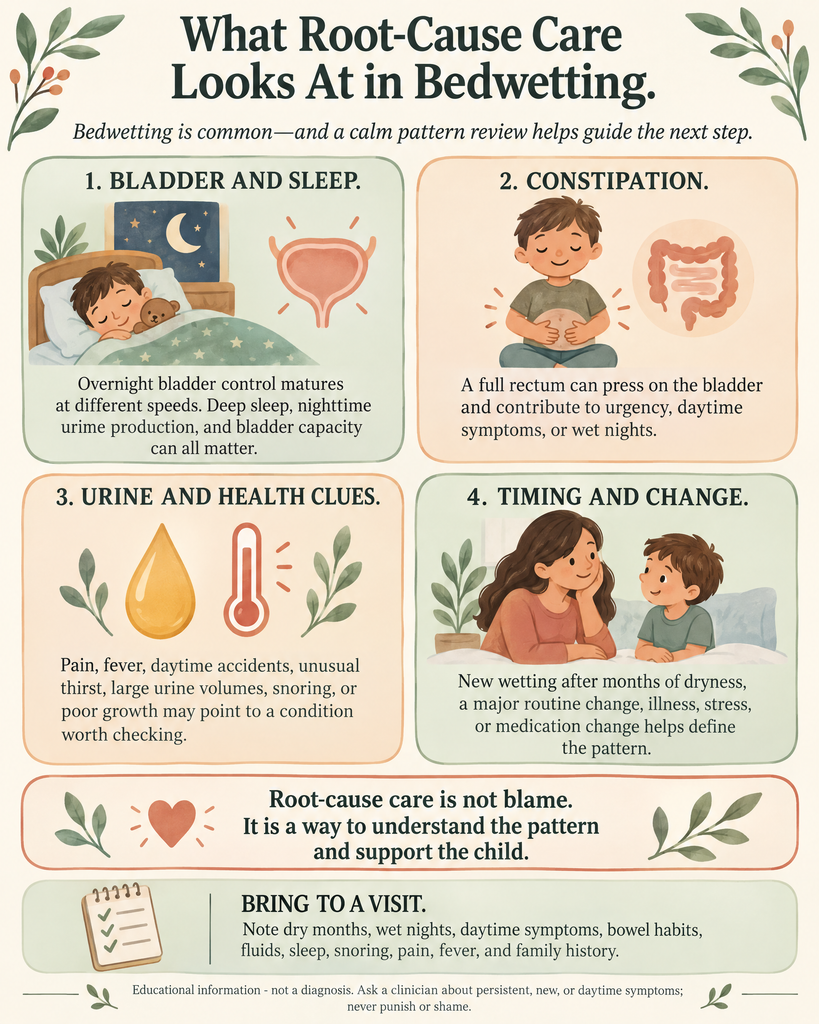
Staying dry overnight requires three things to line up. The bladder has to hold enough. The kidneys have to slow urine production during sleep. And the brain has to either wake the child or keep the bladder quiet until morning.
Those three mature at different rates in different children, which is why the age range for night dryness is so wide. Bedwetting is only defined as a clinical issue at nighttime wetting at least twice a week in a child five or older.
By the numbers: roughly 15% to 20% of children at age five, about 4% by age eight, and 1% to 2% persisting into adulthood. Boys are affected about twice as often as girls. There’s a strong genetic component — when both parents wet the bed as children, a child’s risk runs as high as 77%.
You may already know bedwetting runs in families. What’s less widely known is the distinction that drives the entire evaluation:
Primary bedwetting means a child has never had six consecutive dry months. This is the more common form, and the one most likely to resolve with time.
Secondary bedwetting means dryness was established for at least six months and then stopped. This one deserves a closer look, because something interrupted a system that was already working.
Worth noting before a visit:
Whether your child has ever been reliably dry, and for how long How many nights a week it happens now Whether there are any daytime symptoms — urgency, frequency, accidents Bowel pattern: how often, how hard, any pain or withholding Whether your child snores, mouth-breathes, or sleeps restlessly Any recent changes at home, at school, or socially Whether your child is drinking or urinating much more than usual
The difference between “wait and see” and a real evaluation is that the second one checks a short list of specific, treatable things first.
Constipation. The most commonly missed cause, and the most fixable. A rectum full of stool sits directly against the bladder, reducing how much it can hold and irritating it into contracting. Constipation shows up in roughly 33% to 56% of children with bedwetting. Many of these children have daily bowel movements, so parents reasonably assume constipation isn’t the issue — incomplete emptying is what matters, not frequency.
Urinary tract infection. A common trigger for a sudden return of wetting, sometimes without classic symptoms in younger children. A urinalysis is a standard part of the workup for exactly this reason.
Sleep-disordered breathing. Snoring, mouth breathing, and pauses in breathing are associated with bedwetting, and treating the airway obstruction improves bedwetting in a meaningful share of children. If your child snores most nights, that belongs in the conversation.
Stress and change. A new sibling, a move, a new school, a loss, or anything frightening can trigger secondary bedwetting. This is real physiology, not misbehavior — and it typically settles as the stressor resolves.
Medical causes worth excluding. New-onset diabetes can present as a return of bedwetting alongside excessive thirst, frequent urination, and weight loss. Less commonly, kidney concentrating problems or neurological issues are involved. These are uncommon, but they’re the reason bedwetting gets a real evaluation rather than a shrug.
“Most bedwetting resolves on its own. That’s not a reason to skip checking the bowels, the urine, and the breathing.”
| Conventional Approach | Root-Cause Approach | |
| First step | Wait it out, limit evening fluids | Evaluate bowels, urine, airway, and recent changes |
| Constipation | Often not assessed unless the child reports pain | Assessed directly, since frequency doesn’t rule it out |
| Focus | Manage the wet nights | Remove what’s keeping the system from maturing |
| Timeline | Months to years of waiting | Often weeks once a specific driver is addressed |
1. Treat constipation first, even if you don’t think it’s there. This is the highest-yield step in the whole list. Adequate fluids, regular fiber from food, a consistent post-meal sit, and a footstool so your child’s knees sit above their hips all help. If you’re already managing constipation, make sure it’s genuinely resolved rather than partly improved.
2. Front-load fluids earlier in the day. Rather than restricting drinks at night — which leaves children thirsty and doesn’t address bladder capacity — shift the bulk of the day’s fluids to morning and afternoon, and taper in the last hour or two before bed.
3. Build a double-void routine. Have your child use the bathroom at the start of the bedtime routine and again right before lights out. It’s simple and it meaningfully reduces what the bladder has to hold overnight.
4. Look at nighttime breathing. Go in twenty minutes after your child falls asleep. Is their mouth open? Is there snoring, gasping, or any pause? Restless, sweaty, thrashing sleep alongside bedwetting points toward the airway, which is treatable.
5. Ask about an alarm. Bedwetting alarms have the best long-term track record of the standard options, with success rates reported around 66%. They take several weeks of consistency and work best with an invested child, so timing matters.
6. Protect your child’s dignity above all. Bedwetting is not laziness, and it isn’t under voluntary control. Avoid punishment and avoid making your child the household topic of conversation. Let them help change the sheets as a matter of routine rather than consequence, and reward the effort — doing the routine, using the alarm — not the dry nights, which they can’t control.
Book a visit any time a child who was reliably dry for six months or longer starts wetting again. That’s a real change and worth a urinalysis and a history, not a wait-and-see.
Also worth a visit: bedwetting continuing past age seven, bedwetting that’s distressing your child or limiting sleepovers and camps, or any bedwetting alongside daytime accidents or urgency.
Seek care promptly for excessive thirst, urinating much more than usual, or unexplained weight loss; painful urination, fever, or back pain; snoring with gasping or pauses in breathing; new constipation with pain or stool withholding; or any new changes in walking, coordination, or leg strength.
At what age is bedwetting in kids no longer normal? It’s defined as a clinical issue from age five, at twice weekly or more. But plenty of children are still wetting at six or seven and resolve without intervention. Age matters less than whether anything treatable is going on underneath, and whether it’s affecting your child’s life.
Will my child grow out of it? Most do — roughly 15% of affected children stop each year without treatment. That’s a good reason not to panic and a poor reason to skip checking for constipation, infection, and disrupted breathing.
Could this be behavioral or attention-seeking? No. Bedwetting happens during sleep and isn’t under conscious control. Stress can trigger it, but that’s a physiological response — not a choice your child is making.
My child was dry and started again — is that different? Yes, and it’s the one scenario where we’d say don’t wait. Established dryness that stops means something changed, and it’s usually findable.
Do fluid restrictions at night work? On their own, not very well. Shifting fluids earlier helps more than cutting them off, and neither addresses an underlying driver like constipation or an airway problem.
Bedwetting in kids is common, it’s not your child’s fault, and most of it resolves. The mistake we see most often isn’t over-worrying — it’s waiting a year while an easily treated cause sits underneath.
“Check the bowels, check the urine, check the breathing. That’s most of the answer, most of the time.”
Whether this is your first visit or your next one, this is a straightforward evaluation with a clear path forward.
Is Bedwetting in Kids Affecting Your Child’s Sleep or Confidence? Our team would love to meet with you.
Click this link to schedule a time to meet with our team.
Related: Why Is My Toddler So Constipated? | Why Won’t My Toddler Sleep Through the Night? | Why Does My Child Have Dark Circles Under Their Eyes?