Recurrent Ear Infections: Looking Past “Just Give It Time”
Quick Facts
Recurrent ear infections are common in early childhood, and ear infections are among the most common reasons for pediatric antibiotic prescriptions in the U.S.
Many resolve on their own without antibiotics, but recurrent infections point to an underlying pattern worth investigating.
Drainage anatomy, allergen exposure, and gut health after antibiotics all play a role.
Repeated antibiotic courses can disrupt the gut microbiome, which is one more reason to look at the pattern rather than just the latest infection.
If your child seems to bounce from one ear infection to the next, “it’s just what happens at daycare” isn’t a satisfying answer, and it shouldn’t be. Recurrent infections are usually a sign that something (drainage, environment, gut health) needs closer attention.
What’s Really Happening With Recurrent Ear Infections?
An ear infection (otitis media) happens when fluid builds up behind the eardrum and becomes infected. Occasional infections are common and not usually concerning, but three or more in six months is a pattern, not bad luck.
Common signs include:
Ear pain or tugging at the ear
Fussiness, especially when lying down
Fever
Fluid drainage from the ear
Trouble hearing or muffled response to sound
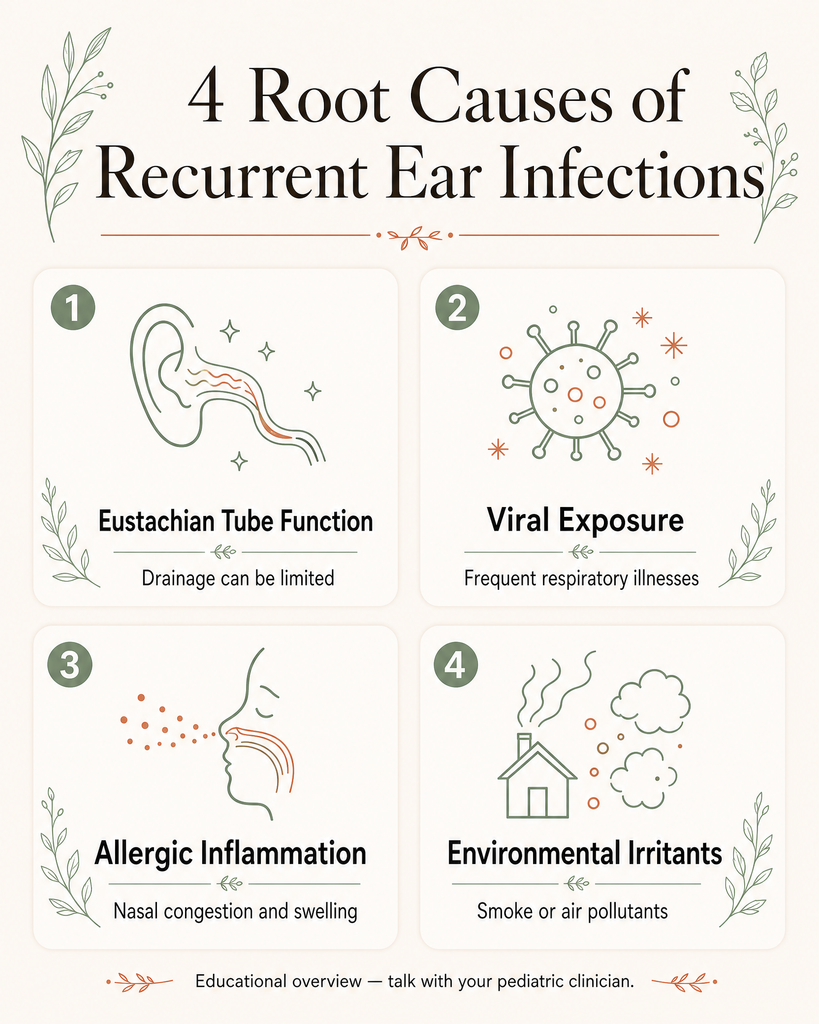
The Root Causes Behind Recurrent Ear Infections
Eustachian tube drainage issues — poor drainage lets fluid pool, creating a breeding ground for infection.
Frequent colds — most ear infections follow a viral cold. Daycare, older siblings, and cold season all raise exposure.
Secondhand smoke or allergen exposure — both are well-documented risk factors for recurrent otitis media.
Structural or anatomical factors — shorter, more horizontal eustachian tubes in young children make fluid drainage naturally harder, which is part of why ear infections cluster in early childhood.
“One ear infection is just an ear infection. Five in a year is your child’s body asking for a different kind of support.”
Recurrent Ear Infections: Looking Past "Just Give It Time" 2
Conventional vs. Root-Cause Approach
Conventional Approach
Root-Cause Approach
First step
Antibiotics (or “watch and wait”)
Drainage, environment, and gut-health review
Focus
Treat the current infection
Reduce frequency of future infections
Timeline
Days per period
Often fewer episodes within 1–2 seasons
5 Natural Approaches for Recurrent Ear Infections
1. Support gut health after antibiotics. Antibiotics can disrupt the gut microbiome. A pediatric probiotic is a reasonable conversation to have with your provider, though the evidence on probiotics for preventing ear infections is still mixed.
2. Address positional drainage. Feed babies upright rather than lying flat, and never prop a bottle. This helps keep milk and fluid out of the eustachian tubes.
3. Cut down on the colds that trigger them. Handwashing, a smaller daycare group where that’s possible, and staying current on recommended vaccines, including the flu and pneumococcal vaccines, all reduce the infections that lead to ear infections.
4. Limit the pacifier after about six months, and breastfeed if you can. Both are linked to fewer ear infections in young children.
5. Give the eustachian tubes time. Since anatomy is a major factor in early childhood, many kids simply need time for the tubes to mature — a fuller evaluation makes sense if infections continue past this stage.
When to See a Provider About Recurrent Ear Infections
Persistent fever, ear drainage, hearing changes, or a pattern of 3+ infections in six months warrants a fuller evaluation, and talking with your pediatrician about recommended vaccines, which reduce some of the infections behind ear infections.
FAQ
Do all ear infections need antibiotics? No — many resolve on their own, and antibiotics are best reserved for more severe or persistent cases.
Can diet really affect recurrent ear infections? Diet isn’t a well-supported lever specifically for ear infections — despite a common belief, controlled studies haven’t found that dairy increases mucus or worsens drainage.[4] Gut health after antibiotics and environmental factors are better-supported places to focus.
Will my child need ear tubes? Sometimes, especially with chronic fluid — but many families see improvement with root-cause changes first.
Final Thoughts
Recurrent ear infections aren’t just bad luck or “a daycare thing.” Looking at drainage anatomy, environmental exposures, and gut health after antibiotics can break a cycle that otherwise just repeats every season.
Is your child experiencing recurrent ear infections? Our team would love to meet with you.
Click this link to schedule a time to meet with our team
References
Danishyar A, Ashurst JV, “Acute Otitis Media,” StatPearls (NCBI Bookshelf), 2024. https://www.ncbi.nlm.nih.gov/books/NBK470332/; Jones LL, et al., “Parental smoking and the risk of middle ear disease in children: a systematic review and meta-analysis,” Archives of Pediatrics & Adolescent Medicine, 2012.
Balfour-Lynn IM, “Milk, mucus and myths,” Archives of Disease in Childhood, 2019; Koren Y, et al., “Respiratory effects of acute milk consumption among asthmatic and non-asthmatic children: a randomized controlled study,” BMC Pediatrics, 2020. https://www.ncbi.nlm.nih.gov/pmc/articles/PMC7488715/
Lieberthal AS, et al., “The Diagnosis and Management of Acute Otitis Media,” Pediatrics, 2013;131(3):e964–e999. https://pubmed.ncbi.nlm.nih.gov/23439909/ (American Academy of Pediatrics guideline; recommends breastfeeding, avoiding tobacco smoke exposure, and pneumococcal and annual flu vaccination to reduce ear infections)
Niemelä M, et al., “Pacifier as a risk factor for acute otitis media: A randomized, controlled trial of parental counseling,” Pediatrics, 2000;106(3):483–488. https://pubmed.ncbi.nlm.nih.gov/10969091/ (counseling parents to limit pacifier use reduced ear infections in young children)
Scott AM, et al., “Probiotics for preventing acute otitis media in children,” Cochrane Database of Systematic Reviews, 2019. https://pubmed.ncbi.nlm.nih.gov/31210358/ (probiotics may reduce ear infections in children who aren’t prone to them; no clear benefit in children who get them repeatedly)