
Chronic heartburn isn’t caused by too much acid. It’s caused by a barrier that isn’t holding — the valve at the bottom of the esophagus, how often it relaxes, and the pressure pushing against it. Acid suppression lowers the damage; it doesn’t change the mechanism. Which is why a third of people with chronic heartburn don’t get better on it. About one in three still have symptoms on once-daily acid suppression, and in that group the usual answer is functional heartburn, reflux hypersensitivity, or non-acid reflux — not acid.But “shutting off acid isn’t a fix” is not the same as “acid blockers are dangerous.” A randomized trial of 17,598 people over three years found no increase in fractures, pneumonia, kidney disease, dementia or gastric atrophy. And chronic heartburn is definitely not the same as “you need more acid.” In atrophic gastritis — genuine, measurable low stomach acid — reflux showed up in only 7.2% of symptomatic patients.
Chronic heartburn is a topic where you can get hurt by bad advice in two opposite directions.
One side says long-term acid blockers are wrecking your bones, kidneys and brain, and you should stop. The other says reflux is really low stomach acid, and you should supplement acid instead. Both are confident. Both are wrong in ways the research has actually settled.
So this is going to be So this is going to be a more careful article about chronic heartburn than the title suggests. than the title suggests. The title’s point stands — shutting off acid doesn’t address why you’re refluxing — but the useful version of that idea looks different from either of the popular ones.
One thing to say up front: don’t stop an acid blocker on your own. There are specific conditions where stopping causes real harm, and I’ll name them. This is a conversation to have with your prescriber, not a decision to make from an article.
Chronic heartburn happens when the barrier between the stomach and esophagus fails. Four things drive that.
The valve’s resting pressure. The lower esophageal sphincter normally holds somewhere around 10 to 30 mmHg. When that resting pressure is too low, stomach pressure wins and contents move upward.
Transient relaxations of that valve. This is the dominant mechanism of individual reflux events — the sphincter spontaneously relaxes for ten to forty-five seconds without a swallow, triggered by stomach distension through a vagal reflex. The interesting part: in healthy people, roughly 40 to 50% of these relaxations carry acid upward; in people with reflux disease, 60 to 70% do. The relaxations aren’t necessarily more frequent — more of them carry acid.
Hiatal hernia. The main structural problem at the junction. The sphincter and the diaphragm’s muscular ring normally overlap and reinforce each other; when they separate, that synergy is lost.
Pressure from below. Obesity, pregnancy and anything that raises intra-abdominal pressure increases the gradient pushing stomach contents up. A dose-response meta-analysis of 43 studies covering 484,219 people found each 10 kg/m² increase in BMI carried a relative risk of 1.68 for reflux disease, with a linear relationship.
Notice what’s missing from that list: how much acid your stomach makes. The volume of acid isn’t the defect. The defect is that it’s going somewhere it shouldn’t.
That’s That’s the honest core of what “not a fix” means in chronic heartburn. Acid suppression makes the refluxate less corrosive, which genuinely heals an inflamed esophagus and genuinely relieves symptoms. It does not tighten a valve, shrink a hernia, or lower abdominal pressure.
I want to be clear about this before anything else, because the honest version of this topic includes the parts that work.
Acid blockers are more effective than the older class of acid reducers for healing an inflamed esophagus — the American College of Gastroenterology rates that recommendation strong, on high-quality evidence. For maintaining that healing, strong on moderate evidence. In a Cochrane review of 34 trials, acid blockers beat placebo for heartburn remission with a relative risk of 0.37 in people treated empirically.
And there are conditions where stopping is genuinely dangerous. Per ACG and the American Gastroenterological Association, long-term therapy should generally not be discontinued in:
Severe erosive esophagitis — grade C or D, where ACG recommends indefinite maintenance therapy or surgery, strong recommendation on moderate evidence. Nearly 100% of grade C patients relapse within six months of stopping.
Barrett’s esophagus
Eosinophilic esophagitis
Esophageal ulcer or peptic stricture
Idiopathic pulmonary fibrosis
High risk of upper gastrointestinal bleeding — prior bleed, multiple blood thinners, or aspirin and NSAID use plus another risk factor
Acid-hypersecretory conditions such as Zollinger-Ellison syndrome
If you’re in one of those groups, the rest of this article is context, not instruction.
This is the part most chronic heartburn content gets wrong, and it’s worth getting right because fear is driving people off medication they need.
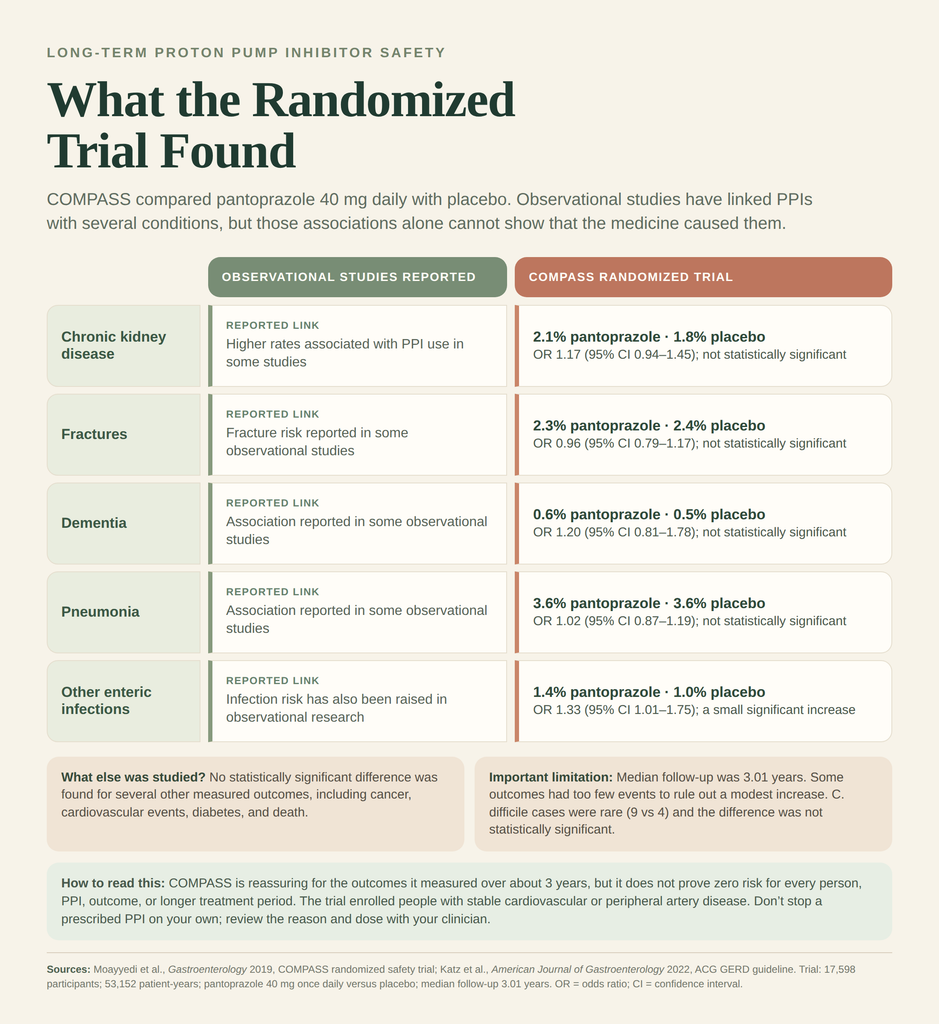
In 2019, investigators reported safety outcomes from a randomized, double-blind, placebo-controlled trial of 17,598 people assigned to a proton pump inhibitor or placebo, followed a median of three years — 53,152 patient-years, in people with no compelling indication for the drug. It’s the best causal evidence that exists.
Fractures: odds ratio 0.96. No effect — numerically slightly below 1. Pneumonia: 1.02. No effect. Kidney disease: 1.17. Not significant. Dementia: 1.20. Not significant. Gastric atrophy: 0.73. Not significant. Diabetes: 0.96. No effect. Other enteric infections: 1.33 — the single significant finding, with a number needed to harm of 301.
The ACG’s own publication on the dementia question is titled, flatly, “Proton Pump Inhibitors Do Not Cause Dementia.” A prospective analysis within a large trial cohort found a hazard ratio of 0.88 over a median 4.5 years, and 0.91 over 6.3 years.
What the regulators have actually done. The FDA has issued exactly three safety communications on this class: a 2010 label change on possible fracture risk with high-dose long-term use, a 2011 communication on low magnesium — mostly after more than a year of use — and a 2012 communication on C. difficile diarrhea. There has never been an FDA warning about dementia, kidney disease, gastric cancer, iron, B12 or bacterial overgrowth.
On the nutrient-depletion testing you’ll see recommended: the AGA explicitly advises against routine screening or monitoring of bone density, creatinine, magnesium or B12 in long-term users, and against routinely taking calcium, B12 or magnesium above the recommended daily amount. Magnesium is the one real label-level signal, and checking a level before long-term use is reasonable — particularly if you take a diuretic.
The framing that helps most: the researchers’ own calibration is that odds ratios persistently above 2 are more likely causal, while a ratio around 1.2 is usually residual confounding with a tiny absolute effect. The absolute excess risks in the AGA’s own table run mostly between 0.03% and 0.5% per patient-year.
“The question isn’t whether acid blockers are dangerous. The randomized trial says mostly not. The question is whether yours was ever reviewed.”
This is heavily promoted as the cause of chronic heartburn, and the evidence runs the other way.
The natural experiment. Atrophic body gastritis is the paradigm case of genuine, measurable low stomach acid. If low acid caused reflux, those patients would be full of it. Instead, dyspepsia dominates — present in 60.2% of symptomatic patients — while GERD was found in only 7.2%. The review also notes that because acid secretion is reduced, acid blockers are largely ineffective in these patients. That’s the real clinical meaning of hypochlorhydria, and it’s the opposite of the popular claim.
The baking soda test. Never validated. No study, no sensitivity or specificity data, no mention in any guideline. Belch timing reflects stomach volume, swallowed air, emptying rate and posture — not acid output. And the reagent is itself an antacid.
Betaine HCl. The entire human evidence base for the acid effect is a six-person pilot study in healthy volunteers whose low acid was deliberately induced with a medication. It measured gastric pH and no clinical outcome at all, and the effect lasted roughly 73 to 77 minutes. A secondary review states that for reflux and ulcers “scientific evidence is lacking,” that earlier studies were out of date and methodologically flawed, and that people with reflux or ulcers shouldn’t use it except on a physician’s advice. The FDA banned betaine HCl from over-the-counter medicines in 1993.
Apple cider vinegar. No controlled trial for reflux symptoms that I could find. Mechanistically, adding acid to an inflamed esophagus is a plausible way to make things worse.
And how real low acid is actually diagnosed: gastric biopsy histology is the gold standard, supported by pepsinogen I, the pepsinogen I/II ratio, gastrin-17 and H. pylori serology — a panel with roughly 70% sensitivity and 94% specificity. Gastric pH isn’t a routine test, and there’s no home version. That matters, because genuine atrophic gastritis carries meaningful gastric cancer risk and causes B12 and iron deficiency. It deserves a real diagnosis, not a supplement.
Here’s the legitimate version of what chronic heartburn is
About a third of people with chronic heartburn don’t respond. About one in three still have symptoms on once-daily therapy, and about one in ten on twice-daily. In that group, functional heartburn affects nearly a third of people with reflux symptoms, reflux hypersensitivity accounts for roughly 30 to 35% of non-erosive disease, and non-acid reflux episodes are found in 60 to 80% of people still symptomatic on double-dose therapy. For most non-responders, the problem genuinely isn’t acid — and the answer is objective testing, not a stronger dose.
ACG is specific here: one medication switch after non-response is reasonable, more than one isn’t supported, and adding other drugs isn’t recommended.
Prescriptions don’t get reviewed. This is the real failure mode. ACG cites a study in which 42% of patients continued acid-blocking therapy after a negative evaluation for refractory reflux. The AGA’s first piece of best-practice advice is that every person taking one should have a regular review of the ongoing indication, documented.
Stopping causes a rebound that fools people. In a randomized trial of 120 volunteers with no significant history of reflux, two months of acid suppression followed by placebo produced clinically significant heartburn, acid reflux or dyspepsia in 44%, versus 15% of those who’d had placebo all along. Acid suppression raises gastrin, which proliferates the acid-producing cells; stopping unmasks the increased capacity.
That’s the single strongest argument for stopping with a clinician rather than alone. Someone who quits by themselves and develops symptoms at week two will reasonably — but wrongly — conclude they need the drug forever. The AGA describes this rebound as transient, with the cell changes usually regressing by six months, and found no significant difference between a three-week taper and simply stopping.
| Common Approach | Root-Cause Approach | |
| The acid question | Suppress it, indefinitely | Suppress it when indicated, and review the indication |
| Non-response | Escalate the dose | Objective testing — the problem usually isn’t acid |
| Mechanism | Not addressed | Weight, pressure, hernia, meal timing, clearance |
| Alleged harms | Either ignored or used as a reason to quit | The randomized trial, and the three real FDA signals |
| “Low acid” | Supplemented on a home test | Diagnosed properly, if at all — it rarely explains reflux |
| Stopping | Abruptly, alone | With a prescriber, expecting transient rebound |
1. Weight loss, which is the only lifestyle measure ACG rates strong. And the effect is dose-dependent, which matters. In a population cohort of 29,610 people followed about eleven years, a BMI reduction greater than 3.5 units carried an odds ratio of 1.98 for losing reflux symptoms — and 3.95 among people on regular antireflux medication. A 0.5-to-1.5-unit reduction wasn’t significant. So this works, and it needs to be a real reduction.
Note the framing from that study: weight loss increased the chance of treatment success with medication. It’s a way to make the medication work better and potentially earn a supervised step-down, not a replacement for it.
2. Don’t eat within two to three hours of bed. ACG’s recommendation, conditional on low-quality evidence, and the single easiest change in the list. Meals within two hours of bedtime worsened nighttime reflux.
3. Raise the head of the bed. A crossover study of 15 patients found less time with esophageal pH below 4 — 15% versus 21%. Small evidence base, trivial cost.
4. Stop smoking. One population study of nearly 30,000 people found a fivefold reduction in risk among those who quit.
5. Take it correctly, if you take it. ACG rates this strong, on moderate evidence: 30 to 60 minutes before a meal, not at bedtime. Bedtime dosing controls acid less well than a dose before dinner. A surprising number of people have been taking it at the wrong time for years.
6. Identify your own trigger foods, and hold that loosely. ACG rates trigger-food avoidance conditional on low-quality evidence. Worth testing individually; not an evidence-based prescription. Low-calorie diets and avoiding carbonated drinks showed no effect on symptoms.
7. Ask your prescriber for a review — specifically. The useful question is: what’s the documented indication, and is a step-down to the lowest effective dose or on-demand use appropriate? For non-erosive disease, one trial found 83% of patients on on-demand therapy were in remission at six months versus 56% on placebo. In another, about 80% successfully stepped down.
8. Consider the full stack of what you take. Several common medications aggravate reflux. That’s a pharmacy review, not a supplement decision.
Seek emergency care for chest pain or pressure — particularly new, severe, exertional, or radiating pain, or pain with shortness of breath, sweating or nausea. This is the most important line in the article: up to 3% of people initially diagnosed with non-cardiac chest pain have an adverse cardiac event within 30 days, and the risk is higher with older age, male sex, high cholesterol, diabetes or known coronary disease. Heartburn and cardiac pain are not reliably distinguishable by how they feel.
Get endoscopy as soon as feasible — ACG’s strong recommendation — for difficulty or pain swallowing, weight loss, gastrointestinal bleeding, vomiting, or anemia.
Book a visit for heartburn more than twice a week, for symptoms that haven’t responded to an eight-week trial, for symptoms returning as soon as you stop, for long-term acid suppression that has never been reviewed, or if you have several Barrett’s risk factors — ACG suggests a single screening endoscopy with chronic reflux plus three or more of: male sex, age over 50, White race, smoking, obesity, or a family history in a first-degree relative.
One practical note: if endoscopy is being used diagnostically, ACG advises doing it 2 to 4 weeks off acid suppression. Don’t start or stop anything right before a scheduled scope without telling the gastroenterologist.
Are acid blockers dangerous long-term? The randomized trial of 17,598 people over three years found no increase in fractures, pneumonia, kidney disease, dementia, gastric atrophy or diabetes. The one significant finding was enteric infections, with a number needed to harm of 301. The FDA’s only label-level signals are fracture risk at high dose, low magnesium after over a year, and C. difficile.
So why do I keep reading that they cause dementia? Because observational studies found associations that randomized evidence didn’t confirm. The ACG published a piece titled “Proton Pump Inhibitors Do Not Cause Dementia,” attributing the signal largely to confounding by indication — people on these drugs have more illnesses and more medications.
Is my chronic heartburn actually low stomach acid? Almost certainly not. In atrophic gastritis, where low acid is real and measurable, reflux appeared in only 7.2% of symptomatic patients — and acid blockers don’t work well in that group. The mechanism of reflux is barrier failure, not acid quantity.
Should I try betaine HCl or apple cider vinegar? I wouldn’t. The human evidence for betaine HCl is a six-person pH study with no clinical outcome, in volunteers whose low acid was drug-induced, and the FDA banned it from over-the-counter medicines in 1993. There’s no controlled trial of apple cider vinegar for reflux. Adding acid to an inflamed esophagus can make things worse.
Can I just stop taking mine for chronic heartburn? Not on your own, and not if you have severe erosive esophagitis, Barrett’s, eosinophilic esophagitis, an esophageal ulcer or stricture, or high bleeding risk. Otherwise, ACG does suggest attempting to stop or step down if symptoms are resolved and you don’t have erosive disease — with your prescriber, expecting a transient rebound.
Why didn’t it work for my chronic heartburn? About a third of people don’t respond, and for most of them the issue isn’t acid — it’s functional heartburn, reflux hypersensitivity or non-acid reflux. That calls for objective testing rather than a higher dose. Worth knowing too: eosinophilic esophagitis requires at least six biopsies from two levels to diagnose, so a scope that “looked normal” doesn’t rule it out unless biopsies were taken.
Chronic heartburn deserves better than the two stories on offer. Acid blockers aren’t poisoning you — the randomized evidence is reasonably clear about that. And your acid isn’t too low — the one place low acid is real, reflux is uncommon and acid blockers don’t help.
What’s true about chronic heartburn is narrower and more actionable. Suppressing acid treats the consequence rather than the cause, a third of people don’t respond because acid was never their problem, and the most common failure in this whole area is a prescription nobody has looked at in years.
So the ask isn’t to quit. It’s to get the indication reviewed, to take it before a meal if you’re taking it, to lose real weight if that’s on the table, and to get objective testing if it isn’t working.
“Don’t stop it on your own. Do ask what it’s for, and when anyone last checked.”
Whether this is your first visit or your next one, long-term acid suppression that’s never been reviewed is one of the most common things worth revisiting.
Have You Been on Acid Reflux Medication for Years Without a Review? Our team would love to meet with you.
Click this link to schedule a time to meet with our team.
Related: Why Am I Always Bloated? | The Gut-Brain Connection: When Anxiety Starts in Your Digestive System | Alcohol, Sugar, and Your Gut: The Holiday Party Effect