
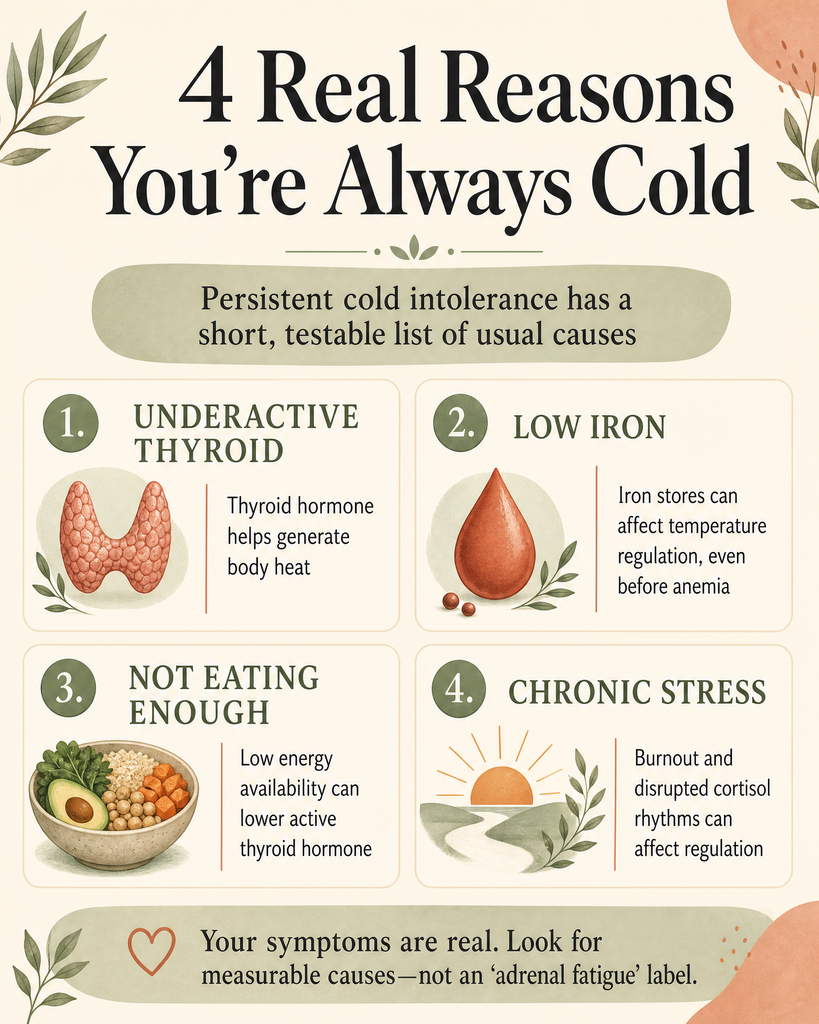
Being cold all the time when everyone else is comfortable isn’t a personality trait. Cold intolerance is a recognized clinical symptom with a short, testable list of usual causes. Thyroid function is the first place to look — reduced thyroid output directly lowers the rate at which your body generates heat. Low iron affects temperature regulation even before hemoglobin drops. In one controlled study, people with mild iron-deficiency anemia warmed more slowly and couldn’t ramp up heat production in the cold the way controls did. Chronically under-eating relative to your activity lowers active thyroid hormone (T3) — the body’s most direct way of turning the thermostat down to conserve energy.
If you’re cold all the time — the one in the office with a space heater in June, or in bed in socks year-round — you’ve probably been told you just run cold. Sometimes that’s true. But persistent cold intolerance is one of the more useful symptoms in medicine, because the short list of causes is almost entirely measurable on a blood panel.
Let’s handle this directly, because it’s the phrase most people arrive with.
“Adrenal fatigue” describes the idea that chronic stress wears out the adrenal glands until they can’t keep up. It’s an intuitive story, and the symptoms people describe under that heading — exhaustion, feeling cold, wired-but-tired, afternoon crashes — are absolutely real.
The label, though, doesn’t hold up. A systematic review examining the published evidence found no substantiation for adrenal fatigue as a distinct medical condition, and no endocrinology society recognizes it.[4] The studies that have found real relationships between cortisol patterns and exhaustion used the framework of burnout and HPA-axis regulation instead.
We’re saying this plainly because it changes what you do next in a useful direction. If you’re cold all the time and exhausted, the answer isn’t an adrenal supplement — it’s finding out which of the measurable causes is yours. That’s a better outcome than a label.
Common signs that come with cold intolerance:
Cold hands and feet that don’t warm up easily Fatigue that sleep doesn’t resolve Hair thinning or brittle nails Constipation Dry skin Afternoon energy crashes Shortness of breath or a racing heart with mild exertion Irregular or absent periods
Underactive thyroid. Cold intolerance is one of the most consistently reported symptoms of hypothyroidism, alongside fatigue and constipation, because thyroid hormone governs your body’s heat-generating capacity.[1]
Low iron — with or without anemia. Iron deficiency impairs thermoregulation. In a controlled study of people with chronic mild iron-deficiency anemia exercising in an 11°C environment, the anemic group showed a slower rise in core temperature and lower skin temperature, and unlike controls, couldn’t increase heat production in response to the cold.[2] Ferritin is the number to check, not just hemoglobin — iron stores fall before anemia shows up.
Not eating enough for your activity level. When energy availability drops, the hypothalamic-pituitary-thyroid axis adapts by lowering T3.[3] This is a normal conservation response, and feeling cold is one of its most reliable outward signs. It shows up in athletes, in people training hard while eating lightly, and in anyone under-fueling without realizing it. Body weight can look completely stable while this is happening.
Chronic stress and disrupted cortisol rhythm. The real version of the “adrenal” story. Cortisol follows a daily curve — highest shortly after waking, tapering through the day. Prolonged stress and burnout are associated with disruptions to that rhythm, which is measurable in ways “adrenal fatigue” is not.[4] Worth noting: genuine adrenal insufficiency is a serious, testable diagnosis, and it is not what’s happening in most people who feel run-down.
Circulation. Cold confined to fingers and toes, especially with color changes from white to blue to red, points toward Raynaud’s rather than a whole-body thermostat problem.
“Your symptoms are real. The label ‘adrenal fatigue’ just points you away from the tests that would actually explain them.”
| Conventional Approach | Root-Cause Approach | |
|---|---|---|
| First step | TSH alone, or told it’s normal to run cold | Full thyroid panel, ferritin and iron studies, B12, plus an honest look at intake versus activity |
| Iron threshold | Only flagged once anemia appears | Ferritin evaluated in its own right, since stores drop first |
| Focus | Rule out disease | Identify which system is conserving energy, and why |
| Timeline | One visit, one test | Weeks to correct stores; longer to rebuild energy availability |
1. Get the right labs, in the right order. A full thyroid panel — not TSH by itself — plus ferritin, iron studies, CBC, B12, and vitamin D. This one step resolves the majority of cold intolerance cases.
2. Eat enough, consistently. If you train hard, skip breakfast, or have been eating lightly for a long stretch, low T3 is a likely driver.[3] Regular meals with adequate carbohydrate and protein signal to your body that conservation mode isn’t necessary. Feeling warmer is often one of the first things people notice.
3. Build iron intake from food and pair it well. Red meat, liver, oysters, lentils, and dark leafy greens. Vitamin C alongside plant sources improves absorption; coffee and tea with meals reduce it. Supplement only with a provider’s guidance and a ferritin result to guide it — iron is not something to guess at.
4. Protect the cortisol rhythm. Morning daylight within an hour of waking, consistent sleep and wake times, and a real wind-down. These aren’t stress-management platitudes — they’re the primary inputs to the circadian system that governs the cortisol curve.
5. Build and use muscle. Muscle is metabolically active tissue and a meaningful contributor to heat production. Two to three resistance sessions a week does more for baseline warmth than most people expect.
New or worsening cold intolerance with fatigue, unexplained weight change, hair loss, or menstrual changes deserves a full workup rather than reassurance. Get evaluated promptly for heavy periods alongside fatigue and breathlessness, fingers or toes turning white or blue with numbness, or dizziness on standing. And if you’ve been told your thyroid is “fine” based on a TSH alone while symptoms persist, it’s reasonable to ask for a fuller picture.
So is adrenal fatigue real or not? The symptoms are real. The diagnosis isn’t recognized, and a systematic review found no evidence supporting it as a condition.[4] What’s real and measurable: thyroid dysfunction, iron deficiency, low energy availability, disrupted cortisol rhythm, and true adrenal insufficiency. Those are worth testing for.
Should I do a salivary cortisol test? Cortisol testing has legitimate clinical uses, but a four-point saliva curve interpreted against “adrenal fatigue” staging isn’t one of them. If adrenal function genuinely needs assessment, there are validated ways to do it.
Can low iron make me cold all the time if I’m not anemic? Yes — this is the most common thing missed. Iron stores deplete well before hemoglobin falls out of range, and thermoregulation is affected along the way.[2] Ask for ferritin specifically.
Do adrenal support supplements help? There’s no good evidence they address the underlying causes, and some contain adrenal glandular material or stimulating herbs that aren’t appropriate for everyone. Money is better spent on the labs.
Being cold all the time is a symptom worth taking seriously — not because it’s dangerous on its own, but because it’s a reliable pointer toward something identifiable.
“Feeling cold is your body telling you it’s conserving. The useful question is what it’s conserving for.”
Whether this is your first visit or your next one, the right panel usually answers this faster than another round of guessing.