
Endometriosis affects an estimated 10% of reproductive-age women worldwide — about 190 million people. The average time to an endometriosis diagnosis is between 4 and 12 years, according to the World Health Organization. A major reason for the delay is now outdated: surgery is no longer required to make the diagnosis. The 2022 European guideline states plainly that laparoscopy is no longer the diagnostic gold standard. Normal imaging does not rule it out. A negative ultrasound or MRI is explicitly described as insufficient to exclude endometriosis, particularly superficial disease.
The road to an endometriosis diagnosis is long, and it’s long for reasons that have very little to do with the person living with it. Most women who eventually get diagnosed describe the same sequence: pain dismissed as normal, a normal-looking scan, a suggestion to wait and see, and years passing.
What’s changed recently is worth knowing. The diagnostic standards shifted, and most patients — and plenty of clinicians — are still operating on the old ones.
Endometriosis is tissue similar to the uterine lining growing outside the uterus, where it responds to hormonal signals, bleeds, and provokes inflammation and scarring.
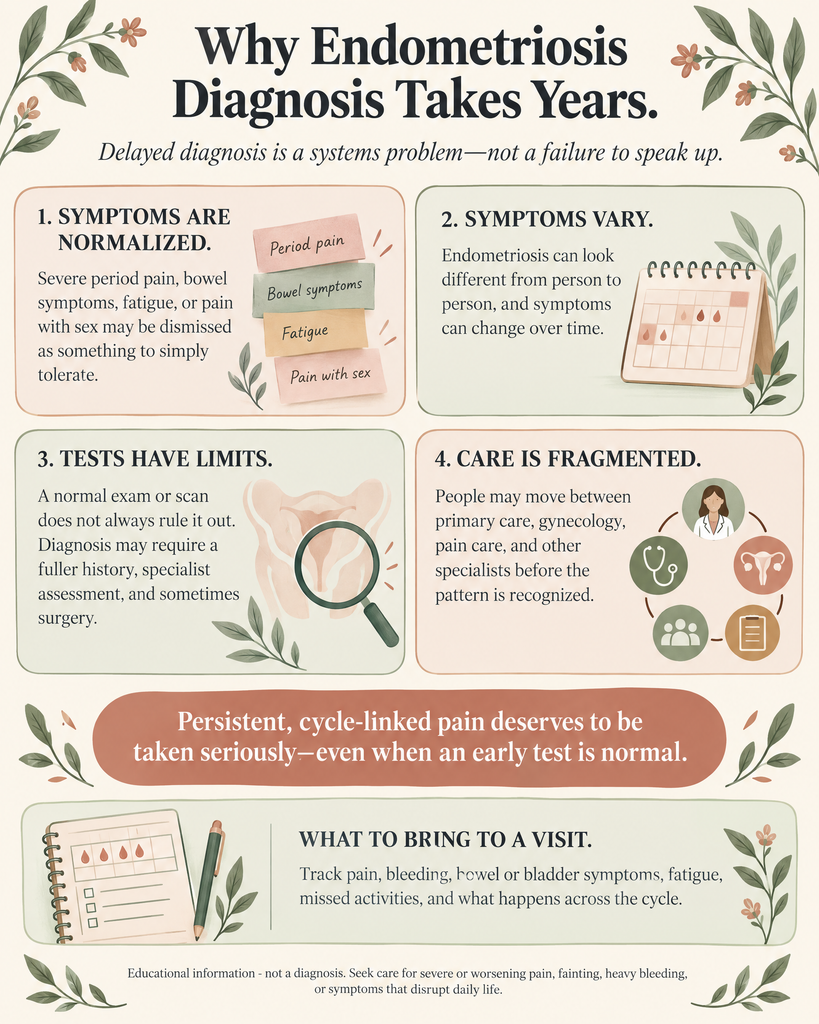
Four things stack up to delay an endometriosis diagnosis.
Pain gets normalized. Period pain is widely treated as a normal cost of menstruating, so severe pain often isn’t flagged as abnormal — by the patient or the clinician. Many women don’t realize their experience differs from their friends’, because nobody compares notes in detail.
Symptoms don’t stay in one specialty. Painful bowel movements, bloating, bladder pain, and fatigue send women to gastroenterology and urology, often with a working diagnosis of IBS or interstitial cystitis, while the cyclical nature of the symptoms goes unconnected.
Normal imaging gets read as reassurance. You may already know that imaging is part of the workup. What’s less well known is the guideline’s explicit caveat: a negative finding does not exclude endometriosis, especially superficial peritoneal disease. A clear scan means the scan was clear, not that nothing is there.
The old surgical standard created a waiting pattern. For years, the only way to confirm endometriosis was laparoscopy, which pushed clinicians toward waiting until symptoms justified surgery. That standard has changed — but practice patterns lag behind guidelines.
Symptoms That Should Prompt an Endometriosis Diagnosis Workup:
Period pain that keeps you home from work or school Pain with deep intercourse Painful bowel movements or pain with urination, especially around your period Spotting for two or more days before your period starts Chronic pelvic pain between periods Bloating that follows a cyclical pattern Cyclical shoulder-tip pain Difficulty conceiving Fatigue that tracks with your cycle
The 2022 ESHRE guideline is direct: “Laparoscopy is no longer the diagnostic gold standard and it is now only recommended in patients with negative imaging results and/or where empirical treatment was unsuccessful or inappropriate.”
In practice, this means an endometriosis diagnosis can be made clinically — from the symptom pattern, exam, and imaging — without waiting for surgery. It also means that if you’ve been told you can’t know without an operation, that reflects an older standard.
Two details worth carrying into an appointment: clinical examination has low diagnostic accuracy on its own, so a normal pelvic exam doesn’t rule it out either. And premenstrual spotting deserves specific mention — in women evaluated for infertility, spotting for two or more days before a period was associated with endometriosis in 89% of cases, compared with 26% of those without it.
“A clear ultrasound rules out what the ultrasound can see. It does not rule out endometriosis.”
| Conventional Approach | Root-Cause Approach | |
|---|---|---|
| First step | Manage the pain; wait and see | Map the symptom pattern against the cycle in detail |
| Imaging | A normal scan ends the conversation | A normal scan narrows it; the question stays open |
| Diagnosis | Often waits for surgical confirmation | Clinical diagnosis per current guidelines, with surgery when indicated |
| Alongside | Symptom suppression alone | Inflammation, gut, pelvic floor, nutrition, and sleep addressed in parallel |
| Timeline | Years | Pattern can be mapped in two to three cycles |
A note on where we differ: conventional first-line management is usually hormonal suppression of the cycle. Our approach starts from understanding what your cycle is doing and lowering the inflammatory and pain-amplifying load around it. Any medication decision is yours to make with your provider — we’d simply rather it come after the picture is clear, not instead of it.
1. A detailed cycle-mapped symptom log. Two to three cycles of daily notes — pain level, location, bowel and bladder symptoms, spotting, fatigue, and where you are in your cycle. This is the single most useful thing you can bring, and it frequently reveals a cyclical pattern that scattered appointments never connected.
2. The symptoms people don’t think to mention. Painful bowel movements, pain with urination, pain with deep intercourse, cyclical shoulder-tip pain, and premenstrual spotting are all on the guideline’s list of suggestive symptoms. Many women never mention them because they don’t seem gynecological.
3. Imaging read by someone looking for it. Endometriosis imaging is operator-dependent. A scan performed by a sonographer experienced in looking for deep endometriosis is a different test than a routine pelvic ultrasound.
4. The inflammatory load. Dietary fat patterns show a consistent relationship with endometriosis risk in large cohort data: in the Nurses’ Health Study II, women with the highest omega-3 intake had a 22% lower likelihood of diagnosis, while those in the highest trans fat quintile had a 48% higher risk. A randomized trial of fish oil supplementation in young women with endometriosis found reduced pain. Diet isn’t a treatment on its own — it’s a lever worth pulling alongside everything else.
5. The pelvic floor. Chronic pelvic pain commonly produces protective pelvic floor muscle tension, which then becomes its own pain generator. Pelvic floor physical therapy addresses a layer that hormonal management doesn’t reach.
6. Gut and bladder overlap. Because symptoms frequently overlap with IBS and bladder conditions, these deserve evaluation alongside — not instead of — the endometriosis question.
7. Fertility timing. Among women experiencing infertility, as many as 25% to 50% have endometriosis. If you’re trying to conceive, that changes the urgency of the workup and is worth stating explicitly to your provider.
Book a visit for period pain that interferes with work, school, or daily life; pain with intercourse; painful bowel movements or urination around your period; spotting for two or more days before your period; chronic pelvic pain; or difficulty conceiving after 12 months of trying — six months if you’re 35 or older.
Seek care promptly for sudden severe pelvic pain, bleeding heavy enough to cause dizziness or soak through a pad every hour, fever with pelvic pain, or inability to urinate or have a bowel movement.
Do I need surgery for an endometriosis diagnosis? Not under current guidelines. Laparoscopy is now recommended mainly when imaging is negative and initial treatment hasn’t worked or isn’t appropriate. Diagnosis can be made clinically.
My ultrasound was normal — does that mean I don’t have endometriosis? No. The guideline states directly that negative imaging does not exclude endometriosis, particularly superficial peritoneal disease. A normal scan is one piece of information, not a conclusion.
Is there a cure for endometriosis? No — the World Health Organization is clear that there’s currently no cure. Symptoms can be managed, often substantially, and getting the diagnosis named is what makes a real management plan possible.
How bad does period pain have to be before it’s worth asking about? If pain keeps you home, has you planning your month around it, or doesn’t respond to the usual measures, that’s enough. You don’t need to rank your pain against anyone else’s to justify asking the question.
The years-long delay to an endometriosis diagnosis isn’t a reflection of patients failing to speak up. It’s a system issue — and parts of it have genuinely changed. Surgery is no longer the gate, and normal imaging was never the final word.
“Bring three cycles of notes and the symptoms you assumed weren’t relevant. That’s often where the answer lives.”
Whether this is your first visit or your next one, mapping the pattern is the fastest way to move from “unexplained” to a plan.
Are You Struggling With Painful Periods or Suspected Endometriosis? Our team would love to meet with you.
Click this link to schedule a time to meet with our team.