A gassy baby isn’t a malfunction. A brand-new digestive system produces a lot of it, and babies haven’t yet developed the coordination to move it through efficiently. How your baby feeds matters more than what you eat. Air swallowed during feeding is one of the biggest and most fixable contributors. For breastfed babies, the probiotic Lactobacillus reuteri DSM 17938 has the strongest evidence of anything on the shelf — meta-analyses show meaningfully reduced crying time.The gas drops most parents reach for first have been tested repeatedly against placebo and didn’t outperform it.
Straining, grunting, pulling the legs up, going red in the face, and then the enormous relief of one small toot. If your baby seems to spend half the day working on it, you are not imagining it — and you are not doing anything wrong.
Three things overlap in the first few months.
Your baby’s gut is being colonized for the first time. Fermentation by a brand-new microbiome produces gas as a normal byproduct.
Their gut motility is still maturing, so gas moves slowly and unevenly.
And they don’t yet have the abdominal coordination to push it out — which is why so much of the straining and grunting is effort, not pain. Much of what looks like distress is a baby learning to do something that will eventually be automatic.
Common signs:
Pulling the knees toward the chest, grunting and straining with a red-faced effort, arching the back during or after feeds, having a firm or full-feeling belly, squirming and fussiness that worsen in the evening, and experiencing clear relief after passing gas or having a bowel movement.
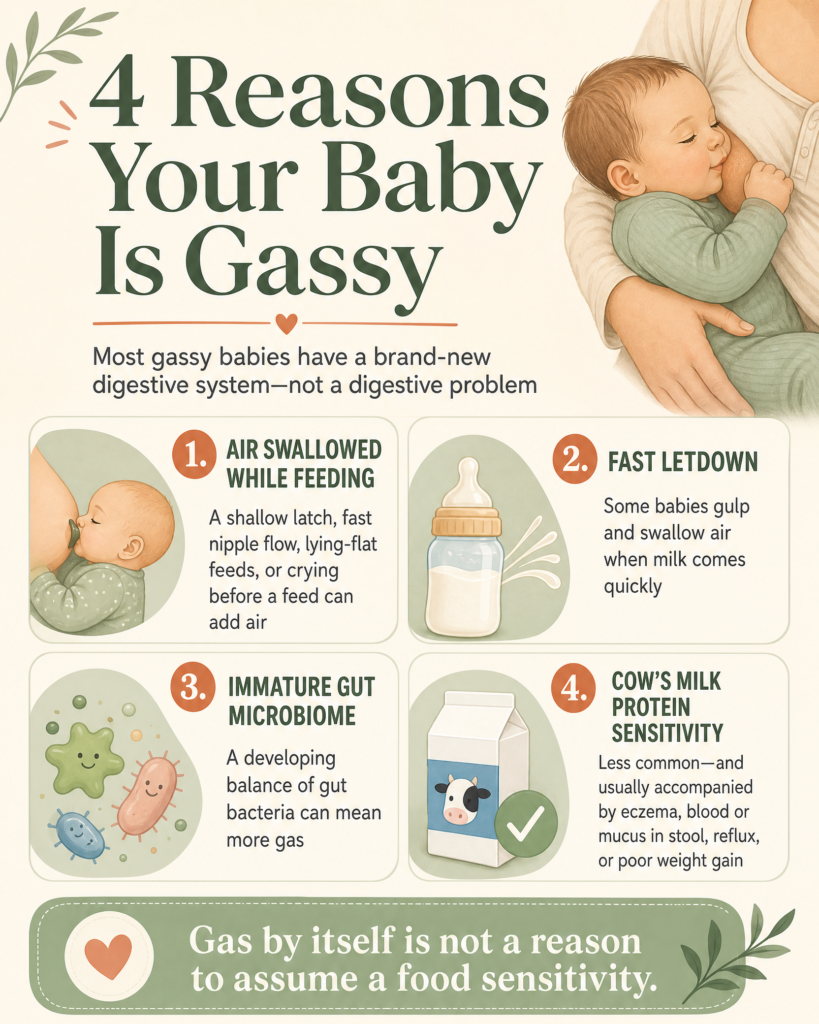
Air swallowed while feeding. The most common and most correctable cause. A shallow latch, a bottle nipple flowing faster than your baby can manage, feeding while lying flat, or starting a feed after your baby is already crying hard all bring extra air in.
An abundant, fast letdown. A generous milk supply is a wonderful thing — and some babies need a little help managing the pace of it. When milk comes quickly, a baby may gulp, swallow air, and take in a large volume of foremilk in a short window, which can mean more gas until they grow into the flow.
An immature gut microbiome. Colonization is still underway, and the balance of bacteria influences how much gas gets produced. Research has found differences in gut bacterial patterns between colicky and non-colicky infants, which is part of why targeted probiotics have been studied here at all.[2]
Cow’s milk protein sensitivity. A smaller subset of babies. This one rarely shows up as gas alone — it usually travels with eczema, blood or mucus in the stool, significant reflux, or poor weight gain. Gas by itself is not a reason to assume it.
“Most gassy babies don’t have a digestive problem. They have a brand-new digestive system, and a bit of trapped air.”
| Conventional Approach | Root-Cause Approach | |
|---|---|---|
| First step | Gas drops | Assess latch, feeding position, and pacing |
| Focus | Break up the bubbles | Reduce air intake and help gas move through |
| Diet | Broad maternal elimination | Targeted, only when other signs point to a real sensitivity |
| Timeline | Little measurable change | Days to weeks, and most babies outgrow it by 3–4 months |
1. Start with the latch and the feeding position. Feed with your baby’s head higher than their stomach, and catch feeding cues before they escalate to crying — a frantic baby swallows far more air. If breastfeeding feels painful or you hear clicking, a lactation consultant can often resolve it in one visit. For bottles, use the slowest flow nipple your baby will tolerate and keep the nipple full of milk.
2. Burp more often, and change positions. Mid-feed and after, and try more than one hold — over the shoulder, seated upright with support under the chin, and lying across your lap. Different positions release different pockets of air.
3. Move the gas along. Bicycle legs, gentle knees-to-chest, and clockwise abdominal massage following the path of the colon. Supervised tummy time between feeds provides gentle pressure that helps too.
4. Consider L. reuteri DSM 17938. This is the one supplement with real trial data behind it. A meta-analysis of six randomized controlled trials found it reduced daily crying time by roughly 43 minutes at two weeks and 46 minutes at three weeks compared with placebo, with no effect on growth and no serious adverse events.[1] The benefit is clearest in breastfed babies — separate analysis found exclusively breastfed infants had the largest reduction in crying.[2] Talk with your pediatrician before starting anything in a newborn.
5. Consider neurologically-focused chiropractic care. Birth is a physical event, and tension through the neck, jaw, and diaphragm can affect both how a baby latches and how comfortably they digest. A meta-analysis of manual therapies for infant crying found chiropractic care produced a significant improvement in crying time.[4] In a Danish randomized controlled trial of 185 infants, 63% of babies receiving chiropractic care achieved a clinically important reduction of at least an hour of crying per day, compared with 47% of controls.[5] An earlier randomized trial reported a substantially higher likelihood of improvement in treated infants.[6] Look for a provider trained specifically in pediatric and infant care.
6. If you’re breastfeeding, don’t overhaul your diet first. Breast milk is the best thing you can give your baby, and the impulse to start cutting foods is usually misplaced. If there’s a genuine reason to suspect cow’s milk protein sensitivity — eczema, blood or mucus in the stool, poor weight gain — a structured trial of removing dairy for two to three weeks, with guidance, is reasonable. Otherwise, keep eating well.
Call your pediatrician for poor weight gain or a drop in wet diapers, blood or mucus in the stool, forceful or projectile vomiting, fever in an infant under three months, a hard or distended belly, or inconsolable crying that feels different from their usual fussiness.
And if the crying is wearing you down — reach out anyway. Prolonged infant crying is genuinely hard on parents, and support for you is a legitimate reason to be seen.
Do gas drops work? The evidence says no. A randomized, double-blind, placebo-controlled crossover trial in 83 infants found simethicone was no more effective than placebo, and a systematic review of three randomized trials reached the same conclusion.[3] Parents perceive improvement on both — which mostly reflects how much babies vary hour to hour.
Does what I eat make my baby gassy? For most mothers, no. The idea that broccoli, beans, or spicy food pass through and cause gas isn’t well supported, and gas doesn’t transfer into milk. Cow’s milk protein is the exception worth considering, and only when other signs point that way.
Is gripe water safe? Products vary widely and aren’t standardized. Anything containing alcohol should never be given to an infant. Check with your pediatrician before using any of them.
When does a gassy baby get better? Most babies improve substantially between three and four months as gut motility matures and they learn to coordinate passing gas. Knowing there’s an end date makes the middle of it easier.
A gassy baby is one of the most common things new parents worry about, and one of the most fixable. Usually it’s mechanics — how milk is going in, how air is coming out.
“Before you change your diet or theirs, change how they’re feeding. That’s where most of the answer is.”
Whether this is your first visit or your next one, we’d rather look at a feed with you than have you white-knuckle it at 2 a.m.