
Growing pains in kids follow a script most parents recognize — reported in up to a third of children, and by some estimates up to 37% of kids aged 3 to 12. Despite the name, growing pains in kids aren’t Growth itself isn’t painful, and the pains don’t line up with growth spurts. The pattern is what defines them: both legs, late afternoon or evening, gone by morning, and a completely normal exam in between. The features that break that pattern — one leg, pain that’s still there in the morning, a limp, swelling, or fever — are the ones that need a closer look.
Growing pains in kids follow a script most parents recognize. Your child is fine all day. Then, at bedtime, their legs ache badly enough that they’re crying, and you’re rubbing their calves at 9 p.m. wondering whether this is normal. By breakfast they’ve forgotten it happened and are running around the kitchen.
That pattern — and especially the complete recovery by morning — is reassuring. It’s when the pattern breaks that it’s worth paying attention.
The name is a holdover, and it’s misleading. Growing pains in kids are described in the medical literature as a benign, noninflammatory pain syndrome of early childhood. Growth plates aren’t the source, and the pain doesn’t correspond to periods of rapid growth.
The leading explanation is that affected children have a lower pain threshold — in other words, the same ordinary muscle fatigue that a different child wouldn’t register registers as real pain. Supporting factors described in the research include reduced bone strength, mechanical contributors like joint hypermobility and flat feet, and emotional or family stress.
That doesn’t make the pain imaginary. The pain is real. What it means is that the target for treatment is comfort, mechanics, and pattern — not a structural injury that needs fixing.
The classic pattern of growing pains in kids looks like:
Both legs, not one Muscles — calves, shins, thighs, behind the knees — rather than joints Late afternoon, evening, or waking the child at night Completely gone by morning, with no limp A normal physical exam No swelling, redness, warmth, or fever A child who runs and plays normally the next day
A lower pain threshold. The most supported explanation. Some children simply register musculoskeletal discomfort more intensely, and the research describes this as similar in character to other pain-amplification patterns.
Mechanics and activity load. Joint hypermobility and flat feet show up repeatedly in the literature. In practice, we also see leg aches spike when a child’s activity jumps suddenly — a new sport season, a day at an amusement park, a growth in screen-free running-around time.
Low vitamin D. There’s an association in the research between low vitamin D and childhood limb pain, and some evidence that correcting a deficiency helps. The honest framing: it’s worth testing if there’s reason to suspect it, not worth assuming.
Sleep and stress. Pain perception rises when sleep is short and when a child is anxious. Evening is also when a tired child has the least capacity to cope with a sensation they’d shrug off at noon.
“Growing pains are a pattern, not a diagnosis of exclusion you arrive at by hoping. When the pattern breaks, look.”
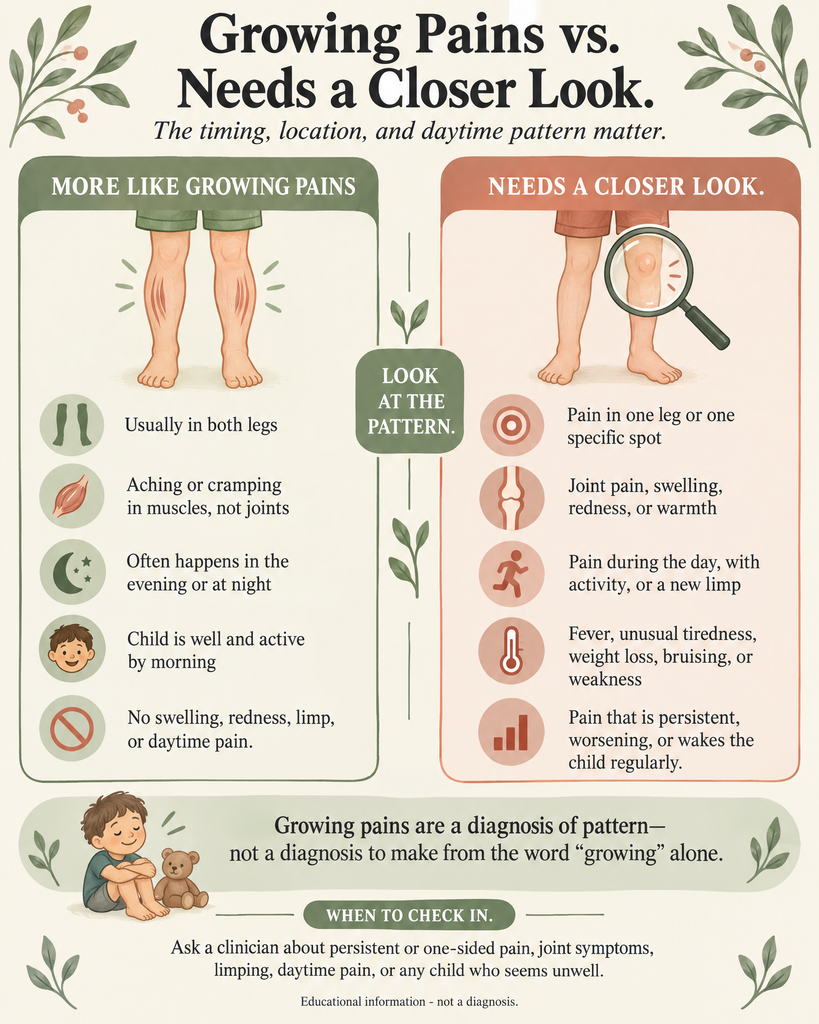
These are the features that don’t fit growing pains, and each one has a reason behind it:
One leg only, or pain your child can point to precisely. Growing pains are diffuse and bilateral. A child who can put a finger on the exact spot is describing something specific.
Pain that’s still there in the morning, or morning stiffness. Growing pains clear overnight. Morning stiffness is a hallmark of inflammatory joint disease like juvenile idiopathic arthritis.
A limp, or refusing to bear weight. Never part of growing pains in kids, and always worth prompt evaluation.
Swelling, redness, or warmth over a joint. Points toward inflammation or infection rather than muscle ache.
Fever, weight loss, fatigue, or looking unwell. Systemic symptoms alongside bone pain need evaluation without delay.
Pain that’s steadily worsening over weeks, or consistently waking your child at the same spot. Progressive, localized bone pain is the pattern that warrants imaging.
Conditions that need to be distinguished from growing pains in kids include juvenile idiopathic arthritis, bone or joint infection, hip conditions like slipped capital femoral epiphysis and Perthes disease, sickle cell disease, vitamin D deficiency, and — rarely — malignancy. Most children with leg aches have none of these. The point of knowing the list is that the distinguishing features are straightforward.
One practical note from pediatric orthopedics: a child who complains of knee pain should always have their hip examined, because hip problems commonly refer pain to the knee.
| Conventional Approach | Root-Cause Approach | |
|---|---|---|
| First step | “It’s just growing pains” | Confirm the pattern actually fits growing pains |
| Assessment | Reassurance only | Full exam including hips, plus activity, footwear, and sleep review |
| Focus | Wait for it to pass | Comfort measures now, and address mechanics and sleep |
| Timeline | Months to years | Comfort improves quickly; pattern usually fades with age |
1. Keep a two-week pattern diary. Note which leg, what time, how long, whether it was gone by morning, and what the day’s activity looked like. This single sheet of paper answers most of the “is this normal?” question and is genuinely useful at a visit.
2. Use warmth and massage in the evening. A warm bath before bed, a heating pad on a low setting, and calf and thigh massage are the best-supported comfort measures. They also give your child a predictable, soothing response to look forward to, which matters more than it sounds.
3. Stretch the calves and hamstrings daily. A short routine before bed — and ideally again in the morning — is low-effort and widely recommended for this pattern.
4. Look at footwear and foot posture. Flat feet and worn-out shoes are mechanical contributors. Supportive shoes that fit, replaced when they break down, are worth more than most parents expect.
5. Pace big activity jumps. If aches follow particularly active days, that’s useful information rather than a reason to restrict activity. Build up gradually, hydrate, and expect a rougher evening after a big day.
6. Protect sleep. A well-slept child tolerates minor aches far better. Since growing pains cluster in the evening, a calm, consistent bedtime routine does double duty here.
7. Ask about vitamin D if there’s reason to. Limited sun exposure, a restricted diet, or darker skin all raise the likelihood of deficiency. It’s a simple test, and worth doing based on a reason rather than reflex.
Book a visit for pain in one leg only, pain your child can localize to a specific spot, morning stiffness, a limp, joint swelling or redness, or pain that’s getting worse over weeks.
Seek care promptly for fever with leg pain, refusal to bear weight, significant swelling or warmth over a joint, unexplained weight loss, unusual bruising or paleness, night pain that keeps worsening, or any leg pain following a significant injury.
Are growing pains in kids caused by growing? No. Growth isn’t painful, and the pains don’t track with growth spurts. The name has stuck, but the mechanism is better explained by a lower pain threshold plus mechanical and activity factors.
At what age do growing pains happen? Most commonly in early childhood through the preteen years, with much of the research centering on ages 3 to 12. Leg pain starting in adolescence deserves more scrutiny before being labeled growing pains.
Should my child take pain medication? For occasional evening aches, warmth, massage, and stretching usually do the job. If you’re reaching for medication regularly, that’s a reason to be evaluated rather than to keep medicating — talk with your pediatrician about what’s appropriate for your child.
Can growing pains wake a child at night? Yes, that’s part of the classic picture. The distinguishing detail is that the pain is gone by morning. Pain that’s still present at breakfast, or that wakes your child in the same precise spot night after night, is a different story.
Growing pains in kids are common and benign, and most evening leg aches are exactly what they look like. The value in knowing the pattern is that it tells you clearly when something doesn’t fit.
“Both legs, evening only, gone by morning, normal exam. Break any one of those and it’s worth a look.”
Whether this is your first visit or your next one, bring the two-week diary. It usually answers the question faster than anything else.
Are growing pains in kids caused by growing? Our team would love to meet with you.
Click this link to schedule a time to meet with our team.