Infant colic affects an estimated 1 in 5 babies, typically peaking around 6 weeks.
“Colic” is a description of symptoms, not a diagnosis — it doesn’t explain why it’s happening.
Gut immaturity, feeding technique, and maternal diet (if breastfeeding) can all play a role.
Most colic resolves by 3–4 months, but there’s still a lot you can try in the meantime.
If you’ve been told colic is just something you have to “wait out,” I understand the exhaustion behind that advice — but I don’t think it’s the whole story. Crying is communication, and a young, immature gut is one of the most common reasons babies struggle in those early months.
What Is Infant Colic, Really?
Colic is typically defined as crying for more than 3 hours a day, more than 3 days a week, for more than 3 weeks, in an otherwise healthy baby. It’s a pattern, not a disease — which means the real question is what’s driving the pattern.
Common signs include:
Intense crying, often in the evening
Clenched fists, arched back, or pulled-up legs
Gassiness or a hard, distended belly
Crying that’s hard to soothe with typical comfort measures
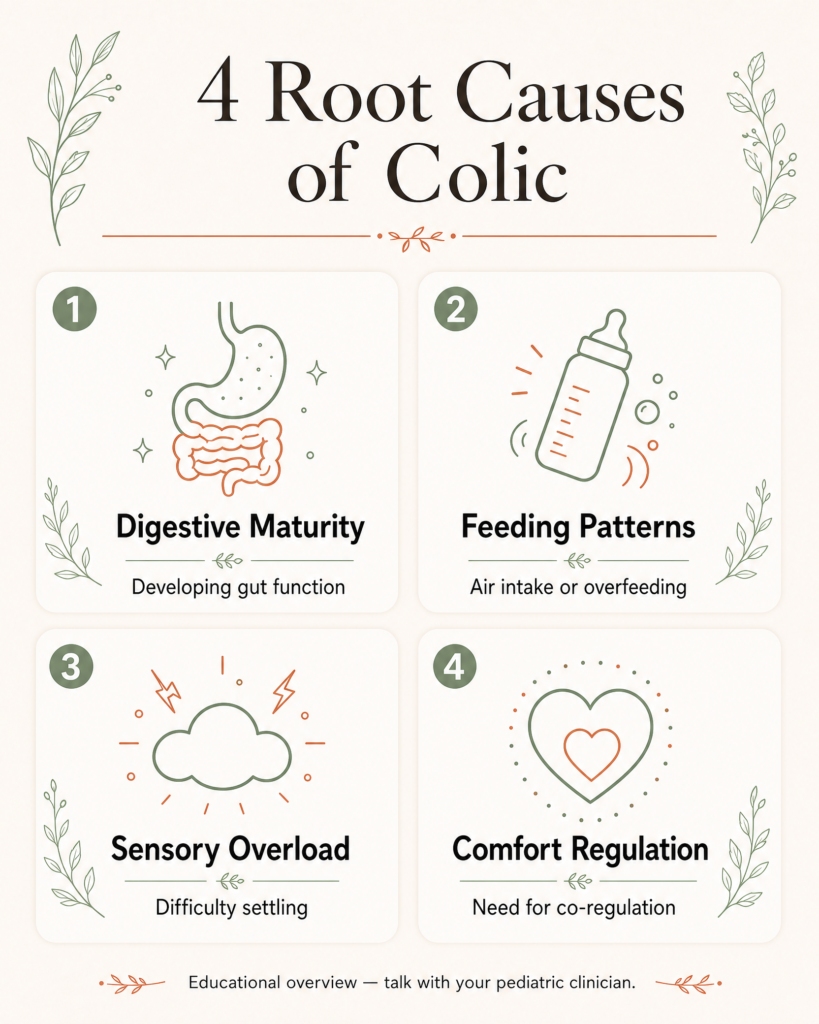
The Root Causes Behind Infant Colic
Immature gut motility and microbiome — a newborn’s gut is still developing, which can cause discomfort with normal digestion.[2]
Feeding technique — swallowed air from a fast flow bottle nipple or a shallow latch can trap gas.
Food sensitivity via breastmilk or formula — dairy protein passed through breastmilk, or a formula intolerance, is a documented trigger in some infants.[3]
Under-supported nervous system regulation — an overstimulated or overtired baby can present with colic-like crying.
Colic isn’t a life sentence, and it’s not ‘just something babies do.’ It’s usually a gut that needs a little more support while it matures.
Infant Colic: What's Actually Behind the Crying 2
Conventional vs. Root-Cause Approach
Conventional Approach
Root-Cause Approach
First step
“Wait it out” reassurance
Feeding, gut, and maternal-diet review
Focus
Time-limited symptom
Comfort now + addressing contributing factors
Timeline
Resolves ~3–4 months regardless
Often noticeable improvement within 1–2 weeks of changes
5 Natural Approaches for Infant Colic
1. Review feeding position and pace. Paced bottle feeding and an upright feeding position can reduce swallowed air significantly.
2. Consider an infant probiotic.Lactobacillus reuteri has research support for reducing crying time in colicky, breastfed infants.[4]
3. If breastfeeding, try a short dairy elimination. Removing dairy from the nursing parent’s diet for 1–2 weeks can be telling if a protein sensitivity is contributing.[3]
4. Use gentle motion and warmth. A warm compress on the belly or gentle bicycle-leg movements can help move trapped gas.
5. Don’t underestimate overstimulation. A calmer, dimmer evening routine can reduce crying episodes tied to an overtired nervous system.
When to See a Provider About Infant Colic
If crying is accompanied by poor weight gain, fever, vomiting, or blood in the stool, this isn’t “just colic” — get it evaluated promptly.
FAQ
Is colic caused by something I did wrong? No. Colic is common and not a reflection of parenting — it’s a developmental and digestive pattern.
Does gripe water work? Evidence is mixed; some parents find it helpful, but it’s not a substitute for addressing feeding or diet triggers if those are present.
When does infant colic usually end? Most cases resolve by 3–4 months as the gut matures.
Final Thoughts
Infant colic is exhausting, and “it’ll pass” isn’t much comfort at 2 a.m. Looking at feeding technique, gut support, and possible dietary triggers gives you something to actually do while your baby’s gut catches up.
Is your baby struggling with colic and frequent crying? Our team would love to meet with you.
Click this link to schedule a time to meet with our team
Savino F, et al., “454 Pyrosequencing Analysis on Faecal Samples from a Randomized DBPC Trial of Colicky Infants Treated with Lactobacillus reuteri DSM 17938,” PLoS One, 2013. https://www.ncbi.nlm.nih.gov/pmc/articles/PMC3585302/