
A lingering cough in kids usually takes longer to clear than parents expect. Studies of young children with acute cough found about half recover by day 10 and around 90% by three weeks — meaning roughly 1 in 10 is still coughing into the third and fourth week.
In children, “chronic cough” has a specific definition: more than four weeks. That’s the line where investigation becomes worthwhile. Whether the cough is wet or dry is the most useful thing you can tell us.
A wet cough lasting more than four weeks has a specific and treatable cause that’s commonly mistaken for asthma. Reflux gets blamed far more often than it should: guidelines recommend against treating for reflux in a child with chronic cough who has no digestive symptoms.
The cold cleared up three weeks ago. Everyone else moved on. Your child is still coughing — mostly at night, mostly dry, and you’re starting to wonder whether waiting is the right call or whether you’re missing something.
A cough after a viral illness isn’t the virus hanging around. It’s the aftermath.
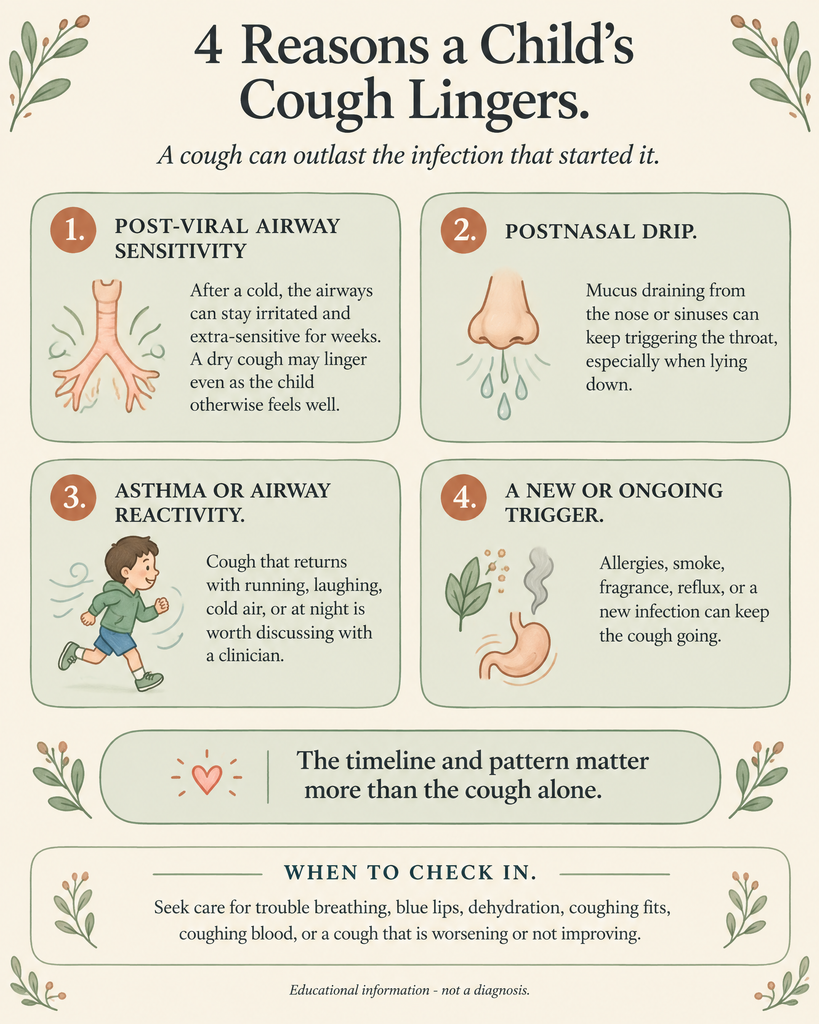
Viral infection inflames the lining of the airway and temporarily turns up the sensitivity of the cough receptors. Even after the virus is gone, that heightened sensitivity takes time to settle — so ordinary triggers like cold air, laughing, or lying down still set off a cough.
The numbers are reassuring, but slower than most parents are told. In prospective studies of young children with acute cough, roughly half had recovered by 10 days and about 90% by three weeks — which leaves about 10% still coughing in weeks three and four. A lingering cough in kids after a simple head cold usually stops by 10 to 14 days.
The typical post-viral pattern:
Dry rather than wet Worse at night and with activity No fever Gradually improving, even if slowly A child who is otherwise acting completely normally
A wet cough that’s lasted more than four weeks. This is the one worth knowing about. Protracted bacterial bronchitis is a frequent but often underdiagnosed cause of chronic wet cough in young children, and it is commonly mistaken for asthma. It’s characterised by a wet cough lasting more than four weeks that resolves with an appropriate course of antibiotics from your provider. The reason to catch it: left untreated, it can progress to lasting airway damage. If your child’s cough sounds rattly or productive and it’s been over a month, say so specifically at the visit.
Cough-variant asthma. Some children with asthma cough without ever wheezing audibly. The clues are a dry cough that’s clearly worse at night, worse with running or cold air, and often worse during allergy season — in a child with eczema, allergies, or a family history of asthma.
Ongoing allergic inflammation and postnasal drip. Drainage from an inflamed nose irritates the throat continuously. This one tends to travel with congestion, throat clearing, and mouth breathing, and it doesn’t resolve until the nasal piece does.
Back-to-back infections. Sometimes there is no single lingering cough — there are three colds in a row with barely a gap. School-age children typically have upper respiratory infections with cough around seven to ten times a year. A few clear days in between is the clue.
Reflux — less often than you’d think. Guidelines recommend that reflux treatment not be used for chronic cough in children without digestive features such as recurrent regurgitation or heartburn. It’s a real cause in some children; it’s just over-attributed in most.
“The two questions that matter most: how many weeks, and is it wet or dry?”
| Conventional Approach | Root-Cause Approach | |
|---|---|---|
| First step | Cough syrup, or wait it out indefinitely | Establish duration and whether it’s wet or dry |
| Four-week mark | Often still watching | The point at which chronic cough is investigated |
| Wet cough | Assumed viral or treated as asthma | Considered for protracted bacterial bronchitis |
| Reflux | Frequently treated empirically | Only considered when digestive symptoms are present |
1. Write down when it started. The single most useful thing you can do. Four weeks is a real clinical threshold in children, and parents routinely underestimate elapsed time when they’re in the middle of it.
2. Listen to the character of the cough and report it accurately. Wet and rattly, or dry and hacking? Is it worse at night, with exercise, or after lying down? This detail genuinely changes what we look for.
3. Support the airway while it settles. Humidified air, adequate fluids, and a cool-mist humidifier in the bedroom. For children over one year, a spoonful of honey before bed has reasonable evidence for nighttime cough — never for infants under one.
4. Remove the irritants you control. No smoking anywhere in the home or car, including on clothing. An airway that’s already sensitized, as it is with a lingering cough in kids, reacts to all of it.
5. Treat the nose if the nose is involved. If there’s congestion and throat clearing alongside the cough, saline rinses and allergen reduction in the bedroom address the drainage feeding it.
6. Don’t reach for over-the-counter cough and cold medicines. They aren’t recommended for young children, carry real risks, and don’t shorten the course. Time and airway support are what actually work here.
Seek care promptly for fast or labored breathing, working hard to breathe, chest retractions, blue color around the lips, or a child who seems unwell rather than simply coughing.
Book a visit for cough lasting more than four weeks; any wet or productive cough that’s gone past a month; cough with fever returning after an initial recovery; cough with weight loss, night sweats, or poor growth; coughing with feeding; a cough that began suddenly during eating or playing with small objects; or coughing up blood.
Also worth raising: cough that consistently wakes your child, or that limits running and play. A cough shouldn’t be shaping a child’s daily life.
How long is too long for a lingering cough in kids? Four weeks is the threshold for chronic cough in children and the point at which evaluation is recommended. Before that, if your child is otherwise well and improving, watching is reasonable — though a check-in around the 10 to 14 day mark is sensible if there’s been no break at all.
Does a wet cough mean antibiotics? Not automatically, and not for an ordinary cold. But a wet cough persisting beyond four weeks is exactly the picture of protracted bacterial bronchitis, which does respond to a targeted course prescribed by your provider. That’s a visit, not a guess.
Could it be asthma if there’s no wheezing? Yes. Cough-variant asthma presents as cough alone. A pattern of night and exercise cough in a child with eczema or allergies is worth evaluating.
Is it worth getting a chest X-ray? Sometimes, and that’s a decision for your provider based on the exam and the specific features of the cough — not something to request or rule out in advance.
A lingering cough in kids is usually the tail end of something ordinary, and it does resolve. The value of knowing the four-week rule is that it tells you when patience stops being the right answer.
“A dry cough that’s slowly improving is usually time. A wet cough at week five is a visit.”
Whether this is your first visit or your next one, bring the start date and the character of the cough. Those two facts do most of the work.
Is Your Child’s Cough Still Not Going Away? Our team would love to meet with you.
Click this link to schedule a time to meet with our team.