
Normal bloodwork but still feel off? You’re not imagining it. ‘Normal’ on a lab report is a statistical statement, not a verdict on how you feel. Reference ranges are built from the middle 95% of a reference population. By that definition alone, 5% of perfectly healthy people get flagged as abnormal — and on a 20-test panel, roughly 64% of healthy people will have at least one “abnormal” result. A standard annual panel often leaves out the tests that explain fatigue: ferritin, a full thyroid panel, vitamin D, B12, and markers of blood sugar regulation. Thresholds move. In September 2026, the American Society of Hematology raised the ferritin cutoffs for diagnosing iron deficiency — meaning results previously called normal may not be.
Normal bloodwork but still feel off is one of the most common things we hear at a first visit. You went in because you’re exhausted, foggy, cold, or just not yourself. The results came back, and the message was some version of “everything looks fine.”
Both things can be true. You can have normal bloodwork but still feel off, and neither fact cancels the other out. Understanding why requires knowing what “normal” actually means on a lab report — which almost nobody is told.
Here’s how a reference range gets made. A lab tests a group of at least 120 people considered healthy. The lowest 2.5% and highest 2.5% of results are trimmed off, and the middle 95% becomes the “normal” range.
Two consequences follow, and they’re both significant.
First, 5% of healthy people fall outside the range by definition. As one clinical review in the Journal of the American Board of Family Medicine put it, with a panel of 20 tests, 64.2% of “normal” patients will have at least one “abnormal” result. Abnormal doesn’t automatically mean sick.
Second — and this is the part that matters when you feel unwell — the reverse is also true. A result can sit comfortably inside a population range and still be wrong for you. The range describes a population. It was never designed to describe your optimal.
You may already know the concept of “normal versus optimal.” What’s worth adding is the honest caveat: standardized “optimal” ranges don’t officially exist for most markers. That’s precisely why results have to be read against your symptoms and your own trend over time, rather than swapped for a stricter cutoff someone made up.
Common experiences that come with normal labs:
Fatigue that sleep doesn’t fix Brain fog or trouble concentrating Feeling cold when others are comfortable Hair shedding or brittle nails Low mood or flat motivation Afternoon energy crashes Exercise that feels harder than it should
Ferritin. A complete blood count detects anemia. It doesn’t measure iron stores, which fall first — often long before hemoglobin moves. This is the single most common gap we see. And the goalposts just moved: in September 2026, the American Society of Hematology set ferritin thresholds at 30 ng/mL or below for adults and menstruating individuals, and 50 ng/mL or below for higher-risk groups such as those with heavy menstrual bleeding. The guideline notes that up to 70% of cases have been missed in high-risk populations. Iron deficiency does not require anemia to be real.
A full thyroid picture. Many panels check TSH alone. Subclinical hypothyroidism — an elevated TSH with a normal T4 — affects an estimated 3% to 15% of the population and is more common in women. Thyroid antibodies, which indicate autoimmune thyroid disease, aren’t on a standard panel at all.
Blood sugar regulation. Fasting glucose is usually included; A1C often isn’t, and fasting insulin almost never is. Insulin resistance can develop for years while fasting glucose stays in range.
Vitamin D and B12. Both are common contributors to fatigue and low mood, and neither is part of a routine metabolic panel.
Timing and context. Several markers vary by time of day, by cycle day, and by how recently you ate. A testosterone or cortisol level drawn in the afternoon, or a progesterone level drawn on the wrong cycle day, can be misleading even when the lab runs perfectly.
“Your results sitting inside a population range tells you that you’re not an outlier. It doesn’t tell you that you’re well.”
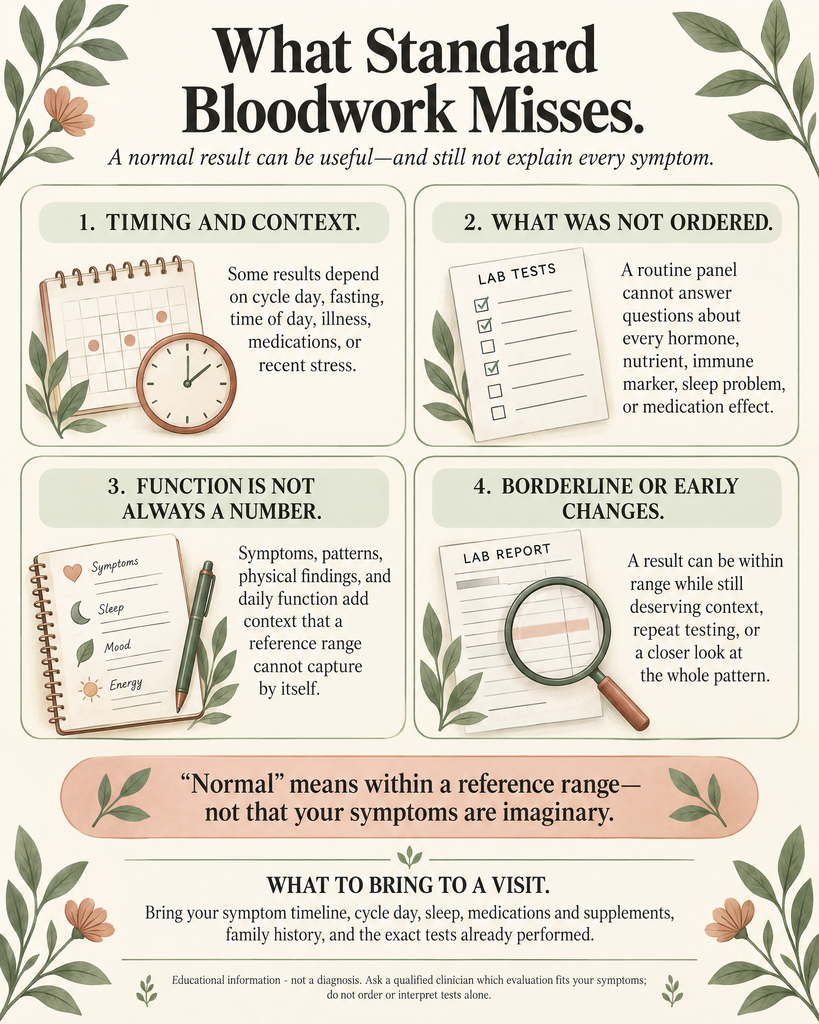
| Conventional Approach | Root-Cause Approach | |
|---|---|---|
| Panel | CBC, metabolic panel, lipids, often TSH alone | Adds ferritin, full thyroid with antibodies, vitamin D, B12, A1C and fasting insulin |
| Interpretation | In range or out of range | Where you sit in the range, your trend over time, and your symptoms |
| Iron | Flagged only once anemia appears | Ferritin assessed in its own right, against current thresholds |
| Next step | “Everything looks fine” | Match the pattern to the symptoms, then re-test deliberately |
1. Get your actual numbers, not the summary. Request a copy of every result with the units and the reference range. “Normal” is not a data point. A ferritin of 14 and a ferritin of 90 can both be reported as normal, and they describe completely different people.
2. Track your trend across years. A TSH that has climbed from 1.2 to 3.8 over three years is a trend, even if every value was in range. Single snapshots hide this; your own historical results reveal it.
3. Ask for the specific tests that match your symptoms. Fatigue, hair shedding, cold intolerance, and exercise intolerance point toward ferritin, a full thyroid panel, and vitamin D. If you’ve already had those, bring the numbers rather than the conclusion.
4. Get the timing right. Fast where it’s required, draw in the morning for markers with a daily rhythm, and time cycle-dependent hormones to the right cycle day. Good timing turns an uninterpretable result into a useful one.
5. Address the inputs while you investigate. Protein at each meal, consistent sleep and wake times, daylight in the morning, strength training a couple of times a week, and genuinely adequate food. These shift how you feel and they also make lab patterns easier to read.
6. Re-test deliberately rather than reflexively. If something is borderline and you’re symptomatic, the right move is usually to re-test in a defined window — six to twelve weeks for most markers — rather than either ignoring it or acting on a single value.
Book a visit if fatigue or brain fog has lasted more than a few weeks, if you’ve been told your labs are normal but you don’t feel well, or if you have a family history of thyroid or autoimmune disease.
Seek care promptly for unintentional weight loss, drenching night sweats, blood in the stool or urine, coughing up blood, severe shortness of breath, chest pain, fainting, or a lump that’s new or growing. These need evaluation on their own timeline, not at your next annual.
A note on scope: feeling persistently unwell with normal labs is also worth discussing in terms of sleep, mood, and stress. Those aren’t a consolation prize when tests come back clear — they’re genuinely common drivers, and they respond to care.
I have normal bloodwork but still feel off — what should I ask for next? Ferritin, a full thyroid panel including free T4 and thyroid antibodies, vitamin D, B12, and A1C with fasting insulin. That combination catches the majority of what a standard annual misses.
Are “functional” or “optimal” ranges legitimate? They can be a useful lens, with an honest caveat: they aren’t standardized, and different practitioners use different numbers. We use symptoms plus your own trend over time as the primary guide, with published thresholds as the anchor — not a stricter range applied rigidly.
If a result is low-normal, does that mean something’s wrong? Not by itself. It means it deserves to be read alongside your symptoms and your previous results. A low-normal ferritin in someone with heavy periods and exhaustion is a very different finding from the same number in someone who feels great.
Should I just order my own labs online? You can, and sometimes it’s a reasonable starting point. The limitation is interpretation — a panel of results without clinical context is exactly how people end up anxious about the one value that happened to fall outside the range.
Normal bloodwork but still feel off isn’t a contradiction, and it isn’t in your head. It usually means either the right test wasn’t ordered, or the right test was ordered and read as a population statistic rather than as information about you.
“Ask for the numbers. Look at the trend. Match it to the symptoms. That’s where answers tend to show up.”
Whether this is your first visit or your next one, bring your past results — even the ones you were told were fine. Especially those.
Normal Bloodwork but Still Feel Off? Our team would love to meet with you.
Click this link to schedule a time to meet with our team.
Related: Why Do I Feel Cold All the Time? | Why Do I Have No Energy After Eating? | Signs Your Thyroid Is Underactive