
Postpartum hair loss catches more every new mom off guard. It’s driven by timing, not damage. During pregnancy, more follicles stay in their growth phase; after delivery they shift into the resting phase together and shed at the same time. Gradual improvement usually happens across the first postpartum year. But if shedding is still going strong past twelve months, that’s the signal to look further. Postpartum thyroiditis affects roughly 5% to 10% of women within the first year after birth, and it’s frequently missed.
You’re four months out, and hair is coming out in the shower drain, on the pillow, in the baby’s fist. Everyone tells you it’s normal. It usually is — and knowing the expected timeline for postpartum hair loss is what lets you tell the difference between the normal version and the one worth investigating.
Hair grows in cycles. At any moment, most of your hair is in an active growing phase and a smaller share is resting, waiting to be shed and replaced.
During pregnancy, that ratio shifts. More follicles stay in the growth phase for longer, which is why hair often feels thicker and fuller in the second and third trimesters. It isn’t that you grew extra hair — you simply stopped shedding at the usual rate.
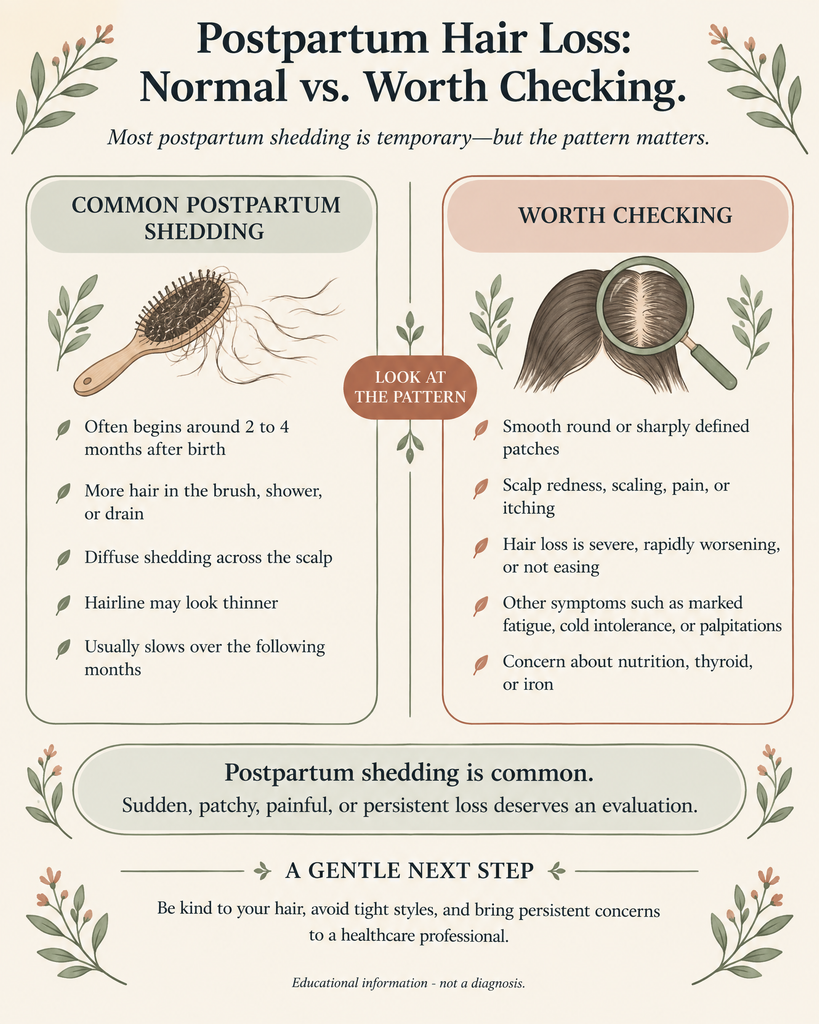
After delivery, the follicles that were held in growth all shift into the resting phase over a relatively short window. Resting hairs don’t fall out immediately; they shed a few months later. That delay is why postpartum hair loss shows up around two to four months after delivery rather than right away, and why it can feel alarming and sudden when it starts.
The normal pattern:
Postpartum hair loss that begins a few months after delivery rather than immediately Diffuse across the whole scalp, not patchy Heaviest in the shower and when brushing Often most visible along the hairline and temples Gradually improving across the first year
Postpartum thyroiditis. The most important thing to rule out. This is an autoimmune inflammation of the thyroid occurring within the first year after delivery, affecting roughly 5% to 10% of women. It typically runs a biphasic course — a period of overactivity followed by underactivity — and it is associated with thyroid peroxidase antibodies. Symptoms overlap heavily with ordinary postpartum life: fatigue, mood changes, weight changes, feeling cold. That overlap is exactly why it gets missed. Roughly half of affected women go on to permanent hypothyroidism, so catching it matters.
Depleted iron stores. Pregnancy and delivery draw down iron, and blood loss at delivery compounds it. Iron deficiency is a common postpartum consideration worth checking with a ferritin level rather than assuming. That said, the evidence linking iron status to postpartum hair loss is inconsistent across studies, and broad supplementation without documented deficiency isn’t supported — so this is a “test, then treat” situation, not a “start iron and hope” one.
Other nutrient gaps. Iron, vitamin D, and zinc can matter when a deficiency is genuinely present. High-quality evidence for supplementing without documented deficiency is limited, and too much of certain nutrients can make hair loss worse rather than better.
Stress and sleep disruption. Stress is a recognized trigger for postpartum hair loss, and postpartum sleep disruption is near-universal.[1] It’s the least satisfying item on the list and often the most relevant.
“Shedding that follows the timeline is physiology. Shedding that’s still going at a year is a question.”
| Conventional Approach | Root-Cause Approach | |
|---|---|---|
| First step | “It’s normal, it’ll pass” | Confirm the timeline fits, then check what doesn’t |
| Thyroid | Often not assessed | Full panel including thyroid antibodies, not TSH alone |
| Iron | Hemoglobin only | Ferritin, since stores drop before anemia appears |
| Timeline | Wait and see | Reassess at twelve months if shedding hasn’t slowed |
1. Know the timeline so you can stop worrying about the normal part. Postpartum hair loss that begins a few months after delivery Shand gradually improves over the first year is doing exactly what it should. Most of what you’re experiencing right now is likely this.
2. Ask for a full thyroid panel, not a TSH. Postpartum thyroiditis is associated with thyroid peroxidase antibodies, and the picture changes depending on which phase you’re in — so a single TSH at a single moment can miss it. If you have type 1 diabetes, another autoimmune condition, or a personal or family history of thyroid disease, your risk is higher.
3. Check ferritin specifically. Iron stores fall before hemoglobin does, so a normal CBC doesn’t rule out depletion. Get the number before supplementing — and then supplement with guidance rather than guessing.
4. Eat for repletion, not for hair. Protein at every meal, iron-rich foods like red meat, liver, lentils and dark greens with vitamin C alongside, and enough total food. If you’re breastfeeding, undereating is common and it works against every system trying to recover.
5. Be skeptical of hair supplements. Biotin in particular is heavily marketed and has little clinical evidence of benefit unless there’s a confirmed deficiency, which is uncommon. Money is better spent on the labs that tell you what’s actually low.
6. Be gentle with what you have. Loose styles rather than tight ponytails or buns, minimal heat, and a wide-tooth comb on wet hair. This won’t change the postpartum hair loss, but repeated tension on the hairline causes its own separate problem — and postpartum is when it tends to start.
Book a visit for postpartum hai the outer third of the eyebrows is worth mentioning specifically.
And separately: if you’re struggling with mood, anxiety, or feeling unlike yourself postpartum, that deserves attention in its own right — not as an afterthought to a hair conversation.
When will it stop? Gradual improvement typically occurs over the first postpartum year as normal cycling resumes, though timing varies considerably between individuals.
Will my hair come back the same? For most women, yes. If density doesn’t return after the shedding resolves, that’s the point to be evaluated rather than to keep waiting.
Does breastfeeding cause it? No. The shedding is driven by the post-delivery shift in the hair cycle, not by nursing. Breastfeeding does raise your nutritional needs, which is a reason to eat well — not a reason to stop.
Should I take a hair, skin, and nails supplement? Not as a first move. Test for deficiency, treat what’s actually low, and be aware that excess of certain nutrients can worsen hair loss.
Most postpartum hair loss is your body finishing something it started in pregnancy. The part worth your attention is what’s still happening at a year.
“The timeline is the test. If it fits, it’s physiology. If it doesn’t, get the labs.”
Whether this is your first visit or your next one, this is a short workup with a clear answer.
Are You Struggling With Postpartum Hair Loss? Our team would love to meet with you.
Click this link to schedule a time to meet with our team.