
Preconception prep has a biological deadline most people miss. The neural tube forms in the first few weeks of pregnancy — often before a positive test — which is why folic acid has to start beforehand. The CDC is explicit: waiting until the first prenatal visit to start folic acid will not prevent neural tube defects. Begin at least one month before conception, at 400 to 800 mcg daily. Three to six months is the right window because biology works on that timeline. Sperm take roughly two to three months to develop, and chronic conditions take months to optimize. This is a two-person project. Everything a male partner changes now shows up in the sperm produced two to three months from now.
Preconception prep is the part of fertility nobody schedules. Most people start trying, and only start thinking about health once a month or two has passed without a positive test.
The case for starting preconception prep three to six months earlier is simple: several of the things that matter most work on a delay. Folate needs to be on board before the neural tube forms. Sperm being made today won’t be mature for months. Thyroid and blood sugar take weeks to adjust. By the time you see two lines, some of those windows have already closed.
The neural tube — the structure that becomes the brain and spinal cord — forms extremely early in pregnancy, during weeks when many women don’t yet know they’re pregnant. That’s the whole reason folic acid is a preconception recommendation rather than a prenatal one. The CDC states plainly that waiting until the first prenatal visit will not prevent neural tube defects.
The same logic applies more broadly. Thyroid replacement takes weeks to adjust and recheck. Blood sugar control takes months to move. Iron stores take months to rebuild. And sperm production runs on a cycle of roughly two to three months, so a partner’s changes today affect the sperm available next season, not next week.
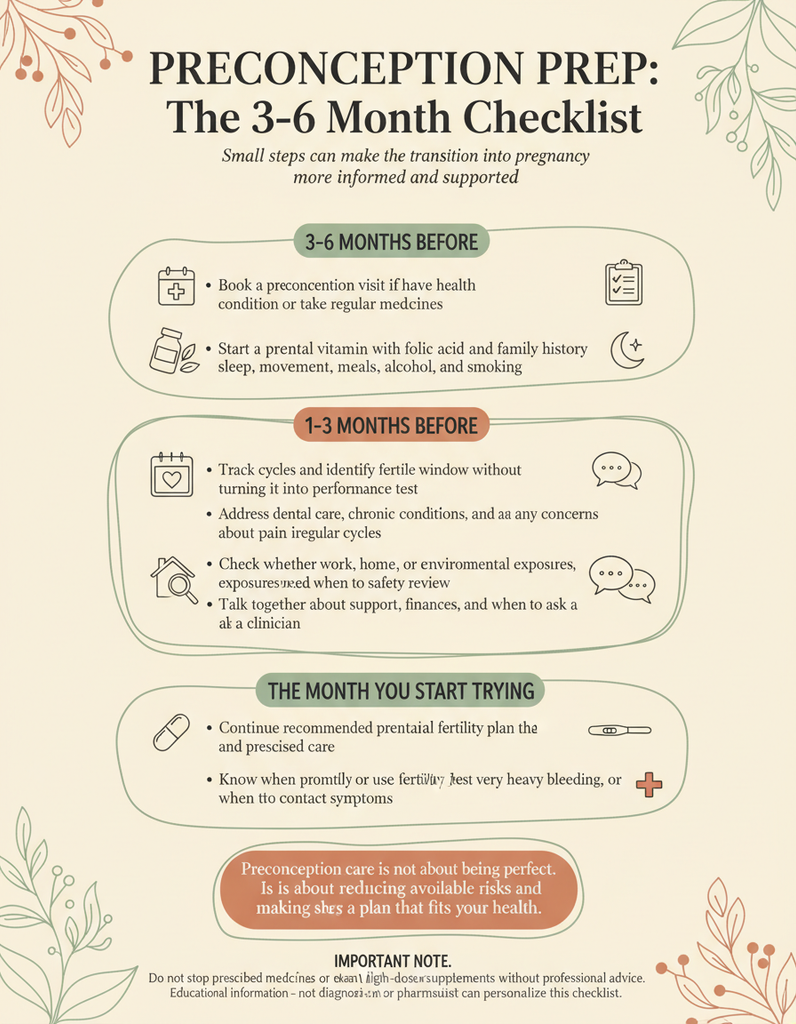
Three to six months of preconception prep isn’t an arbitrary buffer.. It’s how long the biology takes.
What the preconception prep window is for:
Getting folate on board before conception Correcting iron, vitamin D, and thyroid issues Optimizing any chronic condition and reviewing medications Updating vaccinations that can’t be given during pregnancy Learning your cycle so you know when you actually ovulate Giving a male partner a full sperm cycle to benefit from changes
The recommendation is 400 to 800 mcg daily, beginning at least one month before conception and continuing through pregnancy. This carries the strongest evidence rating in preconception care.
If you’ve had a previous pregnancy affected by a neural tube defect, the CDC recommends a much higher dose — 4,000 mcg daily, starting one month before trying and continuing through the first three months. That’s a dose to take under your provider’s direction, not one to self-select.
A note on the supplement aisle: folic acid is the form with the evidence behind it, and it’s what the recommendations are built on. If you’ve read about MTHFR variants and methylated folate, it’s a reasonable conversation to have with your provider — but don’t skip folate supplementation while you sort it out.
Thyroid, if you’re at higher risk. Routine screening of everyone isn’t recommended, but targeted testing is — for women with a personal or family history of thyroid or autoimmune disease, prior infertility, miscarriage or preterm delivery, or advanced maternal age. If you already take thyroid medication, the preconception target is a TSH below 2.5 mU/L, and your dose will likely need increasing once pregnant. The fetal thyroid doesn’t function until around 12 weeks, so early pregnancy runs on yours.
Ferritin. Pregnancy substantially increases iron demand, and starting depleted makes fatigue, and eventually anemia, far more likely. Ferritin falls before hemoglobin does, so ask for it specifically.
Vitamin D and B12, particularly if you eat a limited diet or get little sun.
A1C, particularly if you have diabetes, PMOS, or a family history. For women with diabetes, the preconception target is generally below 6.5%, and contraception is advised until that’s reached.
Rubella and varicella immunity, plus STI screening. These matter now because the vaccines involved are live and aren’t given during pregnancy — so immunity gaps need closing before, not after.
Bring a complete list — prescriptions, over-the-counter products, and supplements — to a preconception visit. Some medications need changing before conception rather than after; others are fine to continue and shouldn’t be stopped on your own. This is a conversation, not a solo decision.
Knowing when you ovulate matters more than most apps imply, since calendar predictions are frequently wrong when cycles vary. Basal body temperature, ovulation test strips, or cervical mucus tracking will show you your actual fertile window and your luteal phase length. Starting now means you’ll have several months of real data before you need it.
A prepregnancy BMI in the 18.5 to 24.9 range is the general recommendation, and in women with higher weight, losing around 10% of body weight has been associated with meaningful reductions in preeclampsia, gestational diabetes, and other complications. If you’ve had bariatric surgery, guidance is to delay pregnancy 12 to 24 months and confirm nutritional status first.
The practical version: steady blood sugar, enough protein, strength training, and adequate food. Under-eating suppresses ovulation, so this isn’t a window for restriction.
Alcohol and smoking both warrant stopping before conception rather than at a positive test. And a dental visit belongs on this list — gum disease is associated with pregnancy complications, and dental work is simpler to do now.
This is the most commonly skipped item. Sperm take roughly two to three months to develop, so changes made today affect what’s available in a season. Alcohol, smoking, heat exposure, sleep, weight, and nutrition all matter in that window. If there’s any history of fertility difficulty, a semen analysis is simple, non-invasive, and belongs early rather than after a year of trying.
“The things that matter most in pregnancy happen before you know you’re pregnant. That’s not a reason to panic — it’s a reason to start early.”
| Conventional Approach | Root-Cause Approach | |
| Timing | Start a prenatal when you start trying | Begin three to six months ahead |
| Labs | Checked at the first prenatal visit | Ferritin, thyroid where indicated, A1C, vitamin D checked and corrected first |
| Cycle | Assumed to be day 14 | Ovulation confirmed by tracking |
| Partner | Not involved until there’s a problem | Included from the start, on a sperm-cycle timeline |
Book a preconception visit if you’re 35 or older, have cycles shorter than 21 or longer than 35 days, have absent or highly irregular periods, have a chronic condition such as thyroid disease, diabetes, hypertension, or an autoimmune condition, take any regular medication, or have a personal or family history of genetic conditions.
Also book sooner rather than later if you’ve had two or more pregnancy losses, a prior preterm birth, a prior pregnancy affected by a neural tube defect, a history of PCOS or endometriosis, prior pelvic surgery or infection, or if you’ve been trying for 12 months already — six months if you’re 35 or older.
When should I start preconception prep? Three to six months before trying is the practical window. The non-negotiable minimum is folic acid at least one month before conception.
Is a regular prenatal vitamin enough? For folate, usually — most contain 400 to 800 mcg. What a prenatal won’t do is tell you whether your ferritin is depleted or your thyroid needs adjusting. Those need testing.
Do I need to stop caffeine? Moderate intake is generally considered acceptable, and guidance varies on the threshold. It’s worth discussing your actual intake with your provider rather than guessing at a number.
What if I’m already trying? Then start today. Folic acid, a medication review, and the relevant labs are all worth doing now — the window isn’t closed, and some of it still works.
Does my partner really need to do anything? Yes. Sperm take two to three months to develop, so his changes need the same lead time yours do. And male factors are involved in a substantial share of fertility difficulty.
Preconception prep isn’t about being perfect before you start. It’s about front-loading the handful of things that only work if they’re already in place — folate, iron, thyroid, and a partner who started two months ago too.
“Start the folate, check the ferritin, learn your cycle, and bring your partner along. That’s most of it.”
Whether this is your first visit or your next one, a preconception visit is one of the highest-value appointments you’ll ever book.
Ready to Start Preconception Prep? Our team would love to meet with you.
Click this link to schedule a time to meet with our team.
Related: Why Can’t I Get Pregnant? | Signs of Low Progesterone | Why Is My Hair Falling Out After Having a Baby?