
Premenstrual anxiety is real, and the late luteal phase is a genuinely vulnerable window. Symptoms that feel manageable at other points in the month can destabilize in the days before a period. There are two different things this can be, and they’re managed differently: anxiety that appears only before your period, and an underlying anxiety that intensifies then. This distinction is called premenstrual exacerbation, and it’s common — analyses of women with major depression found roughly two-thirds reported premenstrual worsening. Your hormone levels are very likely normal. Estrogen and progesterone concentrations don’t differ significantly between women with and without premenstrual symptoms.
Five days out, and everything feels like too much. The email you’d normally shrug at is now evidence that you’re failing. Your heart races at 2 a.m. over something you can’t name. Then your period starts and the volume drops back to normal — and you wonder how you could have been so convinced of something you no longer believe.
After ovulation, progesterone rises and converts to allopregnanolone, a neurosteroid that acts on the brain’s GABA system — the same inhibitory system that produces calm. In most women, this is settling. In women who experience premenstrual mood symptoms, the same signal appears to produce anxiety and irritability instead.
The central point, and the one that reframes everything: current evidence indicates that reproductive hormone secretion patterns remain normal in women with premenstrual disorders, and circulating estrogen and progesterone concentrations do not differ significantly between women with and without premenstrual symptoms. The leading explanation is increased sensitivity to normal luteal fluctuations, not abnormal levels.
You may already know that mood can shift with your cycle. What’s less widely discussed is how broad that vulnerability is: anxiety, panic attacks, obsessive-compulsive symptoms, intrusive memories, and reactive anger have all been reported as more pronounced during the luteal phase.
A wound-up, on-edge feeling starting 5 to 10 days before bleeding Racing thoughts, particularly at night Physical anxiety — racing heart, tight chest, restlessness Catastrophic thinking about relationships or work Anger or irritability that surprises you Poor sleep specifically in that window A distinct lift once bleeding begins
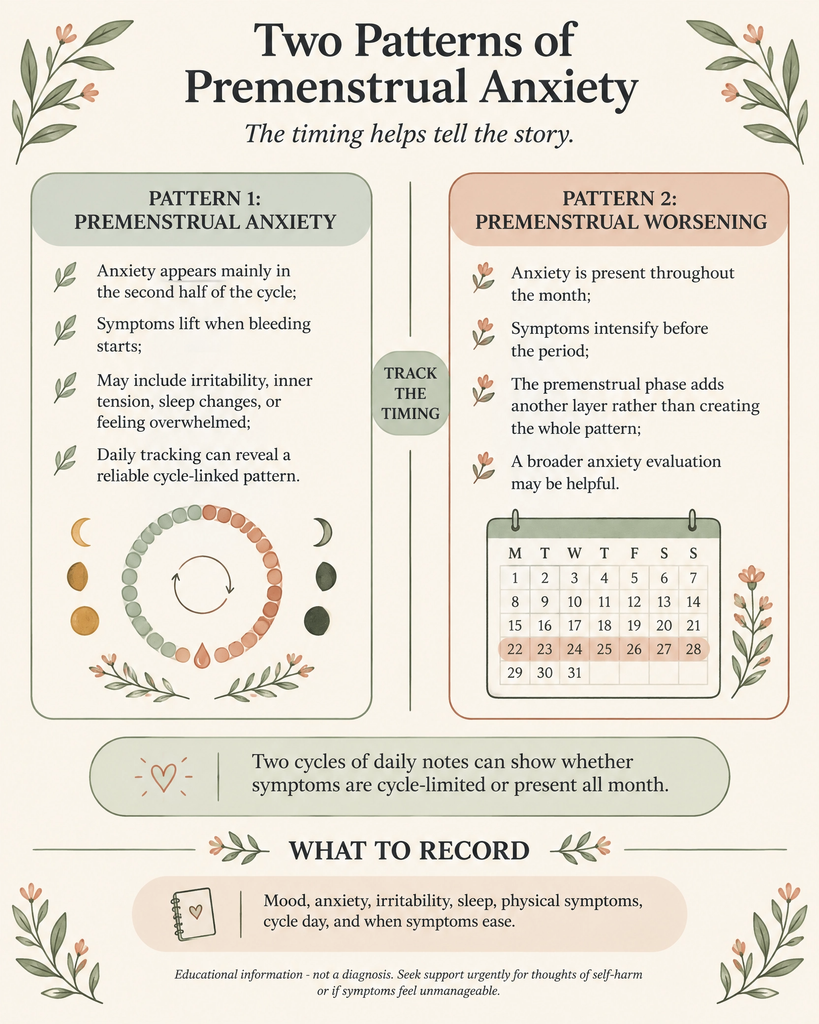
Pattern one: symptoms appear in the luteal phase and resolve with bleeding. This is the premenstrual-disorder picture. Symptoms are essentially absent in the week after your period and return predictably.
Pattern two: anxiety is present all month and intensifies premenstrually. This is premenstrual exacerbation — cyclic intensification of a baseline condition rather than symptoms emerging from nothing. The tell is that symptoms attenuate after bleeding starts but don’t disappear.
This is not an academic distinction. Premenstrual exacerbation is associated with a longer, more anxious course of the underlying condition, and there’s evidence it should be managed differently. Treating the luteal phase alone, when the real issue is present all month, means chasing the wrong target.
What drives it either way: the same threshold factors. Sleep debt, unstable blood sugar, alcohol, and unrelieved stress don’t cause premenstrual anxiety — but they lower the point at which the luteal shift becomes unbearable. Women with premenstrual dysphoric disorder show significantly worse insomnia, inattention, and fatigue in the luteal phase than the follicular phase, and all three correlate with functional impairment.
“The question isn’t how bad your anxiety gets before your period. It’s what your anxiety looks like the week after.”
| Conventional Approach | Root-Cause Approach | |
|---|---|---|
| First step | Treat the anxiety, or suppress the cycle | Two cycles of daily tracking to establish which pattern this is |
| Framing | “Your hormones are off” | Sensitivity to a normal hormonal shift |
| Diagnosis | Retrospective recall | Prospective daily ratings, since recall of timing is unreliable |
| Focus | The luteal week only | Raise the threshold all month; target the right condition |
1. Track daily for two full cycles. This is not a preliminary step — it is the diagnostic step. Prospective symptom tracking across at least two cycles is essential to distinguish premenstrual exacerbation from a premenstrual disorder, and from fluctuation that isn’t cycle-linked at all, because retrospective recall of timing is unreliable. Rate anxiety, irritability, and sleep 1 to 5 every evening, and mark the first day of bleeding.
2. Look specifically at the week after your period. When you review the tracking, that week is the answer key. Near-zero symptoms point one direction; persistent lower-grade anxiety points the other.
3. Protect blood sugar through the luteal phase. Cravings and appetite genuinely change in the second half of the cycle. Riding glucose swings on top of a GABA system that’s already struggling amplifies the physical symptoms of anxiety — the racing heart, the shakiness, the 3 a.m. jolt. Protein at every meal, and eating before you’re depleted.
4. Guard sleep in that specific week. Insomnia and premenstrual distress feed each other, and sleep disruption is measurably worse in the luteal phase. Protecting the hour before bed does more in that week than at any other point in the month.
5. Move, and pull back on alcohol in the luteal week. Regular aerobic exercise has consistent support for premenstrual symptoms. Alcohol fragments sleep and worsens next-day anxiety precisely when your margin is thinnest.
6. Tell the people close to you which week it is. Not as an apology — as information. Much of the damage from premenstrual anxiety happens in conversations that get had at the worst possible moment.
Book a visit if premenstrual anxiety is interfering with your work, your parenting, or your relationships. That’s the threshold — not whether it seems severe compared with someone else’s.
Also worth evaluating: anxiety that doesn’t lift after your period starts, panic attacks, anxiety that began or worsened after a pregnancy, or premenstrual anxiety alongside cycles that have become irregular. Women with generalized anxiety disorder are substantially more likely to also meet criteria for premenstrual dysphoric disorder, so it’s worth assessing both rather than assuming one explains everything.
If premenstrual distress ever includes thoughts of harming yourself, please treat that as a same-day conversation with a provider or a crisis line rather than something to track through another cycle. In the US you can call or text 988 at any hour.
Is this just PMS? Premenstrual anxiety can be part of PMS, part of the more severe premenstrual dysphoric disorder, or premenstrual worsening of an anxiety condition that’s present all month. Those aren’t the same thing and don’t respond to the same approach — which is why the tracking matters more than the label.
My hormone panel was normal. So what’s causing this? Normal levels are the expected finding. Hormone secretion patterns in premenstrual disorders are normal; the leading explanation is heightened sensitivity to those normal fluctuations. A normal result supports the diagnosis rather than ruling it out.
Would going on the pill fix it? Suppressing ovulation removes the fluctuation, and some women do feel better — but it doesn’t address why the sensitivity exists, and it makes the cycle unreadable as a source of information. There’s a lot of ground to cover before that becomes the next step.
How is this different from the PMS mood piece? That one covers the broader mood and irritability cluster. This one is about anxiety specifically, and about telling premenstrual exacerbation apart from a premenstrual disorder — a distinction that changes what actually helps.
The most useful thing about premenstrual anxiety is that it’s predictable. Predictable means trackable, and trackable means you can stop wondering whether you’re imagining it.
“You aren’t a different person that week. You’re the same person, with less margin.”
Whether this is your first visit or your next one, two cycles of notes will tell us more than any lab.
Are You Struggling With Anxiety Before Your Period? Our team would love to meet with you.
Click this link to schedule a time to meet with our team.