
Progesterone is only made after you ovulate. So the signs of low progesterone are really signs that ovulation is missing, delayed, or weak. Regular periods don’t guarantee ovulation. In a Norwegian study of more than 1,500 women with normal-length cycles, over a third showed no sign of ovulation on a single blood draw in the second half of the cycle. A second half of the cycle that lasts 10 days or less is the clearest measurable sign of a luteal phase problem. Some “classic” signs don’t hold up. Spotting before your period is more strongly linked to endometriosis than to low progesterone.
Signs of low progesterone are easy to miss, because most of them look like ordinary annoyances. A cycle that’s crept shorter. Periods heavier than they used to be. Sleep that falls apart in the week before you bleed.
Individually, each one is easy to dismiss. Together, they usually point to the same place: how well you’re ovulating.
You may already know progesterone rises in the second half of your cycle. What’s less often explained is where it comes from.
After an egg is released, the follicle it came from becomes a small, temporary gland called the corpus luteum. That gland produces progesterone for roughly two weeks. If pregnancy doesn’t happen, it shuts down, progesterone falls, and your period starts.
That means progesterone depends entirely on ovulation. No ovulation, no corpus luteum, no meaningful progesterone. A weak ovulation produces a weaker corpus luteum and a shorter or lower progesterone rise.
This is why a regular period isn’t proof that everything is working. In a study of 1,545 Norwegian women with normal-length cycles, 36.7% had a progesterone level on a single blood draw that didn’t indicate ovulation. A single draw can miss ovulation, so that figure likely overstates it — but the point stands: bleeding on schedule and ovulating well aren’t the same thing.
A short second half of your cycle. The American Society for Reproductive Medicine defines luteal phase deficiency as a luteal phase of 10 days or less. If you track ovulation and your period arrives fewer than 11 days later, that’s the most concrete sign you’ll get.
Cycles that are getting shorter. A cycle that used to be 29 days and is now 24 often reflects a shorter luteal phase or earlier, weaker ovulation.
Heavier, longer, or unpredictable periods. When ovulation doesn’t happen, estrogen keeps building the uterine lining without progesterone to stabilize it. The result is often irregular, heavy, or prolonged bleeding.
Sleep that worsens before your period. Progesterone converts to allopregnanolone, which acts on the brain’s calming GABA system. When progesterone is low or falls steeply, sleep and a sense of calm are often the first things to go — especially in your late thirties and forties.
Irregular or absent cycles. Long gaps between periods usually mean ovulation isn’t happening regularly, which means progesterone isn’t being made regularly.
Difficulty conceiving. Progesterone prepares the uterine lining to receive a pregnancy. It’s worth being precise here, though: ASRM has concluded that luteal phase deficiency hasn’t been proven to be an independent cause of infertility on its own. What a short luteal phase usually signals is an upstream ovulation problem — and that’s the part worth fixing.
“Low progesterone is rarely the problem itself. It’s the signal that ovulation needs support.”
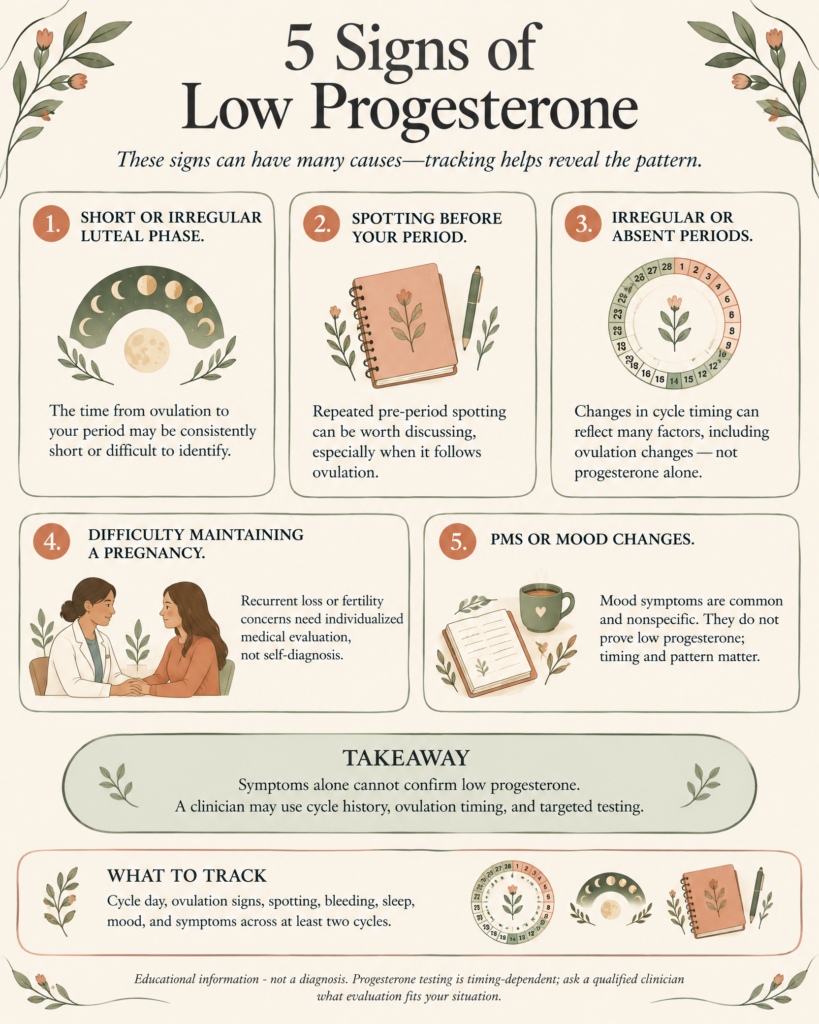
Spotting before your period. This is widely repeated as a low-progesterone sign, and the research doesn’t support it. In women evaluated for infertility, premenstrual spotting lasting two or more days was strongly associated with endometriosis — 89% of women with this symptom had endometriosis compared with 26% without it. Earlier research found the same association with endometriosis, and not with luteal phase problems. If you spot for days before your period, endometriosis deserves a real look.
Premenstrual mood swings. Research consistently finds that women with severe premenstrual mood symptoms tend to have progesterone levels similar to women without them. The issue is more often how the brain responds to normal hormone shifts than the level itself. We cover this in depth in Why Am I So Moody Before My Period?
Stress, under-eating, and over-training. Ovulation is energy-expensive, and the brain suppresses it when it senses scarcity. ASRM lists excessive exercise, significant weight loss, and stress among the conditions associated with luteal phase deficiency.
Thyroid dysfunction and high prolactin. Both interfere with the brain-to-ovary signaling that drives ovulation. Both are easy to test for and very treatable.
PMOS (formerly known as PCOS). The most common cause of irregular ovulation, which means irregular progesterone.
Editor’s note: On May 12, 2026, polycystic ovary syndrome (PCOS) was renamed polyendocrine metabolic ovarian syndrome (PMOS) by global medical consensus, to better reflect that the condition affects hormones and metabolism throughout the body — not just the ovaries. You’ll still see “PCOS” used widely while the new name catches on.
Perimenopause. As ovulation becomes less reliable, anovulatory cycles become more frequent and progesterone falls — often years before estrogen does. This is why heavy periods and poor sleep so often arrive together in the forties.
| Conventional Approach | Root-Cause Approach | |
|---|---|---|
| First step | A random progesterone draw, or told it’s normal | Confirm whether and when you’re ovulating |
| Testing | Progesterone on “day 21” regardless of cycle length | Progesterone about 7 days after confirmed ovulation, plus thyroid and prolactin |
| Focus | Replace the hormone | Restore healthy ovulation, then reassess |
| Timeline | Immediate | Two to three cycles to see a shift |
1. Track your cycle to find your luteal phase. Basal body temperature, ovulation test strips, or cervical mucus observation will show you when you ovulate and how long the second half of your cycle lasts. That single number tells you more than most blood tests.
2. Time your progesterone test correctly. “Day 21” only works for a 28-day cycle. The right time to test is about seven days after ovulation. Progesterone is released in pulses, so a single value is a snapshot rather than a verdict — which is exactly why cycle tracking matters alongside it.
3. Eat enough to ovulate. Under-fueling is one of the most common and least recognized causes of weak ovulation. Regular meals with adequate protein, carbohydrate, and fat tell your brain it’s safe to ovulate.
4. Calibrate exercise. Movement supports hormonal health, but high training volume without enough food can suppress ovulation. If your cycles changed when your training ramped up, that’s worth noticing.
5. Protect sleep and lower stress load. The same brain centers that respond to stress regulate ovulation. Consistent sleep and genuine recovery time aren’t extras here — they’re inputs.
6. Check thyroid and prolactin. Both are simple blood tests, and correcting either can restore ovulation on its own.
Book a visit if your periods are regularly shorter than 21 days or longer than 35 days, if you’ve tracked a luteal phase of 10 days or less for several cycles, or if you’re trying to conceive and it’s been 12 months (or six months if you’re 35 or older).
Seek care promptly for soaking through a pad or tampon every hour, bleeding longer than seven days, bleeding between periods or after intercourse, or spotting for several days before your period — the last of which points toward endometriosis evaluation.
What are the most reliable signs of low progesterone? A luteal phase of 10 days or less, cycles that are shortening, and heavy or irregular bleeding. Cycle tracking gives you the most objective picture.
Can I have low progesterone with regular periods? Yes. Regular bleeding doesn’t confirm ovulation, and a weak or absent ovulation means little progesterone.
Does low progesterone cause weight gain? Not directly. Weight changes in this picture are more often tied to insulin resistance, thyroid function, or perimenopausal shifts than to progesterone itself.
Should I use progesterone cream? Over-the-counter products vary widely in what they actually contain, and adding hormones without knowing why ovulation isn’t happening skips the most important step. Hormone support is a conversation to have with your provider after the underlying cause is clear.
Signs of low progesterone are really signs about ovulation. Once you know that, the question shifts from “how do I get more progesterone?” to “what’s keeping me from ovulating well?” — which is a question with answers.
“Your luteal phase is one of the most honest numbers your body gives you. Start tracking it.”
Whether this is your first visit or your next one, bringing two or three months of cycle data makes the conversation much more productive.
Are You Struggling With Signs of Low Progesterone? Our team would love to meet with you.
Click this link to schedule a time to meet with our team.