
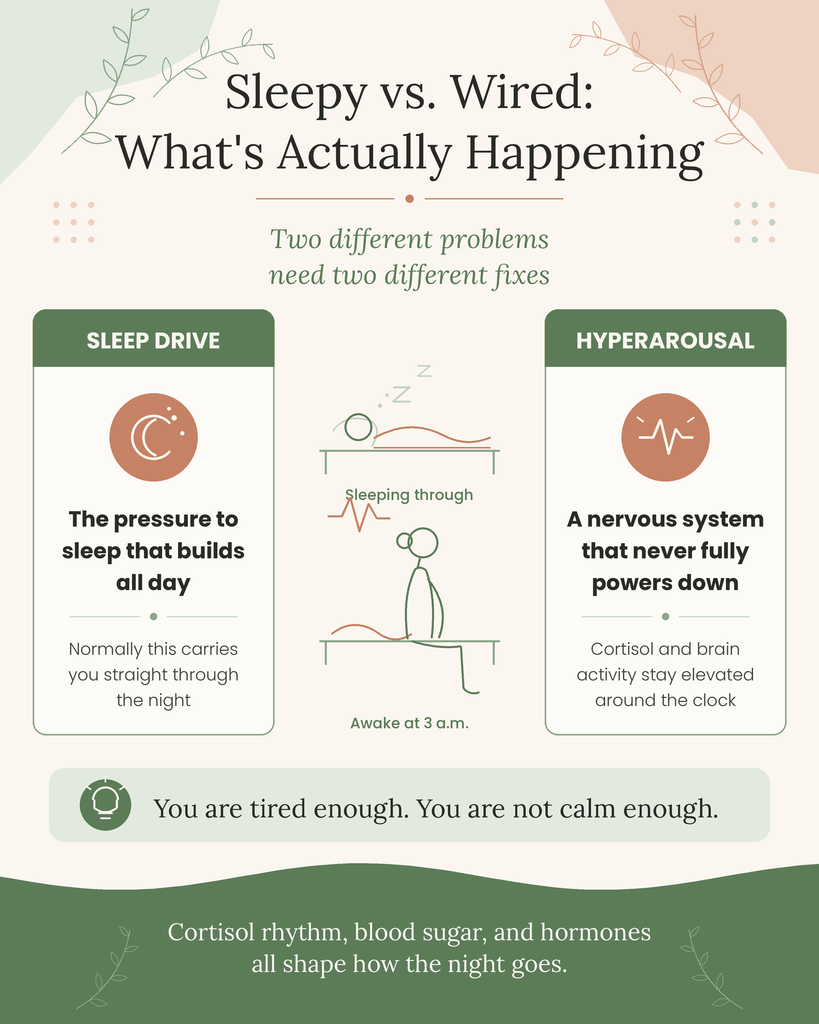
If you can’t sleep through the night, the problem usually isn’t a shortage of tiredness. Chronic insomnia isn’t just “not being tired enough.” It’s increasingly understood as a state of 24-hour hyperarousal — a nervous system that never fully powers down, day or night. A meta-analysis of 20 case-control studies found moderately elevated cortisol in people with chronic insomnia compared with good sleepers. The 2 a.m. wake-up has a physiology behind it, and in women over 40, declining progesterone is often part of it. The most effective treatment isn’t a supplement or a prescription. Cognitive behavioral therapy for insomnia is the recommended first-line treatment for all adults with chronic insomnia.
Falling asleep isn’t the problem. You’re out by 10:30. It’s the 2 a.m. wake-up — fully alert, mind switched on, watching the clock do math on how much sleep is left. If that’s become your normal, there’s usually a reason, and it’s usually findable.
Everyone surfaces briefly between sleep cycles. That’s normal architecture. The question is whether you drop back under or come all the way up.
Chronic insomnia is now understood less as a deficit of sleepiness and more as an excess of arousal. People with insomnia show elevated circulating catecholamines, higher metabolic rates, and greater brain glucose metabolism during sleep and at the wake-sleep transition — a pattern consistent with hyperarousal across the full 24 hours rather than just at bedtime.
Cortisol is part of that picture. Pooled data across 20 studies found overall moderately increased cortisol levels in chronic insomnia, and nighttime cortisol has been observed to be highest during awakenings and lowest in deep sleep.
Common signs of the pattern:
Falling asleep fine, then waking between 1 and 4 a.m. Waking alert rather than groggy Racing or looping thoughts on waking A pounding heart or a wave of anxiety with no obvious trigger Waking hot, or waking damp Feeling wired in the evening despite exhaustion all day Dreading bedtime because of what usually follows
A dysregulated stress response. The most common driver, and the least satisfying to hear. When the nervous system stays in a heightened state, ordinary nighttime arousals become full awakenings, and the cortisol curve that should be at its lowest overnight isn’t.
Falling progesterone. You may already know progesterone is a reproductive hormone. What gets less attention is that it’s also a neuroactive one — it converts to allopregnanolone, which acts on GABA-A receptors, the brain’s primary calming system. As ovulation becomes less reliable in the late thirties and forties, that calming input weakens, and sleep fragmentation is often the sign they can no longer sleep through the night.
Blood sugar swings overnight. A high-carbohydrate, low-protein dinner or a long evening fast can produce a nocturnal dip in blood glucose, and the counter-regulatory response — adrenaline and cortisol — is arousing by design. This is a common contributor to the 3 a.m. wake-up with a racing heart, and one of the more fixable reasons people can’t sleep through the night.
Untreated sleep-disordered breathing. Snoring, gasping, or waking to urinate multiple times deserves screening. Sleep apnea is substantially underdiagnosed in women, in part because the presentation is often fatigue and insomnia rather than loud snoring.
Alcohol and the late scroll. Alcohol shortens sleep onset and then fragments the second half of the night as it metabolizes. Evening light exposure and stimulating input push the same direction.
“Insomnia is rarely a problem of not being tired enough. It’s a problem of not being calm enough.”
| Conventional Approach | Root-Cause Approach | |
|---|---|---|
| First step | A sleep aid | Identify what’s driving the arousal |
| Workup | Rarely beyond a brief history | Thyroid, ferritin, blood sugar, cycle stage, apnea screening |
| Focus | Sedate through the night | Lower 24-hour arousal and stabilize overnight metabolism |
| Timeline | Same night, with rebound on stopping | Several weeks, with durable change |
1. Start with CBT-I, not a supplement. This deserves to be the headline. The American College of Physicians recommends that all adults receive cognitive behavioral therapy for insomnia as the initial treatment for chronic insomnia disorder, and it can be delivered in a primary care setting, through group sessions, or through web-based modules. It addresses the behaviors and thought patterns that keep insomnia going after the original trigger is gone.
2. Get off the clock. Turn it away from the bed. Clock-watching converts a brief arousal into an anxious, fully awake state — the exact loop that keeps you from sleeping through the night.
3. Eat enough protein at dinner, and don’t fast into the night. If you wake at the same hour with a racing heart, this is the first thing to test. Protein and some complex carbohydrate at dinner, and a small protein-containing snack before bed for a week, will tell you quickly whether blood sugar is part of your pattern.
4. Give the nervous system a genuine off-ramp. Not a screen-free hour in theory — a real wind-down: dim light after sunset, a warm shower, slow nasal breathing with a longer exhale. These target the arousal directly rather than trying to override it.
5. Track where you are in your cycle. If the bad nights cluster in the week before your period, or if this started in your forties, it’s a hormonal pattern rather than a sleep-hygiene failure, and it’s worth evaluating as one.
6. Anchor your morning. Same wake time daily, daylight within an hour of getting up, and caffeine stopped by early afternoon. The morning is where the following night’s sleep is actually set.
Get evaluated for snoring, gasping, or observed pauses in breathing; morning headaches; needing to urinate several times a night; or daytime sleepiness severe enough to affect driving. Also worth a visit: insomnia that has persisted for more than three months, night waking with drenching sweats, or a pattern that started alongside low mood, weight change, or a racing heart.
Long-term reliance on any sleep medication should be reviewed with your provider rather than continued by default — approved medications are intended for short-term use.
Does melatonin help with waking at 3 a.m.? Usually not. Melatonin is a circadian timing signal, not a sedative, so it’s better suited to shifting when you feel sleepy than to keeping you asleep. Middle-of-the-night waking is more often an arousal or hormonal issue.
Is waking at the same time every night meaningful? It suggests a rhythm-driven cause rather than a random one — most commonly cortisol timing, blood sugar, or hormonal fluctuation. It’s a useful clue, though the specific hour matters less than the consistency.
Why did this start in my forties? Progesterone declines earlier and faster than estrogen in perimenopause, and it’s the hormone with the most direct calming effect on the brain through the GABA system. Sleep is often the first thing to change.
Should I just get up if I can’t fall back asleep? Generally yes — lying awake trains the brain to associate bed with wakefulness, which makes it harder to sleep through the night over time. Get up, keep the lights low, do something dull, and return when sleepy. This is a core CBT-I technique.
Not being able to sleep through the night is one of the most common things we hear about, and one of the most treatable — but only once you know which mechanism is driving it.
“You don’t need to be knocked out. You need the reason your nervous system won’t stand down.”
Whether this is your first visit or your next one, the workup here is straightforward and usually answers the question.