
Sugar and your immune system: the claim you’ve heard — that sugar shuts down your immune system for hours — traces back to a small 1973 study. The claim you’ve heard — that sugar shuts down your immune system for hours — traces back to a small 1973 study that has never been convincingly replicated. It gets repeated far more confidently than the evidence supports. What is well established about sugar and your immune system is different: chronic high blood sugar chronic high blood sugar measurably impairs neutrophil function, the white blood cells that handle bacterial infection. A 2021 review in Frontiers in Immunology lays out the mechanisms in detail — and explicitly does not address acute sugar intake in healthy people. Meanwhile the best-evidenced immune variable of the season is sleep. In a study where healthy adults were given nasal drops containing rhinovirus, those sleeping under five hours a night had 4.5 times the odds of developing a cold compared with those sleeping over seven. And vitamin D matters more in winter. An individual participant data meta-analysis of 25 trials found daily or weekly supplementation reduced acute respiratory infection risk by around 19%, with the largest benefit in people who started deficient.
Sugar and your immune system is one of the most confidently stated relationships in seasonal health writing, and one of the least well supported in the form it’s usually stated.
The collision between treat season and cold season is real. I see it every year. But the reason is not that a cookie suppresses your white blood cells for five hours — and if we blame the cookie, we miss the variables that actually matter in December, all of which are more fixable than dessert.
Let’s take the sugar and your immune system claims one at a time.
The famous one. The idea that sugar suppresses immune function for several hours after eating it traces largely to a 1973 study measuring neutrophil phagocytosis — how effectively white blood cells engulf bacteria — after volunteers consumed various sugars. It was a small study, over fifty years old, and it has not been convincingly replicated. It is nonetheless the foundation of nearly every “sugar destroys your immunity” article you’ll find. I’d treat it as an interesting early observation rather than established fact.
What’s genuinely established.
Chronic hyperglycemia — persistently elevated blood sugar, as in poorly controlled diabetes — does impair immune defense, and the mechanisms are well worked out. The 2021 Frontiers in Immunology review describes what it calls dual neutrophil dysfunction: impaired recruitment to the site of infection, reduced capacity to produce the reactive oxygen species used for killing bacteria, impaired phagocytosis, and disrupted opsonization — alongside excess inflammatory activity, with primed NET formation and increased inflammatory cytokine release. Infection risk is elevated at skin, urinary and respiratory sites.
Here’s the important caveat, and it’s the review’s own: it addresses chronic hyperglycemia, not acute sugar intake in otherwise healthy people. It also states that whether glucose oscillations impair neutrophil function is not yet known.
So the honest translation on sugar and your immune system is this. If you have diabetes or poorly controlled blood sugar, the immune consequences are real and well documented, and the holidays genuinely raise the stakes. If you’re metabolically healthy and you eat a plate of cookies, there is no good evidence that your immune system shuts down for the afternoon.
The effect that doesn’t need a mechanism. The most defensible concern about holiday sugar isn’t immunological — it’s displacement. Three weeks of eating that’s heavier on sweets and lighter on produce, protein and fiber means less of the micronutrients immune function actually draws on. That’s not dramatic, but it’s real, and it doesn’t require a disputed 1973 study to justify.
This is the useful part, because every item here has better evidence behind it than the sugar and your immune system claim does.
Sleep, by a wide margin.
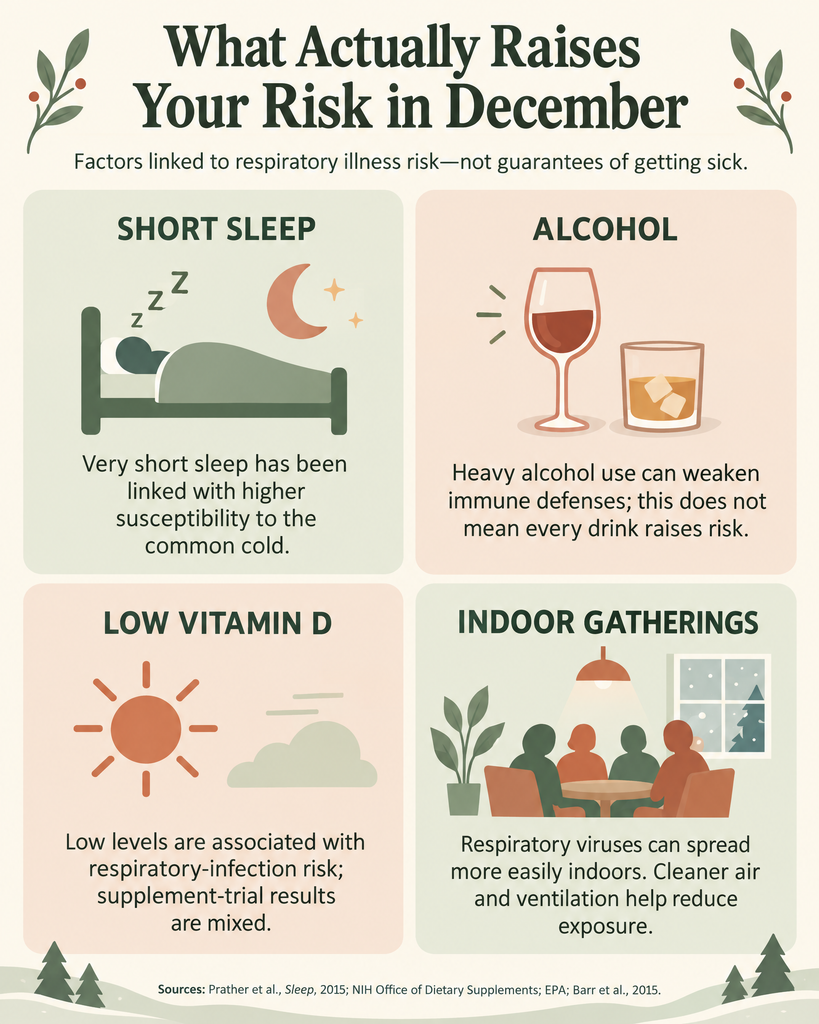
In the rhinovirus study, 164 healthy adults had their sleep measured by wrist actigraphy for a week, then were quarantined and exposed to the virus. Compared with those sleeping more than seven hours, the odds of developing a clinical cold were 4.50 times higher in those sleeping under five hours, and 4.24 times higher at five to six hours. The association held after adjusting for pre-existing antibodies, demographics, season, BMI and health practices. Notably, sleep fragmentation wasn’t related — duration was.
Holiday season is a short-sleep season. Late events, travel, hosting, and a long December to-do list. That’s the biggest lever in this whole article.
Alcohol, which usually arrives with the sugar. It disrupts the second half of the night specifically, which means it hits sleep quality on exactly the nights you’re most exposed to other people.
Vitamin D and the season itself. The Martineau individual participant data meta-analysis of 25 randomized trials found vitamin D supplementation reduced acute respiratory infection risk overall, with an adjusted odds ratio of 0.88. Broken down, daily or weekly dosing gave roughly a 19% reduction while monthly bolus dosing wasn’t protective, and the benefit was concentrated in people who started deficient — around a 70% reduction below 25 nmol/L, with no significant benefit above 50 nmol/L. In an Illinois winter, that’s a relevant distribution.
More time indoors with more people. Respiratory viruses spread where people gather in enclosed spaces. December is structurally designed for that.
Stress and the compressed schedule, which feed back into sleep.
“The cookie isn’t what’s getting you sick in December. The five hours of sleep you got before the party has far better evidence behind it.”
| Common Advice | What the Evidence Supports | |
| Sugar | “Avoid sugar, it suppresses immunity” | Chronic high blood sugar impairs immune defense; a single dessert doesn’t have good evidence behind it |
| Focus | Diet alone | Sleep duration first, then alcohol, vitamin D and exposure |
| Vitamin D | Megadose when sick | Daily or weekly dosing, guided by a tested level |
| Blood sugar | Not tested | A1C and fasting insulin checked if there’s reason to |
| Immune supplements | A cupboard of them | Modest at best; the basics outperform them |
1. Protect sleep duration above everything else. If you take one thing from this article, it’s this. The gap between under five hours and over seven was more than fourfold in cold susceptibility. Not sleep hygiene theater — actual hours in bed.
2. Get your vitamin D level checked, then dose daily rather than monthly. The meta-analysis found daily and weekly dosing protective while monthly bolus dosing wasn’t, and the benefit concentrated in those who were deficient. That makes testing worthwhile rather than guessing.
3. Keep the protein and produce in, rather than cutting the treats out. Displacement is the real mechanism. If dinner still has protein, vegetables and fiber in it, the cookies are a much smaller deal.
4. Treat alcohol as a sleep decision. Finish drinking a few hours before bed, and recognize that the nights you drink most are often the nights you’ve been most exposed to other people.
5. Have treats with meals rather than grazing all day. This helps blood sugar and — per the American Dental Association — it’s also better for teeth, since the frequency of exposure matters more than the total amount.
6. Wash hands and improve ventilation where you gather. Unglamorous and more effective than any supplement in this paragraph.
7. If you have diabetes or prediabetes, this is the season to stay on top of it. This is where sugar and your immune system are genuinely well documented and holiday eating patterns make control harder exactly when exposure is highest.
8. Get the flu shot if you’re going to. Earlier in the season is better than after the first family gathering.
Book a visit for frequent or back-to-back infections, for an infection that isn’t resolving as expected, for persistent fatigue that doesn’t recover between illnesses, or if you have diabetes or prediabetes and your numbers have drifted.
Also worth a visit: wanting a vitamin D level checked before supplementing, or a look at A1C and fasting insulin if you’ve never had them done and have a family history.
Seek care promptly for difficulty breathing or shortness of breath, chest pain, a fever that persists beyond a few days or recurs after improving, confusion, severe dehydration, or an infection with rapidly spreading redness, swelling or warmth.
Does sugar actually suppress your immune system? Not in the way it’s usually claimed. The popular version rests on a small 1973 study that hasn’t been convincingly replicated. Chronic high blood sugar does impair immune defense, with well-described mechanisms — but that’s a different claim from a dessert shutting down your white blood cells for the afternoon.
So if sugar and your immune system aren’t closely linked, holiday treats don’t matter at all? They matter, mostly through displacement — three weeks of eating lighter on protein, produce and fiber. That’s a real effect and a modest one, and it’s addressed by keeping meals intact rather than by banning cookies.
Why do I always get sick in December then? The best-evidenced answers are short sleep, alcohol, more time indoors with more people, lower vitamin D, and a compressed schedule. Sleep is the one with the most striking data.
Should I take vitamin D? Possibly, and it’s worth testing first. The trial evidence shows benefit concentrated in people who were deficient, and daily or weekly dosing outperformed monthly bolus dosing.
What about immune supplements — zinc, elderberry, high-dose C? The evidence is modest and inconsistent, and none of them outperform sleeping seven hours. If you want to spend effort somewhere, spend it there first.
Sugar and your immune system is a real topic that has been oversold with a weak study for fifty years. The version worth acting on is narrower and more useful: if your blood sugar runs high chronically, immune function is genuinely affected. If it doesn’t, the cookie is not your problem.
What is your problem in December is the sleep you’re not getting, the alcohol that’s disrupting what you do get, the vitamin D you don’t have in an Illinois winter, and the number of people you’re standing indoors with. All four are more fixable than dessert.
“Keep the cookies. Get the sleep. That’s the trade that the evidence actually supports.”
Whether this is your first visit or your next one, if you’re catching everything that goes around, that’s worth looking at properly rather than supplementing at.
Catching Everything That Goes Around This Season? Our team would love to meet with you.
Click this link to schedule a time to meet with our team.
Related: The Office Candy Bowl: Why Sugar Wrecks Your 3 PM Energy | Why Your Annual Bloodwork Can Look “Normal” and You Still Feel Off | Why Am I Always Cold?