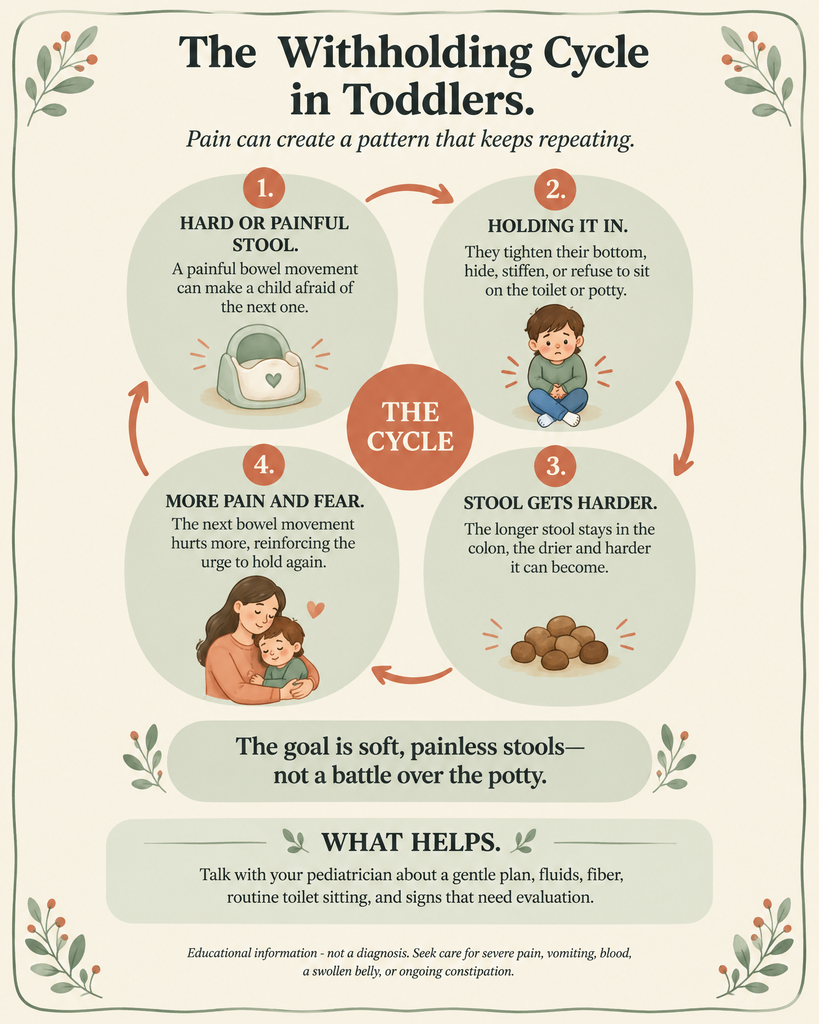
Toddler constipation is almost always functional. About 95% of childhood constipation has no underlying organic disease — which is genuinely reassuring, and also means the cause is usually behavioral and fixable. The most common trigger in young children is withholding, which typically develops after one painful or frightening bowel movement. It becomes self-reinforcing: retained stool sits longer, more water is absorbed, the next stool is harder and more painful, and the child withholds more. Here’s the part most parents aren’t told: increasing fiber and fluid above normal daily recommendations doesn’t provide additional benefit. Normal amounts, plus breaking the withholding cycle, is what works.
You’ve added prunes. You’ve pushed water. You’ve bought the fiber gummies. And your toddler is still going every four days, in tears, producing something that looks genuinely painful. The frustrating part is that the fix usually isn’t more fiber” to “The frustrating part of toddler constipation is that the fix usually isn’t more fiber”
Most parents picture constipation as a plumbing problem: not enough fiber in, not enough moving through. In toddlers, it’s usually a behavior problem wearing a plumbing costume.
Here’s the sequence. One bowel movement hurts — from illness, a diet change, a stretch of not drinking enough, or the stress of toilet training. Your child, reasonably, decides not to do that again. So when the urge comes, they tighten the muscles that should relax, and push the stool back up.
Retained stool sits in the rectum, where more water is absorbed from it. It becomes harder and larger. The next passage is more painful, which reinforces the withholding. Over time the rectum stretches to accommodate the retained mass, the urge to go actually decreases, and soft stool can begin leaking around the harder mass — which parents often mistake for diarrhea or a regression.
Standing on tiptoes, stiffening the legs, or crossing them Hiding — behind a couch, in a corner, under a table Rocking, squeezing, or clenching, often with a red face Going quiet and still, then relaxing Refusing to sit on the toilet
Parents very commonly read this as straining to push. It’s the opposite — it’s active effort to hold it in. Recognizing that changes the whole approach.
One painful stool. The most common starting point, and it can happen at any age. The original cause may have resolved weeks ago while the withholding continues on its own momentum.
Toilet training pressure. Constipation frequently coincides with toilet training, changes in routine, illness, stressful events, or not having an accessible toilet. Pressure to perform produces anxiety, and anxiety produces retention.
Being too busy to go. Toddlers deep in play routinely defer the urge. Deferred often enough, the signal fades.
Diet and routine. Low fiber and low fluid intake contribute, as do diets heavy in dairy and processed foods. This matters — it’s just not usually the whole story, and it’s not where the leverage is once withholding has started.
“Most constipated toddlers aren’t pushing and failing. They’re holding on purpose, because last time hurt.”
| Conventional Approach | Root-Cause Approach | |
|---|---|---|
| First step | Add more fiber | Identify whether withholding is happening |
| Diet | Push fiber and fluid well above normal | Normal fiber and fluid, since more provides no added benefit |
| Focus | Produce a bowel movement | Make bowel movements stop hurting, so the fear resolves |
| Timeline | Days, with relapse | Weeks to months, with relapses expected along the way |
1. Break the pain association first. Nothing else works while passing stool still hurts. This usually means getting stool consistently soft for a sustained stretch — long enough that your child stops anticipating pain. Ask your pediatrician about an appropriate stool softener and how long to continue it; this is the step parents most often stop too early.
2. Aim for normal fiber and fluid, not maximum. This runs against most advice you’ll find, so it’s worth stating plainly: increasing fiber and fluid intake above usual daily recommendations provides no additional benefit for treating constipation. Normal intake plus age-appropriate activity is what’s recommended. Loading a withholding toddler with extra fiber tends to create more volume to hold, not more relief.
3. Build a sit routine after meals. Sitting for about five minutes after meals uses the body’s natural post-meal reflex. Keep it comfortable and pressure-free — the routine is the point, not the outcome of any single sit.
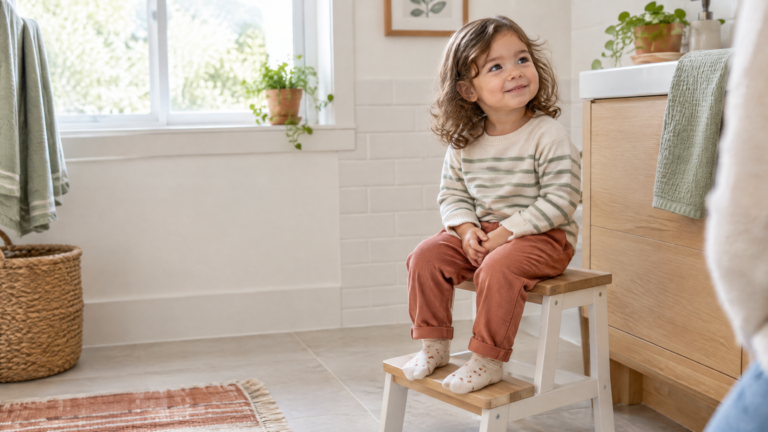
4. Get their feet supported. A toddler dangling on a full-size toilet can’t get into a position that allows the pelvic floor to relax. A step stool under the feet with knees above hips makes a real mechanical difference.
5. Take all pressure off, and never punish. Constipation and toilet training stress feed each other directly. Don’t punish accidents, don’t make the toilet a battleground, and be visibly calm about the whole subject. If you’re in the middle of training and things have gone backward, pausing is a legitimate option.
6. Expect this to take a while, and expect relapses. Functional constipation runs a chronic course with frequent relapses and often needs prolonged treatment. Knowing that in advance is protective — most families stop too soon, precisely when things are starting to work.
Book a visit for constipation that isn’t improving with routine changes, painful bowel movements, blood on the stool or toilet paper, or stool leaking into underwear — which usually signals retained stool rather than a behavioral regression.
Seek evaluation for red flags that point away from ordinary functional constipation: onset before one month of age, delayed passage of the first stool after birth, poor growth or weight loss, explosive stools, severe abdominal distension, vomiting, or fever alongside constipation.
If you’ve been managing this for months without progress, that’s also a reason to be seen. Referral to a pediatric gastroenterologist is appropriate when constipation persists despite adequate treatment.
How often should a toddler poop? There’s a wide normal range, and frequency alone isn’t the measure. Hard, large, or painful stools matter more than the number of days — a child going daily but in pain is constipated.
Should I give magnesium? Talk to your pediatrician before starting anything. Magnesium is widely recommended online for this, but pediatric dosing isn’t something to estimate at home, and it’s worth confirming that plain functional constipation is what you’re dealing with first.
Do probiotics help? The evidence doesn’t support them for this. Reviews have found no evidence for the efficacy of prebiotics or probiotics in treating childhood constipation. They may be worth taking for other reasons — just not as a constipation strategy.
Is the soiling in their underwear a behavior problem? Almost never. Fecal incontinence in a constipated child is soft stool passing around an impacted mass — involuntary and physically not preventable. Children get punished for this regularly, and it’s one of the saddest misunderstandings in pediatrics.
Is dairy behind toddler constipation? Diets low in fiber and high in dairy can contribute to hard stools. Worth reviewing, but not usually the whole answer once withholding has taken hold.
The reframe that helps most families: your toddler isn’t failing to go. They’re succeeding at not going, because they have a good reason to be afraid of it.
“Make it stop hurting, keep it from hurting long enough that they forget to be afraid, and the rest follows.”
“Whether this is your first visit or your next one, toddler constipation is very treatable — it just takes longer than anyone expects.
Is Your Toddler Struggling With Constipation? Our team would love to meet with you.
Click this link to schedule a time to meet with our team.