
Toddler meltdowns are a normal part of development, and there’s real research behind what “normal” looks like. In a study of 279 preschoolers, healthy children’s tantrums lasted about 12 minutes on average. What set them apart wasn’t whether they had tantrums but how: healthy children showed fewer violent, self-injurious or destructive behaviors and recovered faster. “Dysregulated nervous system” isn’t a formal diagnosis, but it’s a helpful way to describe what’s happening: a young child’s emotion-regulation skills are still developing, and the body’s stress response can get stuck on high. Sensory sensitivities can play a role too, and they’re worth looking at as part of the whole picture.
At Well-Rooted, we look at the root causes that affect regulation, like sleep, nutrition and co-regulation at home. We often recommend chiropractic care as one gentle way to support a calmer nervous system — research on gentle adjustments has shown less crying and better sleep in infants, and improved heart rate variability, a marker of a calmer, more adaptable nervous system.
Toddler meltdowns are where most parenting advice splits into two camps. One says it’s all behavior: hold the limit, don’t negotiate. The other focuses on the nervous system and helping a child’s body find calm.
The truth is that both matter. Limits and connection work best when a child’s body is supported too. There’s real data on what ordinary toddler meltdowns look like, clear signs for when one has crossed out of ordinary, and proven ways to help. Here’s what to know.
It helps enormously to have numbers, because without them every meltdown feels like evidence of something.
A study in The Journal of Pediatrics examined tantrums in 279 preschoolers, 150 of them healthy. In the healthy group, the mean total tantrum duration was 11 minutes and 48 seconds — with a standard deviation nearly as large, which tells you how wide the normal range is. Reported frequency at home averaged 20 over a 30-day window, again with enormous variation between children.
So: multiple tantrums a week, lasting ten minutes or so, in a two- or three-year-old, is squarely within what the research describes as healthy.
What distinguished the healthy children was not frequency. It was that they showed fewer violent, self-injurious, destructive and orally aggressive behaviors during tantrums, and that they recovered faster afterward.
That’s the useful reframe. The question isn’t how often or how loud. It’s what happens inside the meltdown, and how it ends.
This phrase is everywhere now, and I want to be straight about it.
It isn’t a clinical diagnosis. You won’t find it in any diagnostic manual, and there’s no test for it. When it’s used well, it’s shorthand for something real: a child whose capacity to manage arousal and emotion is still immature, and who tips over the edge faster than an adult would.
The underlying developmental facts are genuine. The AAP’s own guidance describes why: toddlers are still learning language and how to put words to feelings, and still developing impulse control and the ability to delay gratification. Without the words, a meltdown becomes the way a need gets communicated. That’s not dysfunction — it’s a two-year-old doing what a two-year-old can do.
Where it goes wrong is as an explanation that stops inquiry. If “dysregulated nervous system” is the answer, then the next step is usually a regulation product or protocol. If instead the answer is “my child is three, is hungry, slept badly, and doesn’t have the words yet,” the next steps are different and better supported.
And on sensory processing specifically: the AAP’s policy statement is unambiguous — “pediatricians should not use sensory processing disorder as a diagnosis.” The statement notes there’s no universally accepted diagnostic framework, and asks whether sensory difficulties reflect a true disorder of sensory pathways or are features of other conditions like autism, ADHD, developmental coordination disorder or anxiety, which should be properly evaluated instead. On treatment, the AAP says the research on sensory integration therapy is “limited and inconclusive,” and that it “may be acceptable as one of the components of a comprehensive treatment plan” — with measurable goals, tracked progress, and a time limit for reviewing whether it’s working.
That’s not a reason to dismiss what you observe in your child. It’s a reason to be cautious about the label and the package that comes with it.
“Multiple ten-minute tantrums a week in a three-year-old is the research definition of normal. What matters is what happens inside them, and how they end.”
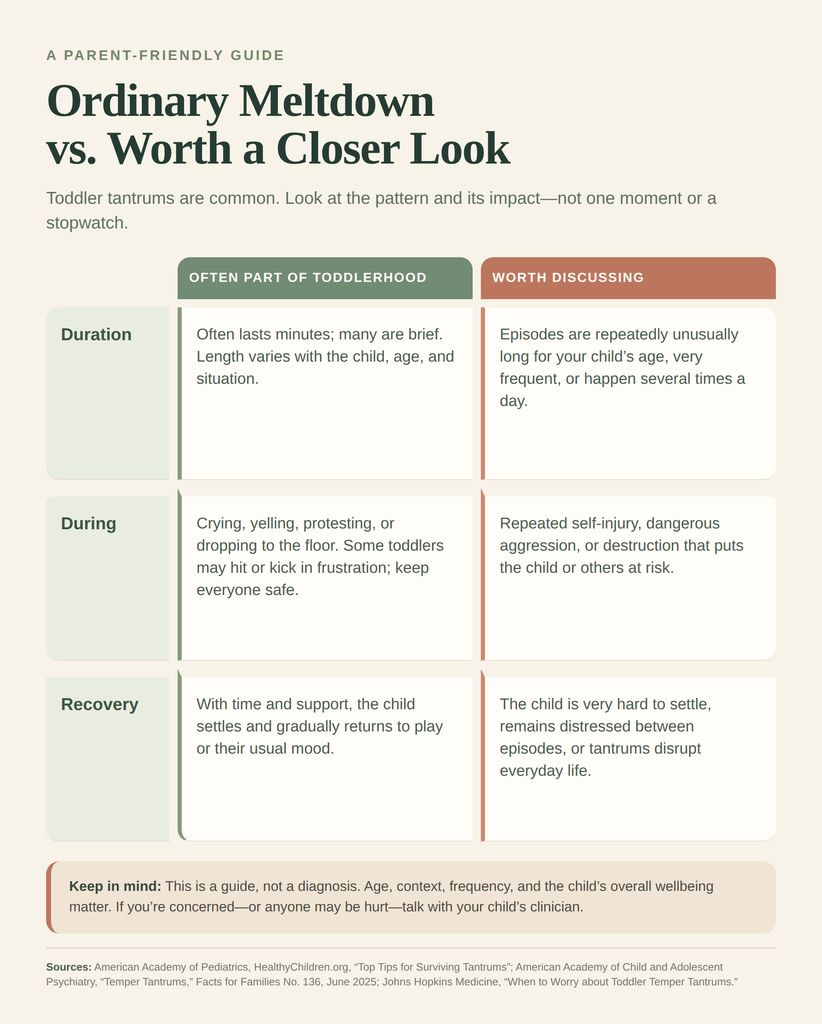
The same study proposed five tantrum patterns as potential markers of concern. I’d hold these loosely — the authors themselves caution that the cutoffs are preliminary, that their value as early markers hasn’t been empirically established, and that up to 30% of healthy preschoolers showed some of the same behaviors in some domains. But they’re the most specific thing available, and far better than a vague sense of worry.
Aggression toward caregivers, or violent destruction of objects, in roughly half of recent tantrums.
Any intentional self-injury during tantrums — regardless of how often or where it happens.
Either 10 to 20 tantrums on separate days at home within 30 days, or an average of more than five a day on multiple days at school or outside the home.
Average tantrum duration around 25 minutes.
Typically being unable to calm down without a caregiver’s help.
Also worth noting from that research: children with disruptive disorders had more tantrums at school and outside the home and more trouble recovering, while self-injury during tantrums was more characteristic of depressed children. Where the meltdowns happen carries information, not just how many there are.
Before concluding anything about temperament or regulation, these are worth ruling out — because each one makes a toddler less able to cope, and each is treatable.
Sleep, and specifically disrupted breathing during sleep. This is the one I’d check first. Snoring on three or more nights a week is the threshold the AAP uses to trigger a focused evaluation, and attention and behavioral difficulties are on its list of findings that should prompt asking about it. A child who isn’t sleeping well has no reserve for frustration.
Iron deficiency. Common, easy to test, and associated with irritability and poor concentration. Worth a ferritin rather than an assumption, and never supplement iron in a child without a lab result and a provider’s guidance.
Constipation. Chronically uncomfortable children are chronically shorter-fused, and this is enormously common and under-recognized.
Hunger and meal timing. Unglamorous, and the single most reliable predictor of a late-afternoon meltdown in most households.
Hearing and language. If a child can’t hear well or is behind on expressive language, meltdowns are the available communication channel. A speech and language evaluation is a reasonable ask.
Underlying conditions the AAP names. Autism, ADHD and anxiety can all present partly as frequent, intense meltdowns in a preschooler, and the AAP’s position is that these should be considered and thoroughly evaluated rather than filed under sensory processing.
| Common Framing | Root-Cause Approach | |
| Explanation | “Dysregulated nervous system” | Emotion regulation is a developing skill — plus what’s depleting it |
| First step | A regulation protocol or product | Sleep, iron, constipation, hunger, hearing and language checked |
| Sensory labels | Used as a diagnosis | Not a diagnosis per the AAP; other conditions evaluated |
| What’s measured | How loud and how often | Behavior during the meltdown and how it ends |
| Intervention | Varies, often untested | Behavioral parent training, which has the strongest evidence |
The best-evidenced intervention for difficult preschool behavior is behavioral parent training — structured programs that coach caregivers rather than treating the child directly. A meta-analysis of 50 studies covering 4,745 participants found an overall effect size of 0.27 on disruptive behavior, rising to 0.50 by parent report in treatment studies, with the largest effects in children whose behavior was most severe at baseline. The authors concluded it meets criteria for a well-established intervention.
That’s worth knowing because it’s the opposite of how this usually gets approached: the thing with the best evidence is a parenting program, not a product for the child.
The AAP’s own practical guidance, for ages two to six, lines up with it:
1. Regulate yourself first. Take a brief break to settle down, then re-engage. A calm adult is the active ingredient — a child borrows your nervous system before they have their own.
2. Name the feeling and draw the line separately. The AAP’s example is exact: “It’s okay to feel mad, it’s not okay to hit.” The feeling isn’t the problem; the behavior is.
3. Offer a choice inside the limit. Which pajamas, which cup, which stair to climb first. A small amount of control often ends a meltdown that opposition would extend.
4. Praise the words, not just the calm. “Thank you for using your words” reinforces the skill you’re actually trying to build.
5. Build a calming routine before you need it. A calm-down corner with comforting items, deep breathing, a favorite stuffed animal. Practised in a good moment, not invented in a bad one.
6. Pick one behavior at a time. Identify a specific behavior like throwing, learn its triggers, and plan a specific alternative. Trying to fix everything at once fixes nothing.
7. Protect sleep and food like they’re interventions. Because they are. Most households can predict their meltdown window to the half hour, and it usually sits on the far side of a missed snack or a short nap.
8. Be careful about handing over a screen to stop a meltdown. The AAP notes that frequently managing a child’s emotions with screens is linked to more emotional problems over time. It works in the moment, which is exactly what makes it easy to rely on.
9. Expect setbacks. The AAP says so directly — consistency and time are needed, and occasional regression is normal. A bad week isn’t a failed approach.
Book a visit if any of the five patterns above describe your child, particularly intentional self-injury during tantrums or aggression toward caregivers in about half of recent episodes.
Also book a visit for meltdowns that are getting worse rather than better over months; for meltdowns alongside snoring, mouth breathing or restless sleep; for a child behind on speech or who may not be hearing well; for constipation or chronic abdominal pain; for loss of previously acquired skills; or if the meltdowns are happening across settings including school.
Seek care promptly for any behavior that puts your child or someone else in physical danger, or if you’re at the end of your own capacity. That second one is a legitimate reason to ask for help and not a failure.
How long is a normal toddler meltdown? In the research, healthy preschoolers averaged just under 12 minutes, with a very wide range. An average of around 25 minutes was one of the proposed markers for a closer look.
How many is too many? Frequency alone turned out to be a poor discriminator. In the healthy group, around 20 tantrums at home over a month was the average. What separated the clinical groups was violence, self-injury, trouble recovering, and tantrums outside the home.
Does my child have a dysregulated nervous system? That isn’t a diagnosis, so there’s nothing to confirm. If what you mean is that your child tips into distress fast and takes a long time to come back, that’s worth evaluating — starting with sleep, iron, constipation, hearing and language.
Should I get a sensory assessment? The AAP’s position is that sensory processing disorder shouldn’t be used as a diagnosis, and that conditions like autism, ADHD and anxiety should be evaluated instead. Sensory-based occupational therapy may be one part of a plan, with measurable goals and a review date — not the whole explanation.
What single change helps most with toddler meltdowns? Honestly: regulating yourself during the meltdown, and protecting sleep and snacks around it. Those cost nothing and they’re doing the same work the structured programs teach.
Toddler meltdowns are developmentally normal, measurably so, and the research gives you something better than reassurance — it gives you a specific list of what would make one worth a closer look.
Before reaching for a regulation protocol, check the boring things: sleep and breathing, iron, constipation, hunger, hearing, language. Then work on the one intervention with strong evidence, which is coaching the adult rather than fixing the child.
“Your calm is the intervention. Everything else is support for it.”
Whether this is your first visit or your next one, meltdowns that fit the patterns above are worth a proper look rather than another year of waiting it out.
Are Your Child’s Meltdowns Beyond What Feels Normal? Our team would love to meet with you.
Click this link to schedule a time to meet with our team.
Related: Snoring and Mouth Breathing in Kids: Why It’s Not Just Noisy Sleep | Why Is My Toddler So Constipated? | Why Is My Toddler So Clingy All of a Sudden?