
Tongue and lip ties are diagnosed far more often than they used to be. US data show roughly a ten-fold rise in ankyloglossia diagnoses and frenotomy procedures between 1997 and 2012, with further increases after that.
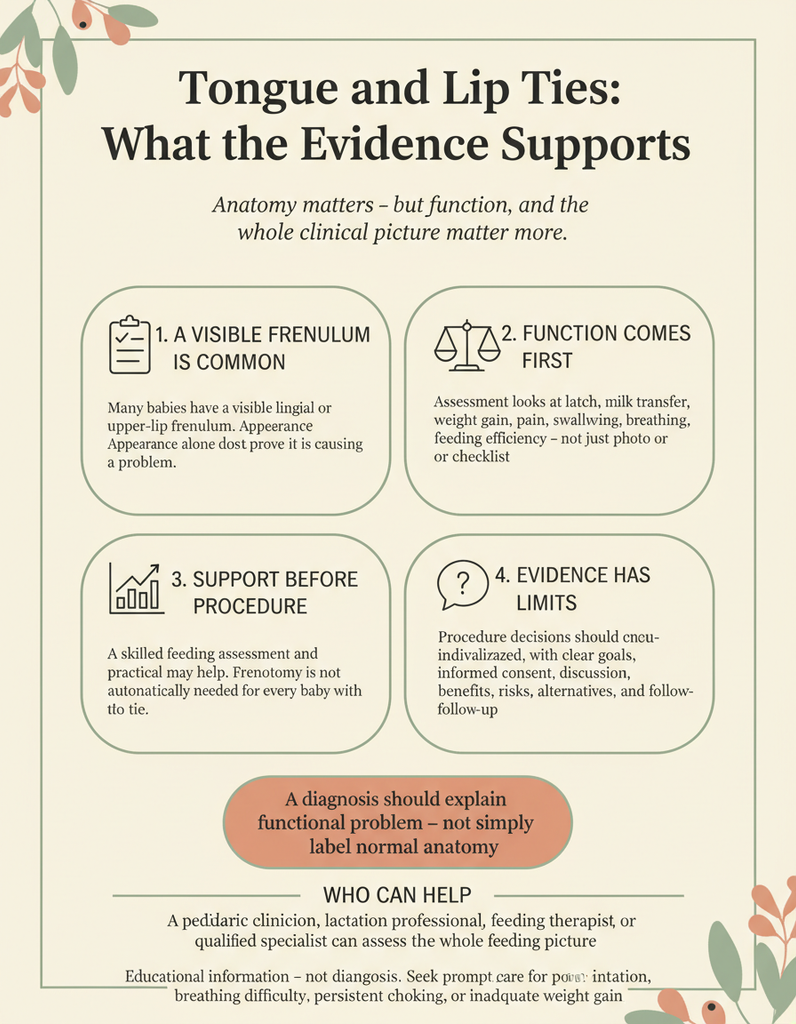
A tight frenulum is not automatically a problem. The American Academy of Pediatrics describes ankyloglossia as a variation of a normal oral structure, and notes that fewer than half of infants with the physical finding have breastfeeding difficulty.
Lip tie is a different story than tongue tie. The AAP’s 2024 clinical report describes labial and buccal frenula as normal structures unrelated to breastfeeding mechanics, with no randomized trials supporting release. Releasing tongue and lip ties to prevent future sleep apnea or speech problems is specifically described as not evidence based.
Everyone has a lingual frenulum — the band of tissue under the tongue. Ankyloglossia, or tongue tie, means that band is short or tight enough to restrict tongue movement.
The crucial distinction in the AAP’s 2024 clinical report is between the anatomy and the problem. “Symptomatic ankyloglossia” means a restrictive frenulum plus breastfeeding problems that haven’t improved with lactation support. A tight-looking frenulum in a baby who is feeding well and gaining weight needs no intervention at all.
You may already know that tongue tie can affect latch. What’s less widely known is how weak the link is between appearance and function: diagnosis rates across US, Canadian and English studies range from 1.7% to 10.7%, and fewer than half of infants with the physical finding have any feeding difficulty.
Signs that warrant a proper feeding assessment:
Nipple pain that doesn’t improve with position changes Nipple damage, cracking, or a compressed, lipstick-shaped nipple after feeds Poor weight gain or slow milk transfer Feeds that take very long, or a baby who never seems satisfied Clicking sounds during feeding A baby who repeatedly slips off the breast Recurrent blocked ducts or mastitis
Note what that list is: feeding problems. Not the appearance of the frenulum.
Tongue tie (lingual frenulum). This is the one with real supporting evidence, and it’s narrower than most parents are told. Small trials and reviews suggest frenotomy produces a short-term reduction in maternal nipple pain. Effects on the baby’s feeding are inconsistent, and no well-conducted randomized trial has shown improvements in breastfeeding duration or exclusivity. Pain relief matters — it’s frequently what allows a mother to keep breastfeeding — but it’s a narrower claim than “it will fix feeding.”
Lip tie (labial frenulum). The AAP report is direct: labial and buccal frenula are normal oral structures, unrelated to breastfeeding mechanics, and do not require surgery to improve breastfeeding. There are no randomized trials supporting maxillary labial frenotomy, and the grading system most commonly used to diagnose lip tie is unvalidated. The American Academy of Otolaryngology states that surgery to release a buccal tie should not be performed.
“Posterior tongue tie.” The report calls this “a poorly defined term, lacking agreement from experts,” and says it “should not be used as a reason to perform surgical intervention on an infant.”
Sleep apnea and speech. Their brief inclusion here deserves a straight answer: performing a frenotomy to prevent future problems such as speech articulation difficulties or obstructive sleep apnea is, in the AAP’s words, “not evidence based.” If your child snores, mouth breathes, or has restless sleep, that’s a real and worthwhile evaluation — but the structures to assess are the adenoids, tonsils, and nasal airway, not the frenulum.
“A tight frenulum in a baby who feeds well and grows well is an anatomical variation, not a diagnosis.”
| Common Approach | Root-Cause Approach | |
| First step | Look in the mouth, name a tie | Watch a full feed and assess milk transfer |
| Lip tie | Released alongside the tongue | Recognized as a normal structure, not released |
| Decision | Anatomy drives the procedure | Symptoms that persist despite skilled lactation support drive it |
| Aftercare | Daily stretching exercises | Not recommended — they aren’t evidence based and may cause oral aversion |
Before any procedure is considered, the AAP recommends a complete breastfeeding assessment. If you’ve been offered a release without most of this, it’s reasonable to ask for it first.
1. A full feeding history. Nipple pain, feed duration, how your baby behaves at the breast, and what’s already been tried.
2. Pregnancy, birth, and postpartum history, including medications and your own breast and nipple anatomy — all of which affect feeding independently of your baby’s mouth.
3. A complete infant exam. Not just the tongue — the face, jaw, palate, and how the tongue actually moves. Several other conditions affect feeding, including infection, congenital heart disease, and metabolic conditions.
4. Measured milk transfer. Pre- and post-feed weights give an objective answer to the question that matters most: is milk moving?
5. Standardized latch assessment, using a recognized scoring tool rather than an impression.
6. Skilled lactation support, and time to work. Positioning and latch changes resolve a substantial share of painful feeding without any procedure. The AAP’s own definition requires that problems persist despite this support.
Worth knowing: no tongue assessment tool has been validated. The scores and grades you may be shown are not as objective as they appear.
It should be done by a trained professional, after a clear consent conversation covering bleeding, infection, and pain control, with vitamin K status documented and follow-up arranged.
Simple scissors frenotomy has a good safety record. Laser has no comparative evidence showing it works better than clipping.
Skip the stretching exercises. This one surprises families, because post-procedure stretching protocols are widely prescribed. The AAP states they are not evidence based and not recommended, and notes they may cause oral aversion — a real harm, in a baby you need to keep feeding.
Expect pain relief more reliably than a transformed feed. Going in with accurate expectations protects you from concluding something went wrong if feeding still needs work afterward.
Book a visit promptly for poor weight gain or weight loss, fewer wet diapers than expected, a baby who is persistently sleepy at the breast or difficult to wake for feeds, nipple damage or bleeding, or signs of mastitis — fever, a red painful area, or feeling unwell.
Seek care the same day for a baby under three months with a fever of 100.4°F or higher, a baby who is difficult to rouse, breathing difficulty during feeds, or any bleeding after a frenotomy that doesn’t stop with gentle pressure.
Book a regular visit for snoring most nights, mouth breathing day and night, or restless sleep with pauses — these deserve an airway evaluation in their own right, separate from any question about a frenulum.
Does my baby need a tongue tie release? Only if feeding is genuinely impaired and hasn’t improved with skilled lactation support. A tight-looking frenulum in a baby who feeds comfortably and grows well needs nothing.
What about lip tie? The AAP describes labial frenula as normal structures unrelated to breastfeeding mechanics, with no randomized trial evidence supporting release.
Will a tongue tie cause speech problems or sleep apnea later? Releasing a tie to prevent those outcomes is specifically described as not evidence based. Snoring and disordered sleep in a child warrant evaluation — of the airway.
Why are tongue and lip ties diagnosed so much more than they used to be? Diagnoses and procedures rose roughly ten-fold between 1997 and 2012 in US data. The AAP notes this may reflect better recognition, genuine increases, or overdiagnosis — and the absence of validated assessment tools makes that hard to untangle.
Should I do the stretches afterward? The AAP says post-procedure stretching exercises are not evidence based, are not recommended, and may cause oral aversion. Follow your provider’s specific instructions, and ask about this directly if stretches are prescribed.
Tongue and lip ties matter when feeding is genuinely impaired and skilled support hasn’t fixed it. They don’t matter because of how the frenulum looks in a photo, and the lip tie piece in particular hasn’t held up.
“Watch the feed before you look at the frenulum. The feed is the diagnosis.”
Whether this is your first visit or your next one, painful or ineffective feeding deserves a full assessment — and most of the time, that’s where the answer is.
Worried About Tongue and Lip Ties? Our team would love to meet with you.
Click this link to schedule a time to meet with our team.
Related: Why Is My Baby So Gassy? | Safe Teething Remedies for Babies | Why Won’t My Toddler Sleep Through the Night?