
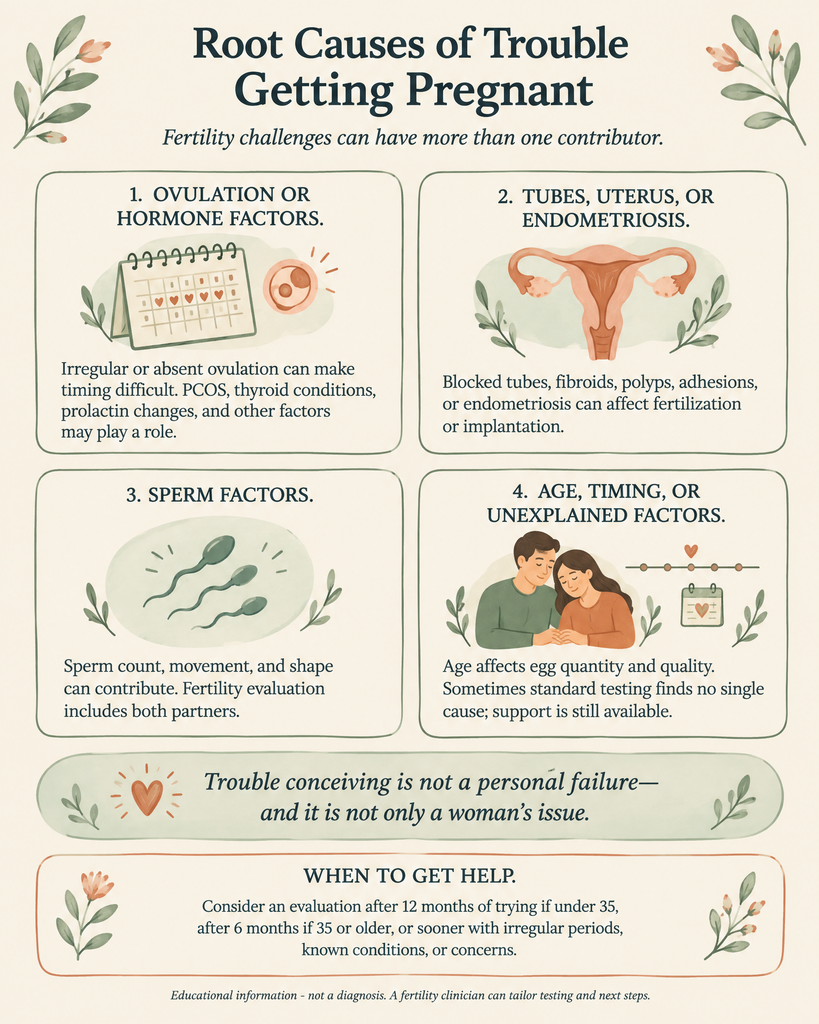
The fertile window is shorter than most couples realize. A landmark study found conception happened only when intercourse fell within a six-day window ending on the day of ovulation. Ovulation problems account for roughly 25% to 40% of female infertility, and PMOS (formerly known as PCOS) is behind about 70% of cycles where ovulation isn’t happening. Fertility is a two-person question. About one-third of infertility cases involve a male factor alone, and many more involve factors in both partners. The guidance on when to seek help depends on age: after 12 months of trying under 35, after six months at 35 or older, and sooner after 40.
Why can’t I get pregnant is one of the most common questions we hear — and part of the answer is that the fertile window is shorter than most couples realize.
Most fertility challenges have identifiable, often addressable causes. Some are as simple as timing. Others involve ovulation, thyroid function, metabolic health, or factors on the male side that never got checked. The first step is knowing where to look.
Conception requires a surprising number of things to line up in a short window. An egg has to be released. Sperm need to be present and healthy. The fallopian tubes need to be open. The uterine lining needs to be ready. And all of it has to happen within a day or two of ovulation.
You may already know that fertility declines with age. What’s less often explained is how narrow the monthly window is even at your most fertile. In a well-known study of 221 women trying to conceive, pregnancy occurred only when intercourse happened within the six days leading up to and including ovulation. Outside that window, conception didn’t happen.
Even at peak fertility in your early twenties, the chance of conceiving in any given month is roughly 25% to 30%. By 40, it drops to 10% or less per month. Not getting pregnant in the first few months is common and expected. Not getting pregnant after a year is a signal worth following.
Common signs something may need attention:
Cycles shorter than 21 days or longer than 35 days Periods that are unpredictable or absent for months Very heavy or very painful periods No clear signs of ovulation when tracking A second half of the cycle shorter than 10 days Signs of excess androgens, like acne or unwanted hair growth Known thyroid issues or a family history of them
Timing. The most fixable cause and a more common one than people expect. Ovulation doesn’t always happen on day 14, and apps that predict it from calendar math alone are frequently wrong for women whose cycles vary. If you’re asking why can’t I get pregnant after only a few months, timing is the first thing to check.
Irregular or absent ovulation. Ovulatory dysfunction accounts for an estimated 25% to 40% of female infertility. The most common cause by far is PMOS, which is responsible for roughly 70% of anovulatory cycles. Under-eating, over-training, high stress, and significant weight change can also suppress ovulation — all frequent answers to why can’t I get pregnant.
Editor’s note: On May 12, 2026, polycystic ovary syndrome (PCOS) was renamed polyendocrine metabolic ovarian syndrome (PMOS) by global medical consensus, to better reflect that the condition affects hormones and metabolism throughout the body — not just the ovaries. You’ll still see “PCOS” used widely while the new name catches on.
Thyroid and prolactin. Both regulate the signaling between brain and ovaries. An underactive thyroid can reduce ovulation rates, and elevated prolactin is a frequent cause of absent ovulation. Both are simple blood tests and very treatable, and both are worth ruling out early when you’re asking why can’t I get pregnant.
Tubal and structural factors. Blocked or damaged fallopian tubes contribute to an estimated 20% to 35% of female infertility. Endometriosis, past pelvic infections, and prior surgery are common reasons. Painful periods, pain with intercourse, or spotting for several days before your period are worth mentioning specifically.
Age. Egg quantity and quality decline with age, particularly after 35. This is the reason evaluation timelines shorten as you get older — not because conception becomes impossible, but because time becomes more valuable.
The male side of the equation. Why can’t I get pregnant is a two-person question. This one gets overlooked constantly. According to the American Society for Reproductive Medicine, about one-third of infertility cases involve a male factor alone. A semen analysis is simple and non-invasive, and it belongs at the start of the workup, not the end.
“Fertility isn’t a test you pass or fail. It’s a system — and systems have specific places where they get stuck.”
| Conventional Approach | Root-Cause Approach | |
|---|---|---|
| First step | Keep trying, or move quickly to intervention | Confirm ovulation and timing, and evaluate both partners |
| Testing | Often female-focused and staged over months | Cycle tracking, thyroid, prolactin, metabolic markers, and semen analysis together |
| Focus | Achieve pregnancy | Understand why it isn’t happening and support the underlying system |
| Timeline | Varies | Several cycles to see ovulation and metabolic changes take effect |
1. Learn your actual fertile window. Cycle tracking — basal body temperature, ovulation test strips, and cervical mucus observation — confirms whether and when you ovulate. That information alone resolves a meaningful number of “unexplained” cases, and it gives your provider far better data than a calendar app.
2. Time intercourse to the days before ovulation. Because sperm survive several days and the egg lives only about a day, the days leading up to ovulation matter most. Waiting until a positive ovulation test can mean arriving late to the window.
3. Support ovulation with enough food. Regular meals with adequate protein, carbohydrate, and healthy fat signal to your brain that it’s safe to ovulate. Chronic under-eating is one of the most common and least recognized reasons ovulation becomes irregular.
4. Address metabolic health, especially with PMOS. Steady blood sugar, strength training, and protein-forward meals support ovulation in women with insulin resistance. Changes in metabolic health often translate into more regular cycles within a few months.
5. Start a prenatal early — for both of you. Folate is essential before conception, not just after a positive test. Partners benefit from attention to nutrition, alcohol, heat exposure, and smoking, since sperm take roughly two to three months to develop.
6. Get the male evaluation done early. A semen analysis at the start saves months of guessing. It’s one of the easiest and most informative tests in the entire workup.
Seek evaluation after 12 months of trying if you’re under 35, after six months if you’re 35 or older, and sooner if you’re over 40 — at that age, monthly conception chances drop to 10% or less.
Don’t wait out the full timeline if you have cycles shorter than 21 days or longer than 35 days, absent periods, very painful periods or pain with intercourse, known thyroid disease, a history of PMOS or endometriosis, prior pelvic infection, or two or more pregnancy losses. Any of those is reason enough to start sooner.
Why can’t I get pregnant when my periods are regular? Regular bleeding doesn’t guarantee ovulation, and even when ovulation is happening, timing may be off. Tubal factors, male factor, and thyroid issues can all be present alongside perfectly regular cycles.
Does stress really affect fertility? Chronic stress can interfere with the brain signals that drive ovulation. That’s different from saying you’d get pregnant if you “just relaxed” — which isn’t a fair or accurate thing to tell anyone.
Is it normal to take a few months to conceive? Yes. Even at peak fertility, the monthly chance is roughly 25% to 30%. Several months without success is common and expected.
Should my partner get tested even if he has no symptoms? Yes. Male factor rarely causes symptoms, and a semen analysis is simple, non-invasive, and very informative.
Why can’t I get pregnant when both of us are healthy? Healthy doesn’t rule out a narrow fertile window, an ovulation problem that isn’t obvious, or a male factor with no symptoms. That’s exactly what basic testing is for — it turns “unexplained” into something specific.
Why can’t I get pregnant? The honest answer is that it depends — and that’s the point. Timing, ovulation, thyroid, structure, age, and male factor are all distinct causes with distinct solutions, and the right starting place is finding out which ones apply to you.
“Start with the data: when you ovulate, how long your luteal phase is, and what both partners’ labs show.”
Whether this is your first visit or your next one, bringing a few months of cycle tracking makes the first conversation far more productive.
Are You Asking Why Can’t I Get Pregnant? Our team would love to meet with you.
Click this link to schedule a time to meet with our team.