
Feeling sluggish after a meal is common, but having no energy after eating most meals is a pattern with identifiable causes — usually meal size, meal composition, and blood sugar. You don’t need diabetes to have blood sugar swings. When researchers put continuous glucose monitors on people considered healthy by standard tests, many reached prediabetic glucose ranges after ordinary meals. The afternoon slump is partly built in. Your circadian rhythm naturally dips in the early afternoon, and a large lunch lands right on top of it. Two of the most effective fixes cost nothing: the order you eat your food in, and a short walk afterward.
Why do I have no energy after eating? It’s one of the most common questions we hear from women who are otherwise doing everything right.
You eat lunch, and forty-five minutes later you could put your head on the desk. Food is supposed to give you energy. When it reliably does the opposite, your body is telling you something specific about how it’s handling what you eat.
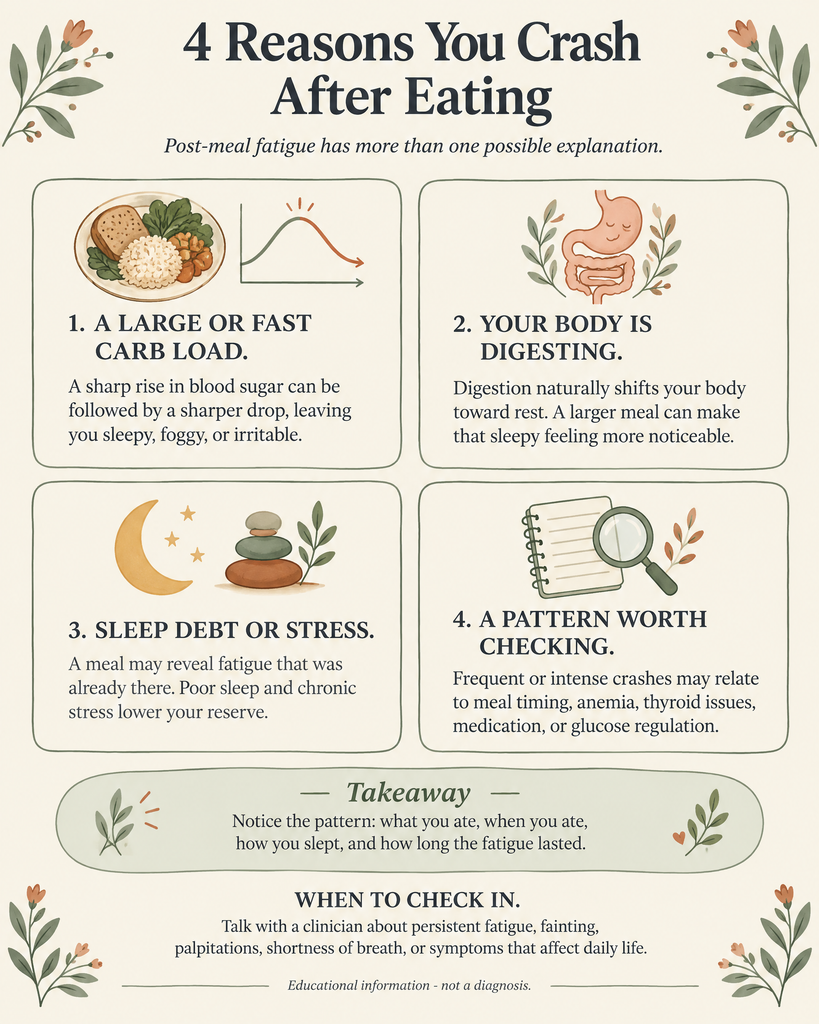
A little drowsiness after a meal is normal physiology. Digestion shifts your nervous system toward “rest and digest,” and the early afternoon is a natural low point in your circadian rhythm — signals that promote wakefulness tend to drop in that window whether you’ve eaten or not.
What turns a normal lull into a crash is usually what and how much you ate. Larger meals produce more sleepiness than lighter ones, and carbohydrate-heavy meals produce more than balanced ones.
The cause of no energy after eating that most women haven’t been told about is blood sugar. You may already know that people with diabetes have glucose spikes. What’s less well known is how often people without diabetes do too. A 2018 Stanford study fitted 57 people with continuous glucose monitors — including many classified as normal by standard blood tests. Those “normal” participants still spent about 15% of their time in the prediabetic glucose range, and a common breakfast of cornflakes and milk produced sharp spikes in most of them.
A fast rise in blood sugar is followed by a strong insulin response and, often, a fall. That fall is where the fog, the heavy eyelids, and the sudden craving for something sweet tend to show up.
Common signs of no energy after eating:
Sleepiness or brain fog within an hour or two of eating Crashes that are worst after carb-heavy meals Cravings for sugar or caffeine after a meal Shakiness, irritability, or hunger a few hours after eating Feeling better on days you eat more protein An afternoon slump that feels non-negotiable
Blood sugar swings. A meal built mostly on refined carbohydrates — a bagel, pasta, a sandwich and chips — raises glucose quickly. The bigger the spike, the bigger the correction.
Reactive low blood sugar. Some people experience a drop in blood sugar within about four hours of eating, with shakiness, sweating, hunger, weakness, fatigue, irritability, or anxiety. Mayo Clinic describes this as reactive (postprandial) hypoglycemia. In people without diabetes, the underlying cause often isn’t clear, but the dietary pattern that helps is consistent.
Insulin resistance. When cells respond less efficiently to insulin, the body produces more of it to keep glucose in range, which can exaggerate the post-meal rise and fall. This often develops quietly for years before any lab value flags it — and it’s especially common in women with PMOS (formerly known as PCOS).
Meal size and timing. A large meal, especially at midday, stacks digestion on top of your natural circadian dip. Skipping breakfast and eating a big lunch is one of the most reliable recipes for a 2 p.m. crash.
Something else lowering your baseline. Low iron, an underactive thyroid, poor sleep, or undiagnosed celiac disease all lower your baseline energy, so any post-meal dip feels much deeper than it should. If you have no energy after eating even small, balanced meals, these are worth checking.
“Food should refuel you. If it reliably knocks you out, that’s information, not a character flaw.”
| Conventional Approach | Root-Cause Approach | |
|---|---|---|
| First step | Told it’s normal, or reach for caffeine | Look at meal composition, size, and blood sugar response |
| Testing | Fasting glucose or A1C only | Fasting insulin, A1C, iron, thyroid, and a picture of post-meal response |
| Focus | Push through the slump | Flatten the glucose curve and raise baseline energy |
| Timeline | Daily, indefinitely | Often noticeable within one to two weeks |
1. Eat your vegetables and protein before your carbs. This sounds too simple to matter, and it matters a lot. In a crossover study published in Diabetes Care, eating the same meal with vegetables and protein first — carbohydrates 15 minutes later — lowered post-meal glucose by about 29% at 30 minutes and 37% at 60 minutes, and insulin by 73%. That study was in adults with type 2 diabetes, and a follow-up found similar benefits in prediabetes; the principle applies broadly.
2. Build every meal around protein, fiber, and fat. A plate that’s mostly starch will crash you. A plate anchored by protein, with vegetables and some healthy fat, slows how quickly glucose enters your bloodstream.
3. Walk for ten minutes after you eat. A 2022 meta-analysis in Sports Medicine found that light walking after sitting significantly lowered post-meal glucose and insulin — and did so more effectively than standing alone. It doesn’t need to be a workout. A lap around the block works, and it’s one of the quickest fixes for no energy after eating.
4. Eat a real breakfast. Starting the day with protein steadies blood sugar for hours and makes the midday meal less likely to spike you. Skipping breakfast and eating a big lunch is a reliable recipe for a crash.
5. Right-size lunch. If afternoons are your worst time, make lunch moderate and dinner the larger meal. You’re working with your circadian rhythm instead of against it.
6. Rule out the baseline drains. Ferritin, a full thyroid panel, fasting insulin, and A1C answer most of the “why am I always this tired” question — and they explain why some women crash far harder than others after the same meal.
Book a visit if you have excessive thirst, frequent urination, blurry vision, or unexplained weight change alongside post-meal fatigue. Also worth evaluating: shakiness, sweating, or confusion a few hours after eating; fatigue after meals that comes with bloating, diarrhea, or abdominal pain; or exhaustion that doesn’t improve after a couple of weeks of changing how you eat.
Seek care promptly for fainting, or for symptoms of low blood sugar that don’t resolve after eating.
Why do I have no energy after eating even when I eat healthy? “Healthy” and “blood-sugar-friendly” aren’t always the same thing. A large bowl of oatmeal with fruit, a smoothie, or a grain bowl can still spike glucose if it’s mostly carbohydrate with little protein. The fix is usually adding protein and fat, not removing food.
Is no energy after eating a sign of diabetes? Not on its own — post-meal sleepiness is common and usually driven by meal size and composition. But paired with thirst, frequent urination, or weight change, it’s worth checking A1C and fasting glucose.
Does coffee after lunch help? It masks the slump rather than fixing it, and afternoon caffeine can undermine the night’s sleep — which then makes the next day’s crashes worse.
Could it be a food sensitivity? Sometimes, particularly if fatigue comes with digestive symptoms. Celiac disease is worth ruling out with testing before cutting gluten, since removing it first makes the test unreliable.
Why do I have no energy after eating? For most women, the answer is a combination of what’s on the plate, how much of it there is, and what time of day it lands. The good news is that no energy after eating is one of the most responsive patterns.
“Change the order, add the protein, take the walk. Most women feel the difference within a week.”
Whether this is your first visit or your next one, checking the labs underneath the pattern is a quick way to know what you’re working with.
Are You Struggling With No Energy After Eating? Our team would love to meet with you.
Click this link to schedule a time to meet with our team.