
More common than parents assume — studies put halitosis prevalence in children somewhere between roughly 15% and 41% worldwide. About 90% of bad breath originates in the mouth itself, most often from bacterial coating on the tongue rather than from the teeth. Roughly 10% of cases trace to ear, nose, and throat causes, and about 5% to gastrointestinal or endocrine ones. One-sided foul breath with a runny nose in a young child has a specific and easily fixed explanation that’s worth knowing about.
Morning breath is universal and means nothing. What sends parents looking for answers is the version that’s there all day, after brushing, in a child who has no cavities. That one usually has a findable cause — and it’s rarely the one people guess.
The odor itself comes from volatile sulfur compounds, produced when bacteria break down proteins in the mouth.
The main site of production isn’t the teeth. It’s the tongue. The surface of the tongue is large, rough, and papillary, which gives it a high capacity to retain food debris, bacteria, and shed cells — and in younger people, tongue coating is the dominant source of oral malodor.
Research comparing children with and without halitosis found meaningfully different microbial communities on the tongue: children with bad breath had greater bacterial richness on the tongue coating and distinct species profiles compared with children without it. So this genuinely is a microbiome story — it’s just an oral microbiome story, which is not where most parents are told to look.
Common signs worth noting:
Breath that’s bad all day, not just on waking A visibly white or coated tongue Mouth breathing, especially at night Chronic congestion or postnasal drip Frequent throat clearing Dry mouth or infrequent drinking
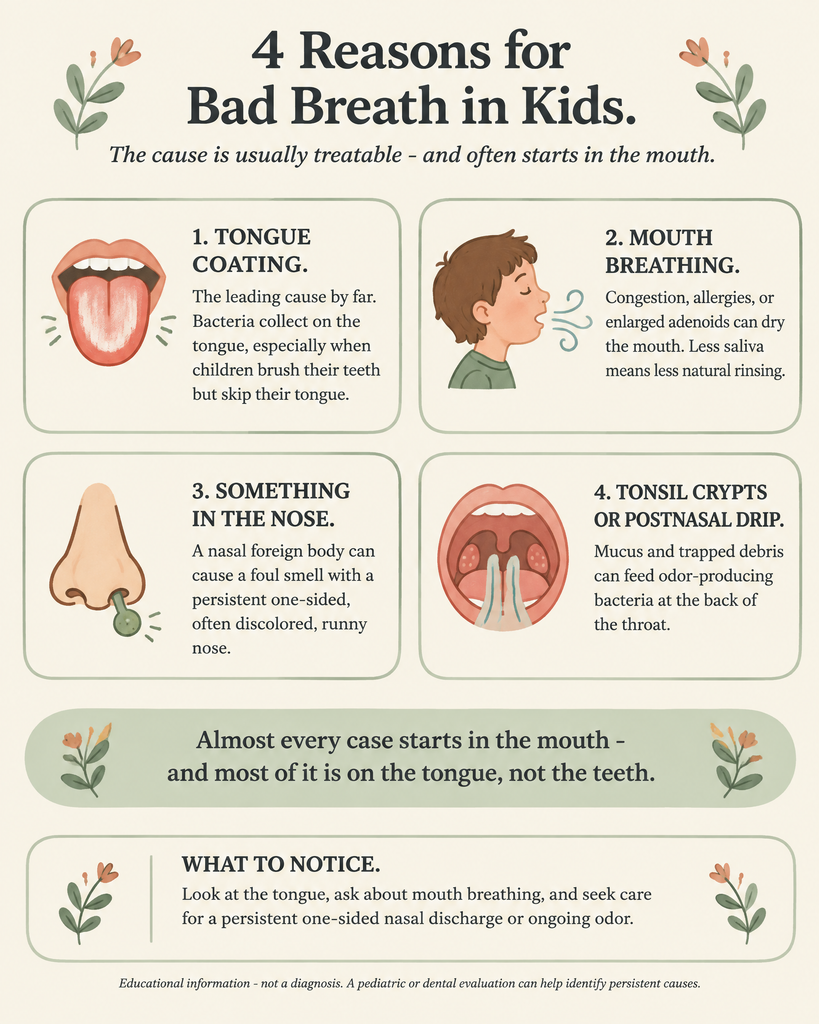
Tongue coating and oral hygiene. The leading cause by a wide margin. Studies in children find tongue coating thickness strongly associated with halitosis, alongside poor oral hygiene, gum inflammation, and cavities. Most children brush teeth and skip the tongue entirely.
Mouth breathing and dry mouth. Saliva is the mouth’s natural rinse. Persistent mouth breathing changes salivary flow and dries the oral surfaces, and multiple studies report significantly higher rates of halitosis in mouth breathers. This is also why bad breath so often travels with chronic congestion, allergies, and enlarged adenoids.
Something in the nose. Foreign bodies in the nasal cavity produce a foul odor — and toddlers put things in their noses. The tell is usually one-sided: a persistent one-sided runny nose, often discolored, with a smell that doesn’t match anything happening in the mouth. This is quickly resolved, but only once someone thinks to look.
Tonsil crypts and postnasal drip. Mucus from the sinuses draining onto the back of the tongue feeds the same bacteria. Deep tonsillar crypts can also collect small, foul-smelling debris that may not be visible on a casual look.
“Almost every case starts in the mouth — and most of it is on the tongue, not the teeth.”
| Conventional Approach | Root-Cause Approach | |
|---|---|---|
| First step | Brush more, use mouthwash | Look at the tongue, and at how the child is breathing |
| Focus | Mask the odor | Reduce the bacterial load and restore saliva flow |
| Airway | Not considered | Mouth breathing and congestion assessed directly |
| Timeline | Hours | Usually noticeable improvement within one to two weeks |
1. Brush the tongue, every time. This is the highest-yield change and the one almost everyone skips. Gentle brushing of the back two-thirds of the tongue, twice daily, targets exactly where the odor is produced.
2. Get water in throughout the day. Saliva is the mouth’s own defense. Children who drink infrequently, or who are mouth breathing at night, run dry — and dry mouths smell. A water bottle in reach all day does real work here.
3. Address the congestion, not just the breath. If your child is mouth breathing because they can’t breathe through their nose, the bad breath is downstream of that. Saline rinses, allergen reduction in the bedroom, and an honest look at whether adenoids are involved will do more than any rinse.
4. Feed the mouth well. Crunchy raw vegetables and fruit mechanically clean, and they stimulate saliva. Frequent grazing on sticky, sugary foods and sipping juice all day does the opposite — it keeps a constant fuel supply available to the bacteria producing the odor.
5. Keep dental visits current. Halitosis is among the most common reasons for dental visits, after cavities and gum disease. A dentist can spot decay, gum inflammation, and areas of food retention that aren’t visible to you.
6. Skip the alcohol-based mouthwash. It masks odor briefly and dries the mouth, which works against saliva — the thing you actually want more of. If you use a rinse, choose an alcohol-free one appropriate for your child’s age.
Book a visit for one-sided foul-smelling nasal discharge, which warrants a look inside the nose; bad breath with fever, sore throat, or difficulty swallowing; a sweet, fruity, or unusual odor to the breath, which is a different situation and should be evaluated promptly; bad breath with poor weight gain, vomiting, or persistent stomach pain; or persistent bad breath in a child with good oral hygiene and a clean dental exam.
Also worth a conversation: snoring, gasping, or constant open-mouth breathing, since the airway piece connects to more than just breath.
Does bad breath mean my child has a gut problem? Usually no, and this is worth being clear about. Around 90% of halitosis originates in the mouth, with only about 5% traced to gastrointestinal or endocrine causes. Gut health matters for plenty of reasons — it just isn’t where this particular symptom usually starts. Cleaning the tongue is a far better first move than a digestive protocol.
Could this be tonsil stones? Possibly. Deep tonsillar crypts can hold small calcified deposits with a distinctly foul odor, and they may not be obvious on a quick look. Worth mentioning at a visit if the breath is bad and the mouth otherwise looks fine.
Should I try a probiotic? Oral probiotics are being actively studied for halitosis and are a reasonable conversation to have with your provider. They’re a supplement to tongue cleaning and airway care, not a replacement for either.
Why is it worse in the morning? Saliva production drops during sleep, so bacteria go unrinsed for hours. Morning breath alone is normal. All-day breath is the one to investigate.
Bad breath in a child is one of those symptoms that seems trivial and turns out to be informative — most often about the tongue, and second most often about how they’re breathing.
“Brush the tongue for two weeks. If nothing changes, look at the nose.”
Whether this is your first visit or your next one, this is usually a quick one to sort out.