
Hives are common in childhood — roughly 15% of children under 10 have at least one episode, and the rate is higher in children who already have allergies or eczema. Viral infections are the single biggest identifiable trigger, accounting for about 40% of acute hives in children. Food is a far less common cause than most parents assume. In roughly half of cases, no clear trigger is ever found. That’s a normal outcome, not a failed investigation. Hives alone are not an emergency. Hives with swelling of the lips, tongue, or face, or any trouble breathing or swallowing, need emergency help immediately.
Why does my kid get hives? Most often, a virus — not food. It’s one of the more alarming things to walk into — raised, blotchy welts that seem to move around the body, appear from nowhere, and look far more dramatic than almost anything else that happens to a child’s skin.
The reassuring news: when parents ask ‘why does my kid get hives?’, the answer is usually harmless and short-lived, and the most common cause is something you’d never guess from looking at them.
Hives, or urticaria, happen when specialized immune cells in the skin release histamine and other chemicals. That causes small blood vessels to leak fluid into the surrounding tissue, which produces the raised, itchy welts.
Two features distinguish hives from almost any other rash. Individual welts move — one fades within minutes to a day while new ones appear somewhere else. And they blanch: press one with a finger and the center briefly goes pale.
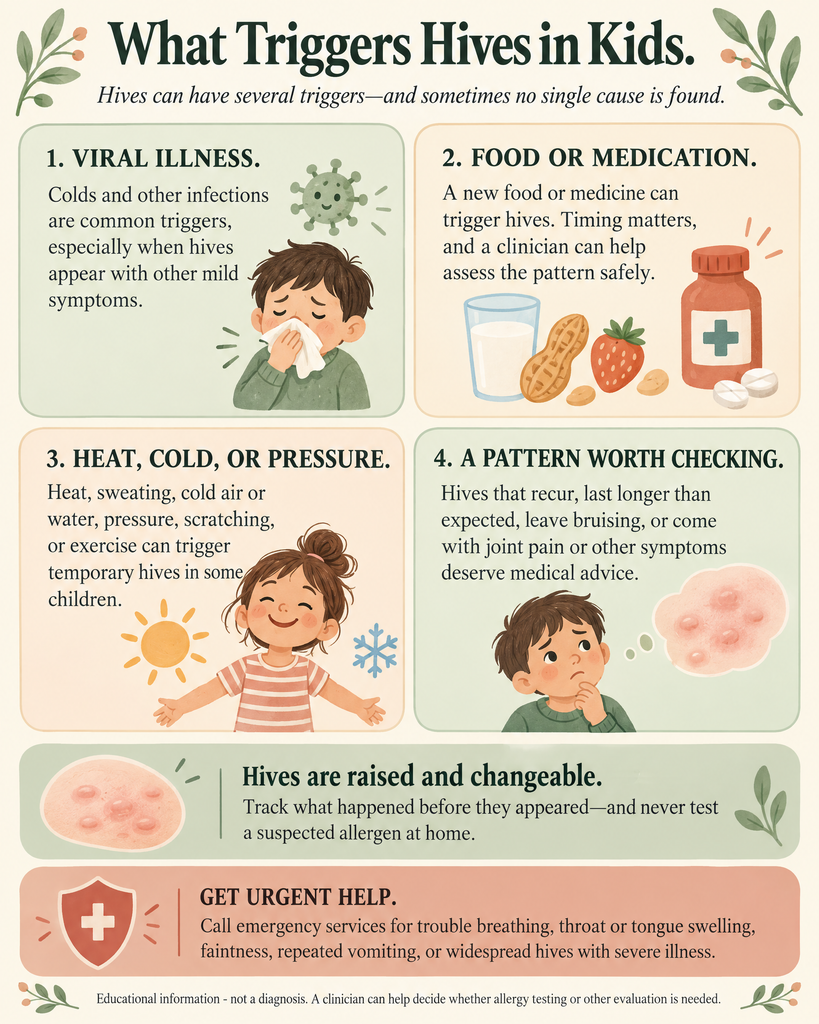
You may already know that allergies cause hives. What surprises most parents is how far down the list food actually sits. Viral infections are the most common identifiable trigger in children, responsible for about 40% of acute cases. This is why hives so often show up during or just after a cold — the immune system is already activated, and the skin reacts.
What typical childhood hives look like:
Raised welts, pink or skin-colored, often with a pale center Itchy, sometimes intensely Individual spots lasting minutes to 24 hours, then fading New welts appearing elsewhere as old ones disappear Changing size and shape, sometimes merging into larger patches Blanching when pressed No lasting mark once a welt fades
Viral infections. The leading identifiable cause. Hives frequently appear a few days into a cold, or just as a child is recovering — which is why so many parents connect them to a new food or medicine started during the illness instead. If you’re wondering why does my kid get hives after a cold, this is usually the answer.
Foods. Real, but less common than assumed. Food-triggered hives follow a tight timeline: they appear within minutes to about two hours of eating, and the same food does it reliably every time. Milk, egg, peanut, tree nuts, soy, wheat, fish, and shellfish account for most of it. Hives appearing hours after a meal, or after a food your child has eaten safely for years, usually point elsewhere.
Medications. Antibiotics and anti-inflammatory medicines are the usual suspects. Because antibiotics are often started during an infection that could itself cause hives, this one genuinely requires your provider’s judgment — don’t label your child allergic without that conversation.
Physical triggers. Pressure, friction from clothing or a backpack strap, heat, cold, sweat, and exercise can all produce hives in susceptible children. These tend to be reproducible and localized to the area involved.
Insect stings and environmental contact. Stings, plants, animal saliva, and latex can produce hives where contact occurred, or more widely.
No identifiable trigger. In about half of cases, the honest answer to ‘why does my kid get hives?’ is that nothing specific is found. The hives resolve anyway.
“If hives show up during a cold, the cold is usually the explanation. Most parents go looking at the dinner plate instead.”
Acute hives resolve within hours to days, and usually fully within a few weeks. This is the overwhelming majority of childhood hives.
Chronic hives means welts recurring most days for more than six weeks. This is much less common, and worth knowing one thing about: food allergy is almost never the cause. Parents put enormous effort into elimination diets for chronic hives, and it rarely helps. Chronic hives are sometimes linked to thyroid or autoimmune conditions, which is why evaluation looks in a different direction entirely.
| Conventional Approach | Root-Cause Approach | |
|---|---|---|
| First step | Antihistamine and reassurance | Same relief, plus a timeline to identify what actually triggered it |
| Food | Broad allergy testing or elimination | Test the specific suspicion when the timeline fits; avoid blind panels |
| Chronic cases | Ongoing symptom control | Look at thyroid and autoimmune contributors |
| Timeline | Days | Days for acute; weeks to sort a recurring pattern |
1. Write down the timeline before you change anything. When the hives started, what your child ate in the two hours before, any illness in the previous week, new medications, new soaps or detergents, and where on the body it started. This is far more diagnostically useful than a broad allergy panel, and it costs nothing.
2. Cool the skin. Cool compresses, a cool (not cold) bath, and loose cotton clothing all help genuinely. Heat makes hives itchier, so skip the warm bath you’d normally reach for.
3. Keep fingernails short. Scratching releases more histamine and makes the welts worse. Short nails and soft sleeves limit the damage overnight.
4. Ask your pediatrician about an antihistamine. An over-the-counter antihistamine is the standard first-line comfort measure, but the right product and dose depend on your child’s age and weight — that’s a question for your pediatrician rather than a guess at the pharmacy.
5. Don’t eliminate foods on suspicion alone. Unnecessary elimination narrows a child’s diet, creates anxiety around eating, and can make true allergy testing harder to interpret later. If the timeline genuinely points at a food, test that specific food.
6. Photograph it. Hives often vanish by the time you reach an appointment. A clear photo in good light settles a lot of questions quickly.
Get emergency help right away — call 911 — for swelling of the lips, tongue, face, or throat; trouble breathing, wheezing, or noisy breathing; difficulty swallowing or a change in voice; repeated vomiting alongside hives; dizziness, pallor, or floppiness; or hives that come on within minutes of a known allergen, a sting, or a new medication. These suggest a serious allergic reaction, which needs treatment immediately rather than observation.
Book a regular visit for hives lasting more than a few days, hives recurring most days for more than six weeks, hives with joint pain or fever, welts that leave bruising or last longer than 24 hours in one spot, or any episode where you suspect a specific food or medication.
Why does my kid get hives after being sick? Because the immune activation from a virus is itself one of the most common triggers. It’s an immune response to the infection, not a new allergy — and it typically settles as the illness resolves.
Are hives always an allergy? No. Viral infections, physical triggers like pressure and cold, and unidentified causes together account for far more childhood hives than food allergy does.
Should my child get allergy tested? Only when the history points somewhere specific. Broad panels ordered without a clear suspicion frequently produce positive results to foods a child eats without any problem, which leads to unnecessary restriction.
How long will this last? Individual welts fade within minutes to 24 hours. Most episodes clear within days, and nearly all within a few weeks. Beyond six weeks, it’s considered chronic and the evaluation changes.
Why does my kid get hives? Most often, a virus their immune system is already fighting — not something they ate. They look dramatic, they itch, and they almost always resolve on their own.
“Hives alone, with a comfortable child, is a watch-and-soothe situation. Hives with swelling or breathing trouble is a 911 call. Knowing the difference is most of what parents need.”
Whether this is your first visit or your next one, bring the timeline and the photos — they usually answer the question.
Does Your Child Keep Getting Hives? Our team would love to meet with you.
Click this link to schedule a time to meet with our team.