
Why does my kid get so many stomach bugs is a seasonal question with a seasonal answer — school and daycare put children in contact with the most contagious viruses we know of. Hand sanitizer is the weak link. The CDC states plainly that hand sanitizer alone does not work well against norovirus, the most common cause of stomach bugs. Children stay contagious long after they feel better. Norovirus can remain in stool for two weeks or more after symptoms stop. Rehydration is the whole game. Oral rehydration beats everything else for mild to moderate dehydration, and anti-diarrheal medicines are not recommended for children.
Why does my kid get so many stomach bugs? If it feels like your household has been through three of them since August, you’re not imagining a pattern — and in most cases, you’re also not doing anything wrong.
Acute gastroenteritis accounts for roughly 1.5 million pediatric office visits a year in the US. The viruses behind it are built to spread, children are built to share, and the standard defenses most families rely on don’t work as well as people assume.
Most stomach bugs are viral, and norovirus is the usual culprit. A few things about it explain almost everything parents find frustrating.
It takes a tiny dose to infect someone. It spreads through contaminated hands, surfaces, food, and airborne particles from vomiting. Immunity after an infection is short-lived and strain-specific, so catching one in October offers little protection in January. And it survives on surfaces and resists many routine cleaners.
You may already know that handwashing matters. What’s less widely known is how specific that advice needs to be: alcohol-based hand sanitizer, which works well against many germs, is not effective against norovirus. Families who switched to sanitizer as their main defense are effectively unprotected against the most common stomach bug.
A typical viral stomach bug:
Sudden onset of vomiting, often with diarrhea Low-grade fever and stomach cramps Worst in the first 24 to 48 hours Resolving within a few days Multiple household members affected in sequence Contagious before symptoms start and for two weeks or more afterward
Ordinary exposure. Several viral illnesses a year is normal for a young child in group care. The immune system is building a library it doesn’t have yet.
Short, strain-specific immunity. Recovering from one norovirus strain doesn’t protect against the others in circulation. This is the single biggest reason for repeat infections in the same season.
The hand-hygiene gap. Sanitizer in the backpack, sanitizer by the classroom door, sanitizer in the car — and very little actual soap-and-water handwashing. Twenty seconds with soap and running water is the intervention that works. Handwashing campaigns have been found to reduce gastrointestinal infections by around 30%.
Reinfection inside the house. The virus lingers on surfaces, in laundry, and in stool for weeks. Households often pass the same bug around for a fortnight because cleanup didn’t match the organism.
Returning to shared food too soon. The CDC advises waiting at least 48 hours after symptoms stop before preparing food for others — a detail almost nobody follows.
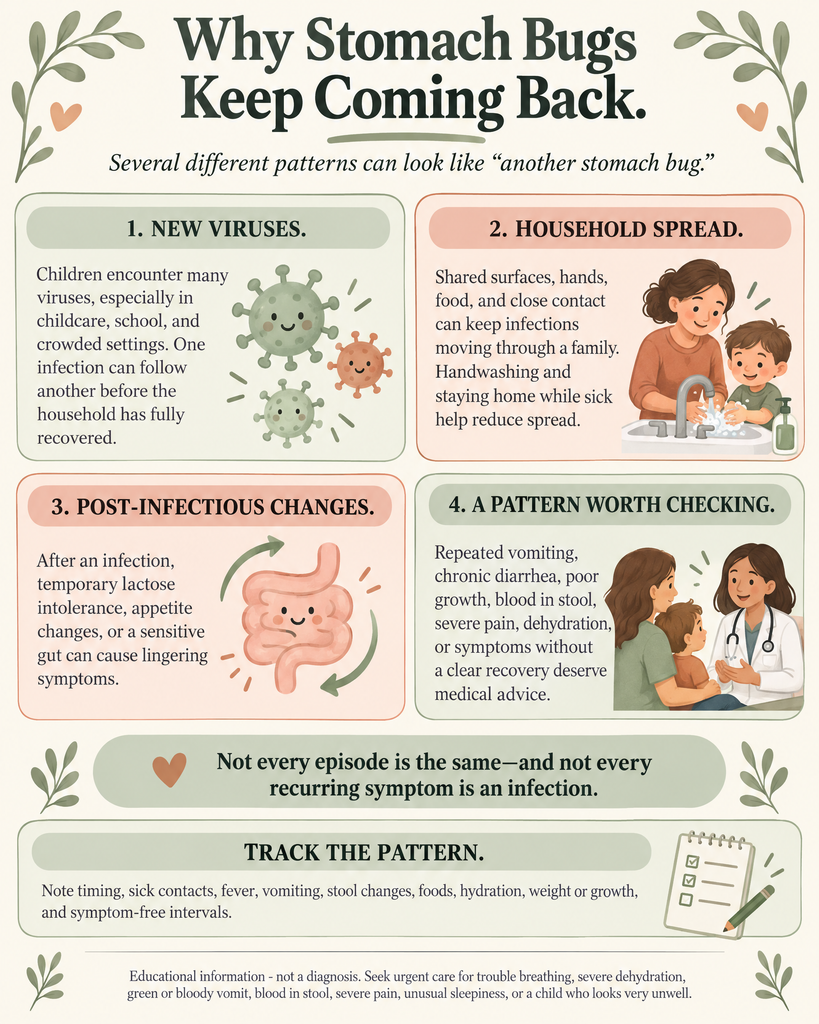
If you’re asking why does my kid get so many stomach bugs, most of the time the answer is exposure. These patterns suggest looking further:
Symptoms that never fully clear between “bugs.” Loose stools continuing for weeks, rather than discrete episodes with well periods in between, points toward something ongoing — giardia, celiac disease, a food intolerance, or post-infectious changes — rather than back-to-back viruses.
Diarrhea lasting more than two weeks. This is a different conversation from an acute bug and deserves evaluation.
Poor weight gain or weight loss. The most important signal on this list. Frequent illness that’s affecting growth needs a workup.
Greasy, pale, foul-smelling, or floating stools. Suggests fat malabsorption rather than a simple virus.
Blood in the stool, or recurrent unexplained fevers.
Severe infections in other systems too — recurrent pneumonia, skin abscesses, or unusual infections alongside the gut symptoms. Immune problems are genuinely rare, and this is the pattern that raises the question.
“Several stomach bugs a winter in a child at daycare is a social problem, not a medical one. Symptoms that never fully resolve are a different story.”
| Conventional Approach | Root-Cause Approach | |
| Prevention | Hand sanitizer and hope | Soap-and-water technique, household containment, the 48-hour rule |
| During illness | “Push fluids” | Structured oral rehydration in small, frequent volumes |
| After illness | Back to normal immediately | Deliberate gut recovery with food-first support |
| Recurrence | Assume bad luck | Distinguish repeat exposure from one unresolved problem |
1. Teach the twenty seconds. Soap and running water, scrubbing for a full twenty seconds, especially after the toilet and before eating. Sanitizer is a supplement for when there’s no sink — not a substitute, and not reliable against norovirus.
2. Clean up vomit like it’s contagious, because it is. Gloves, paper towels, straight into a bag. Then disinfect with a bleach solution and leave it on the surface for at least five minutes before wiping. Routine all-purpose sprays won’t do the job.
3. Wash laundry hot, and don’t shake it. Soiled clothes and bedding carry the virus. Handle them without shaking, wash with detergent on the hottest, longest cycle, and dry on high heat.
4. Rehydrate in small, frequent volumes. This is the core of home care. For a young child, roughly a teaspoon every one to two minutes works better than a cup they’ll vomit back. If vomiting happens, wait five to ten minutes and restart more slowly. An oral rehydration solution is the standard for moderate dehydration; for mild cases, diluted apple juice followed by preferred fluids performed well in trial data. Keep breastfeeding right through.
5. Skip the anti-diarrheal medicines. They aren’t recommended for children with acute gastroenteritis. Let the illness run its course while you keep up with fluids.
6. Return to normal food sooner than you think. Once rehydrated, an age-appropriate diet is recommended — there’s no need for an extended bland-food period, and milk products don’t need avoiding.
7. Support recovery afterward. A few days of easy, nourishing food — soups, cooked vegetables, yogurt or kefir if tolerated, plenty of fluids — helps the gut lining and microbiome recover, particularly after repeated illnesses or a recent course of antibiotics.
8. Hold the 48-hour line. No food prep for others, and where possible no return to group care, until 48 hours after symptoms stop. This is the single most effective way to stop the household cycle.
Seek care promptly for signs of dehydration — no urine for 8 hours, no tears when crying, a dry mouth, sunken eyes, or unusual sleepiness; vomit that is green or bloody; blood in the stool; a temperature of 104°F or higher; severe or localized abdominal pain; a child who is difficult to rouse, limp, or inconsolable; or any vomiting or diarrhea in an infant under six months.
Book a regular visit for diarrhea lasting more than two weeks, symptoms that never fully clear between episodes, poor weight gain or weight loss, greasy or pale stools, or recurrent infections in other systems alongside the gut symptoms.
Why does my kid get so many stomach bugs but I never do? Adults have encountered more strains and have better hand hygiene habits. You’re also probably not putting your hands in your mouth after touching a classroom door handle.
Does hand sanitizer prevent stomach bugs? Not reliably. The CDC states that hand sanitizer alone does not work well against norovirus. Soap and water is the defense that works.
How long are they contagious? Longer than most parents expect. Virus can appear before symptoms start and remain in stool for two weeks or more after recovery. Wait at least 48 hours after symptoms stop before food prep or close contact with others.
Do probiotics prevent stomach bugs? The evidence for routine use during acute gastroenteritis is unclear. A food-first approach to gut recovery after illness is reasonable; a specific supplement is worth discussing with your pediatrician rather than assuming.
Should I give sports drinks? They’re high in sugar and not designed for rehydration during illness. An oral rehydration solution is the better choice for moderate dehydration, and diluted juice is a reasonable option for mild cases.
Why does my kid get so many stomach bugs? Usually because the viruses are extraordinarily contagious, immunity is short-lived, and the hand sanitizer everyone’s relying on doesn’t work on the main offender.
“Soap, hot laundry, and 48 hours. That’s what breaks the cycle in a house — not another bottle of sanitizer.”
Whether this is your first visit or your next one, if the bugs never fully clear or growth has slowed, that’s worth a closer look.
Still Asking Why Does My Kid Get So Many Stomach Bugs? Our team would love to meet with you.
Click this link to schedule a time to meet with our team.
Related: Why Is My Child’s Poop Weird? | Why Does My Toddler Get Sick So Often? | Why Is My Toddler So Constipated?