
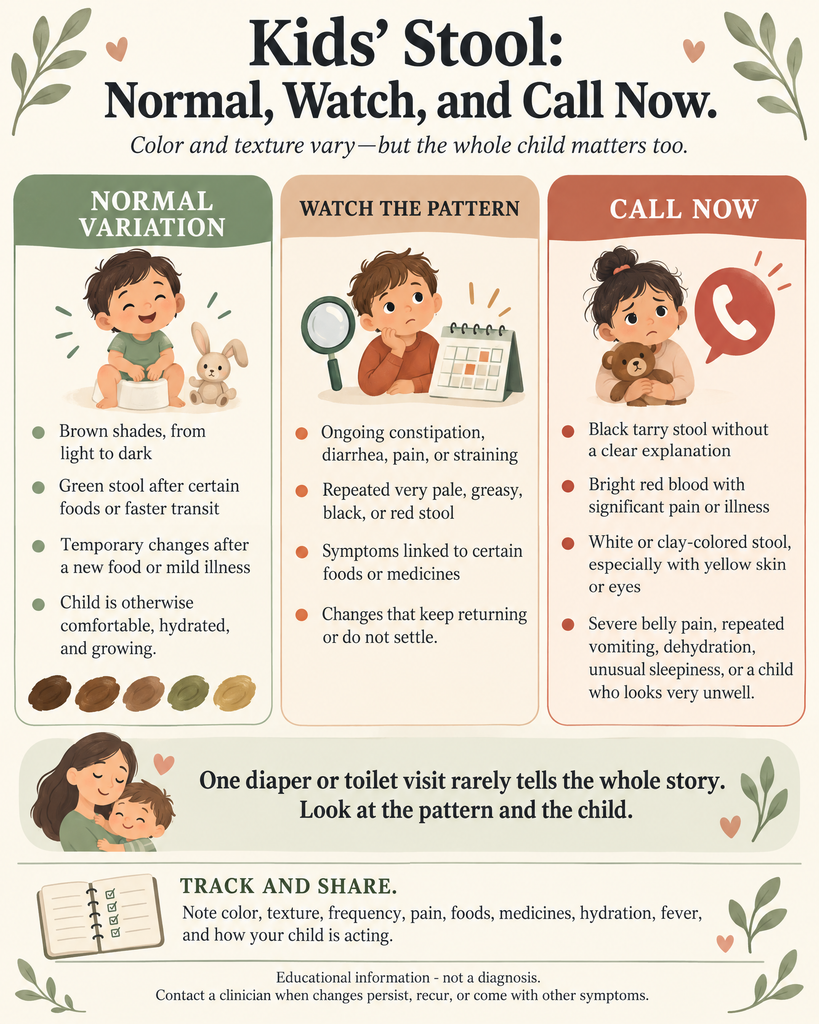
Why is my child’s poop weird is a question with a reassuring answer most of the time — brown, green, and yellow are all normal, and most unusual colors come from food. Three colors are worth acting on: white or clay-colored, black that isn’t explained by iron or bismuth, and red that isn’t explained by food. Texture tells you more than color does. Hard pellets, ribbon-thin stools, and greasy floating stools each point somewhere specific. Undigested food in a toddler’s stool is usually normal. Food moves through small children quickly, and recognizable corn or carrot is not a sign of poor digestion.
Why is my child’s poop weird? Every parent has stood over a toilet or a diaper at some point wondering whether what they’re looking at is normal.
Usually it is. Stool color and texture shift constantly with diet, hydration, and how fast things are moving. But a small number of findings genuinely matter, and knowing which ones saves you both unnecessary worry and dangerous reassurance.
Stool gets its normal brown color from bile, a digestive fluid made by the liver. As bile travels through the intestine it changes color — from green, through yellow, to brown. So where stool lands on that spectrum mostly reflects how fast it moved.
Fast transit means less time to change color, which is why diarrhea is often green or yellow. Slower transit means browner stool. Both are normal.
Brown — normal.
Green — normal. Common with faster transit, leafy vegetables, green food coloring, and iron supplements.
Yellow — normal, and expected in breastfed infants, where seedy mustard-yellow stool is the standard.
Blue or purple — almost always food dye. Frosting, sports drinks, and brightly colored candy are frequent culprits.
Red or pink — usually food or medication: beets, cranberries, tomato soup, red gelatin, red candy or cereal, and certain antibiotics. Red that food doesn’t explain needs a provider’s assessment.
Black — usually iron supplements or bismuth-containing stomach medicines. Black that isn’t explained by those needs assessment, because digested blood from higher in the gut looks black and tarry.
White, gray, or clay-colored — always needs evaluation, and reasonably promptly. Pale stool can mean bile isn’t reaching the intestine, which points to a liver or bile-duct problem.
Texture is often more informative than color, and parents tend to overlook it.
Hard pellets or large, hard, painful stools. The most common abnormal finding in children. This is constipation, even if your child goes every day — and especially if there’s pain, straining, or stool withholding afterward.
Thin, ribbon-like stools. Occasionally normal, but worth mentioning if persistent, particularly alongside constipation.
Loose and watery. Expected with a stomach bug. Lasting more than two weeks is a different conversation.
Greasy, pale, floating, foul-smelling stools that are hard to flush. Suggests fat isn’t being absorbed properly. Worth evaluating, particularly alongside poor weight gain — celiac disease and pancreatic conditions present this way.
Mucus. Small amounts are common and usually harmless, including with constipation. Persistent mucus with blood, pain, or weight loss needs assessment.
Undigested food. Normal in toddlers. Transit is fast and chewing is imperfect, so corn, peas, carrots, and beans frequently appear recognizable. On its own, this isn’t a digestive problem.
Very loose stools several times a day in an otherwise thriving toddler. Often “toddler diarrhea,” a benign pattern commonly driven by high juice intake and a low-fat diet, in a child who is growing normally and acting well.
“Color is usually about what they ate and how fast it moved. Texture is usually about what’s actually happening.”
| Conventional Approach | Root-Cause Approach | |
| Focus | Is the color alarming? | What do color, texture, frequency, and comfort say together? |
| Constipation | Treated as infrequency | Treated as hard or painful stools, regardless of frequency |
| Diet | Rarely reviewed | Juice, fiber, fluid, and dairy volume reviewed directly |
| Persistent change | Watch and wait | Evaluated when it passes two weeks or affects growth |
1. Track for a week before changing anything. Color, texture, frequency, pain, and any straining or withholding. A week of notes answers ‘why is my child’s poop weird?’ far better than memory, and is genuinely useful at a visit.
2. Photograph anything concerning. Especially pale, black, or red stool. Describing a color from memory is unreliable, and a photo settles it immediately.
3. Check the juice. Excess juice is one of the most common causes of chronic loose stools in toddlers. Reducing it — and offering whole fruit and water instead — often resolves the pattern within a week or two.
4. Build fiber and fluid gradually for hard stools. Fruits, vegetables, beans, and whole grains, alongside adequate water. Add slowly; a sudden jump produces gas and discomfort. Pears, prunes, and kiwi are reliably helpful.
5. Create an unhurried post-meal sit. Five minutes after a meal, with a footstool so knees sit above hips. This uses the body’s natural post-meal reflex and gives a child a predictable, pressure-free routine.
6. Watch for the withholding cycle. One painful stool teaches a child to hold the next one, which makes it harder and more painful. Catching this early is far easier than unwinding it later — we cover it in depth in our piece on toddler constipation.
7. Review the medication and supplement list before worrying about color. Checking this list often answers ‘why is my child’s poop weird?’ before it turns into unnecessary alarm.
Seek care immediately for stool that looks like red currant jelly, especially with episodes of severe intermittent abdominal pain and drawing the knees up — this combination can indicate a bowel obstruction and is an emergency. Also seek urgent care for significant rectal bleeding, black tarry stools in a child who isn’t taking iron or bismuth, a swollen hard belly with vomiting, or green bilious vomiting.
Book a visit for white, gray, or clay-colored stool at any age; red or black stool not explained by food or medication; diarrhea lasting more than two weeks; greasy, pale, floating stools; poor weight gain or weight loss; persistent abdominal pain; stool withholding or painful bowel movements; small amounts of blood on the surface of stool or on the toilet paper, which usually indicates a fissure from constipation but should still be confirmed; or yellowing of the skin or eyes alongside pale stool.
For infants, pale or white stool should be evaluated promptly rather than at the next scheduled visit.
Why is my child’s poop green? Usually faster transit, leafy greens, green food coloring, or iron. Green alone, in a well child, is not a concern.
Is undigested food in my toddler’s stool a problem? Usually not. Food moves quickly through small children and chewing is incomplete. It becomes relevant only alongside poor growth, greasy stools, or persistent diarrhea.
My child’s stool had a streak of blood — how worried should I be? Small amounts of bright red blood on the surface or on the toilet paper most often come from a small tear caused by a hard stool. It’s common and usually benign, but it should be confirmed rather than assumed, especially if it recurs.
What does white or pale stool mean? It can mean bile isn’t reaching the intestine, which is a liver or bile-duct issue. This is the one color that always needs evaluation, and promptly in infants.
How often should my child poop? The range is wide — several times a day to every other day can be normal. What matters more is whether stools are soft, comfortable, and passed without straining or withholding.
Why is my child’s poop weird? Nine times out of ten, the answer is something they ate or how fast it moved through. The value of knowing the short list of exceptions is that it tells you exactly when to stop watching and make a call.
“Green, yellow, and brown are fine. White, unexplained black, and unexplained red are phone calls.”
Whether this is your first visit or your next one, bring the week of notes and the photo. It makes this a five-minute conversation.
Are You Struggling With Your Child’s Tummy or Stool Troubles? Our team would love to meet with you.
Click this link to schedule a time to meet with our team.
Related: Why Is My Toddler So Constipated? | Why Does My Kid Get So Many Stomach Bugs? | Why Is My Baby So Gassy?