
A rash that won’t clear is often a rash that’s being treated as the wrong thing. Ringworm treated with a steroid cream can look better for a few days, then spread. Some rashes simply take a long time. Molluscum usually lasts six months to a year, and pityriasis rosea typically runs six to eight weeks, on their own. Contact allergies in kids are more common than parents expect. In a review of more than 11,000 children, nearly 12% reacted to nickel — found in snaps, zippers, belt buckles, and jewelry. Hives that keep coming back for more than six weeks are rarely caused by food.
Why won’t my child’s rash go away? A rash that won’t clear is often a rash that’s being treated as the wrong thing.
A rash that lingers isn’t necessarily serious. But it usually means one of two things: it’s a condition that naturally takes weeks or months to run its course, or it’s being treated as something it isn’t. Figuring out which one is the whole game.
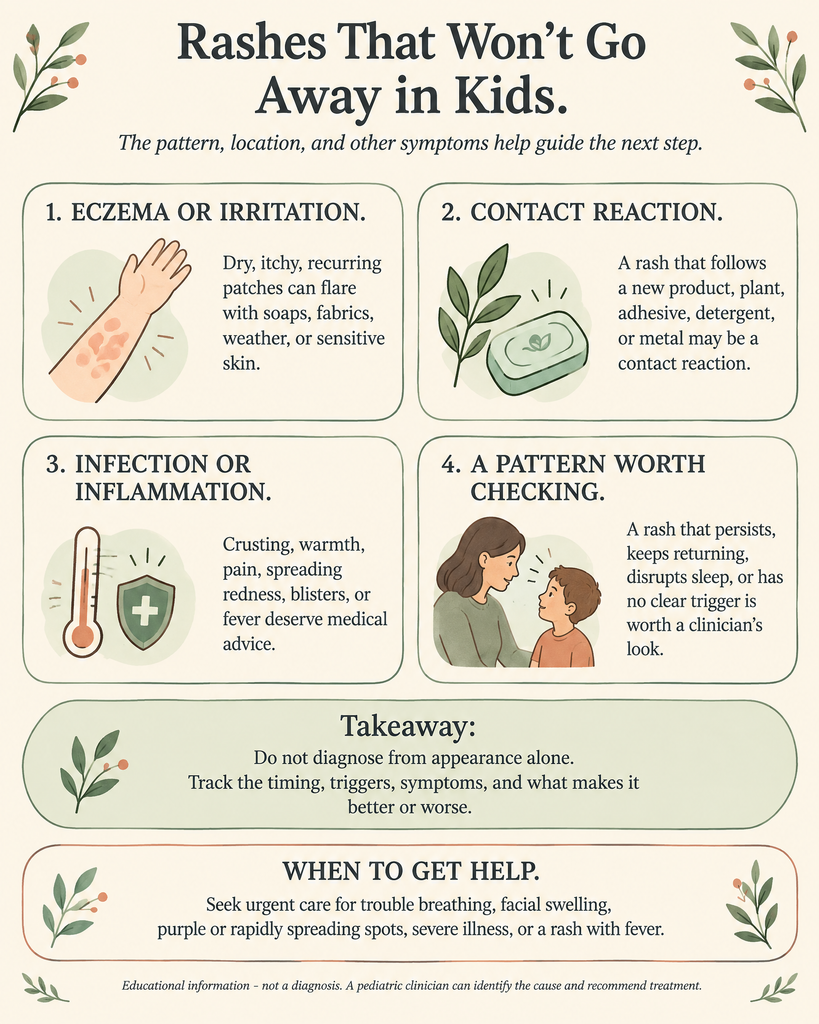
Most childhood rashes fall into a few categories: infections (fungal, viral, or bacterial), reactions to something touching the skin, immune reactions like hives, and skin conditions that come and go.
You may already know that eczema and diaper rash are the most common. What gets missed is that several other rashes look similar enough to be mistaken for them — and some get worse with exactly the treatment that helps eczema.
That’s why the most useful questions aren’t about the cream. They’re about the rash itself: what shape it is, where it is, whether it itches, how long it’s been there, and whether anyone else in the house has it.
Details worth noting before you see a provider about why won’t my child’s rash go away:
When it started and whether anything changed around that time Whether it’s one patch or many The shape — ring-shaped, raised bumps, flat patches, or scattered spots Whether it itches, and whether itching is worse at night Whether it’s spreading, and in which direction What you’ve already put on it, and whether it helped or hurt Whether siblings or parents have anything similar
Ringworm treated like eczema. Ringworm is a fungal infection, not a worm, and it often starts as a scaly, ring-shaped patch with a clearer center. Steroid creams — including over-the-counter anti-itch creams — can suppress the inflammation and make it look better for a few days. But they don’t treat the fungus, and they change how it looks. DermNet describes this altered version, called tinea incognito, as less raised, less scaly, more widespread, and more irritable than untreated ringworm. The cycle is familiar: cream helps, cream stops, rash comes back bigger — a classic answer to why won’t my child’s rash go away.
Molluscum contagiosum. Small, smooth, pearly, dome-shaped bumps, often with a tiny dimple in the center. It’s a common viral skin infection in children aged 1 to 10, and according to the CDC it typically clears on its own in six months to a year, sometimes longer. It’s harmless, but slow — which is exactly why parents ask why won’t my child’s rash go away.
Contact dermatitis. An itchy rash exactly where something touches the skin. In a 2025 review of 11,593 children who were patch tested, nickel was the most common allergen at 11.9%, followed by cobalt at 6.6% and fragrance mix at 4.8%. The pattern is the clue: a patch under a pants snap, on the earlobes, on the wrist under a watch, or on the hands after homemade slime.
Pityriasis rosea. Often begins with one larger oval patch — the “herald patch” — followed days later by smaller patches across the trunk, sometimes in a pattern that looks like the branches of a tree. The American Academy of Dermatology describes it as harmless. It usually lasts six to eight weeks before disappearing on its own — another slow, harmless answer to why won’t my child’s rash go away.
Chronic hives. Raised, itchy welts that move around and come and go within hours. When they recur at least twice a week for more than six weeks, they’re considered chronic. The American College of Allergy, Asthma and Immunology notes that in most cases no specific cause is found — and that food is almost never the trigger, despite what most parents assume.
Scabies. Intensely itchy, especially at night, often between the fingers, on the wrists, around the waist, or in skin folds — and frequently affecting more than one person in the household. It doesn’t clear without treatment.
Keratosis pilaris. Rough, sandpapery little bumps on the backs of the upper arms, thighs, or cheeks. Very common, harmless, and slow to change — it tends to improve with age and with gentle, consistent moisturizing.
“A rash that won’t go away is usually a rash that hasn’t been correctly named yet.”
| Conventional Approach | Root-Cause Approach | |
|---|---|---|
| First step | Try a steroid cream and see | Identify the rash by shape, location, and history first |
| When it fails | Try a stronger cream | Reassess — a failed treatment is diagnostic information |
| Focus | Calm the skin | Find the trigger, infection, or exposure behind it |
| Timeline | Days, often with relapse | Depends on the cause — some resolve in days, some take months on their own |
1. Stop, photograph, and observe. Take a photo in good light each day for a week. It shows whether the rash is spreading, changing shape, or improving — far more reliably than memory — and it’s genuinely useful at a visit.
2. Don’t keep using a cream that isn’t working. If a steroid cream helped briefly and then the rash got worse, stop and have it looked at. Continuing makes fungal rashes harder to diagnose.
3. Hunt for the contact. Look at exactly where the rash is and ask what touches that spot. Metal snaps on pants, earrings, watches, new soaps, fragranced lotions, and slime are frequent offenders. Swapping to fragrance-free products and covering metal fasteners is often enough to confirm the answer.
4. Support the skin barrier. A plain, fragrance-free moisturizer applied after a lukewarm bath helps nearly every irritated skin condition and doesn’t interfere with diagnosis.
5. Keep contagious rashes contained. For molluscum and ringworm, avoid scratching and shaving over the area, keep towels separate, and cover lesions during contact sports or swimming. It limits spread to other parts of the body and to siblings.
6. Check the rest of the household. If a sibling or parent is itchy too, especially at night, say so. It changes the list of likely causes immediately.
Book a visit for a rash that’s lasted more than two weeks without clear improvement, a rash that got worse after using a steroid cream, a ring-shaped scaly patch, honey-colored crusting, bumps that are spreading quickly, or intense itching that’s worse at night — especially if others in the house are itchy too.
Seek urgent medical care immediately for a rash with fever in a child who seems unwell; small red or purple spots that don’t fade when you press a clear glass against them; blistering or peeling skin; rapidly spreading redness that’s warm or painful; swelling of the lips, tongue, or face; difficulty breathing; or any rash near the eyes with swelling or vision changes.
Why won’t my child’s rash go away even with cream? The most common reason is that the cream doesn’t match the cause. Steroid creams calm inflammation but don’t treat fungal infections, and they won’t speed up viral rashes like molluscum. A rash that’s resisting treatment needs to be re-identified, not treated harder.
How do I know if it’s eczema or something else? Eczema tends to appear in skin folds, is dry and very itchy, and flares and settles over time. Ring-shaped patches, pearly bumps, rashes in the exact shape of something touching the skin, or a single large patch followed by many smaller ones point elsewhere.
Is my child contagious? It depends on the cause. Ringworm, molluscum, impetigo, and scabies all spread through contact. Contact dermatitis, pityriasis rosea, hives, and keratosis pilaris do not.
Could it be a food allergy? Less often than parents expect. Food-related hives typically appear within minutes to a couple of hours of eating. Hives that recur for weeks are rarely caused by food, and most other lingering rashes aren’t food-related at all.
Why won’t my child’s rash go away even after we changed detergents and soaps? Because most lingering rashes aren’t caused by products at all. Contact reactions show up in the exact shape of what touched the skin — a snap, a waistband, a watch. If the rash doesn’t match that pattern, the cause is somewhere else, and swapping more products just delays the answer.
Why won’t my child’s rash go away? Usually because it’s either a slow rash doing exactly what it’s supposed to do, or a rash that’s being treated as the wrong thing. Both are answerable with a good look and a good history.
“When a cream stops working, don’t reach for a stronger one. Reach for a better answer.”
Whether this is your first visit or your next one, bring your photos. They do half the work.
Are You Asking Why Won’t My Child’s Rash Go Away? Our team would love to meet with you.
Click this link to schedule a time to meet with our team.