
Dark circles in kids are usually not about sleep. The most common cause is nasal congestion backing up the small veins that drain the area under the eyes.[1]
These are common enough to have a name: allergic shiners. In a study comparing 126 children with allergic rhinitis to 123 healthy children, the shiners were measurably darker and larger in the allergy group.[1]
The longer a child has had untreated nasal allergy, the darker the circles tend to get — and the darkness tracked with how much the allergies were affecting daily life.[1] Dark circles that come with constant mouth breathing and snoring point toward a structural airway issue worth evaluating, not a cosmetic one.[2]
The skin under the eyes is thinner than anywhere else on the face, and a network of small veins sits just beneath it. Those veins drain the lining of the nose and sinuses.
When that lining stays inflamed and congested, drainage backs up. The veins dilate and engorge, and because the skin above them is so thin, the pooling shows through as a blue-gray or purple shadow.[1] The term for dark circles in kids is allergic shiners, and it’s a plumbing problem, not a sleep problem.
Common signs that go with it:
A crease across the lower bridge of the nose from pushing it upward Mouth breathing, especially at night Snoring or noisy, restless sleep Frequent throat clearing or sniffing Extra skin folds under the lower eyelids Rubbing at the eyes and nose Circles that stay the same regardless of bedtime
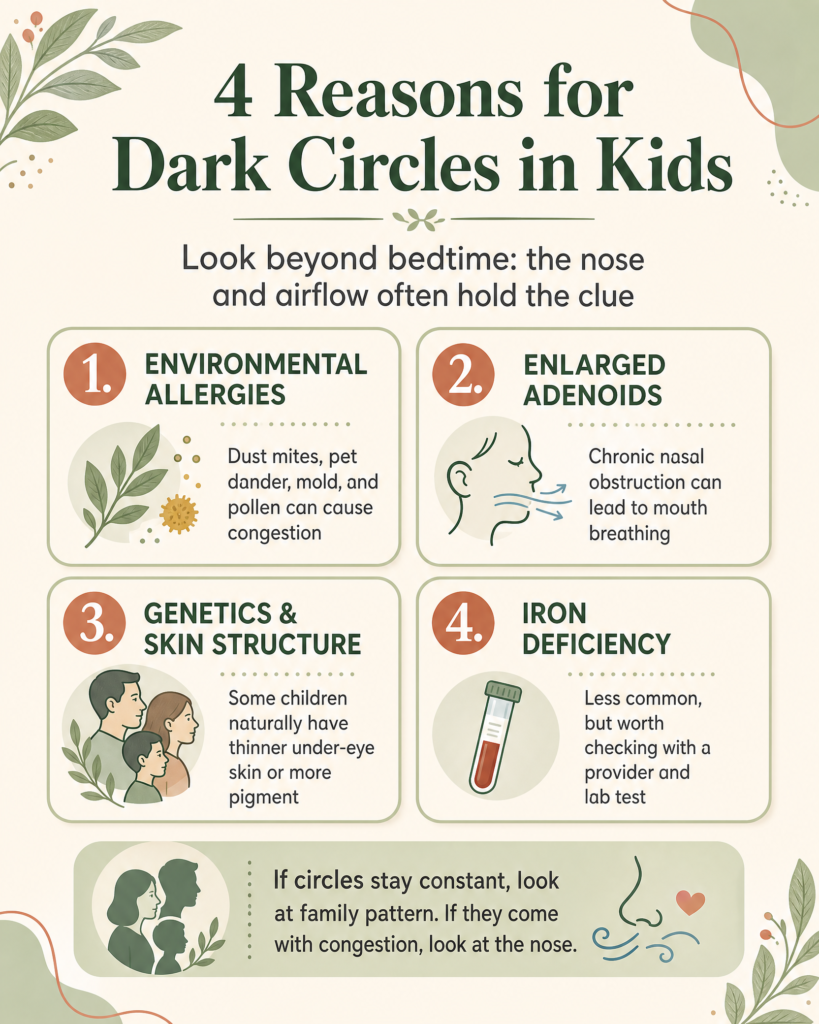
Environmental allergies. The most common driver of dark circles in kids. Year-round triggers like dust mites, pet dander, and mold matter as much as seasonal pollen, and perennial exposure is what produces the persistent version.[1]
Enlarged adenoids or chronic nasal obstruction. Adenoid tissue and nasal polyps can block airflow and produce the same venous congestion pattern. This is the one worth catching, because chronic mouth breathing in a growing child is associated with changes in facial and dental development over time — a narrow palate, an open-mouth resting posture, and altered jaw growth.[2]
Genetics and skin structure. Some dark circles in kids are simply structural simply have thinner under-eye skin or more pigmentation there, often mirroring a parent. The distinguishing feature is that genetic circles are constant — they don’t get darker in spring or after a night in a dusty room.
Iron deficiency. A real but less common cause in children than congestion, and worth checking with a blood test rather than assuming. Iron should never be supplemented in a child without a provider’s guidance and a lab result to justify it.
“If your child looks tired no matter how much they sleep, stop looking at bedtime and start looking at their nose.”
| Conventional Approach | Root-Cause Approach | |
|---|---|---|
| First step | Reassurance, or more sleep | Identify what’s keeping the nose congested |
| Focus | The appearance | Airflow, drainage, and how the child is breathing at night |
| Airway | Rarely assessed | Mouth breathing and snoring evaluated directly |
| Timeline | No change | Circles often lighten within weeks of resolving the congestion |
1. Clean up the bedroom environment first. It’s where your child spends the most consecutive hours. A HEPA filter, allergen-proof mattress and pillow covers, weekly hot bedding washes, and keeping pets out of the bedroom target the exposure that matters most.
2. Use saline rinses consistently. A daily saline spray or gentle rinse clears allergens and mucus mechanically, without medication. Consistency is what makes it work — occasional use won’t shift a chronic pattern.
3. Test rather than guess at allergies. Environmental allergy testing identifies the actual trigger instead of a season of trial and error with dark circles in kids. Given that duration of untreated allergy correlates with how dark the circles become, this isn’t worth putting off.[1]
4. Watch how your child breathes while they sleep. Go in twenty minutes after they fall asleep. Are their lips together or apart? Is there snoring, gasping, or a pause in breathing? Are they sleeping in odd positions with the neck extended? These observations are genuinely useful information for a provider.
5. Ask about an adenoid evaluation if mouth breathing persists. If your child is breathing through their mouth day and night, this deserves a look. The facial and dental changes associated with chronic mouth breathing develop gradually, which is exactly why they’re easier to address early.[2]
Book a visit for snoring most nights, gasping or observed pauses in breathing, constant open-mouth breathing, or circles that keep darkening despite allergy management.
Most dark circles in kids don’t need urgent evaluation, but book a visit for evaluation for discoloration that appears suddenly and looks like bruising — particularly on one side only, or paired with fever, bone pain, limping, unusual bruising elsewhere, or a child who simply isn’t acting like themselves. That combination is uncommon, and it isn’t the ordinary allergic pattern.
Does this mean my child isn’t sleeping enough? Usually no. It’s the most common assumption and the least common cause. Congestion and airway obstruction explain far more cases — and if your child is sleeping poorly, congestion is often why.
Will dark circles in kids go away? Allergic shiners typically fade as the nasal congestion resolves. In children who’ve had year-round allergies for a long time, the discoloration can be more stubborn and take longer to clear even after treatment starts.[3]
Can allergies really cause this if my child doesn’t sneeze much? Yes. Perennial allergy often looks less like classic hay fever and more like a child who is quietly congested all the time — mouth breathing, throat clearing, restless sleep.
Would eye cream help? No. There’s nothing to treat at the skin level; the discoloration comes from the veins beneath it. Anything applied topically near a young child’s eyes should be run past your pediatrician first.
Dark circles in kids are one of the more honest signals a child’s body gives — visible, consistent, and pointing at something specific.
“Kids don’t get dark circles from being tired. They get them from not being able to breathe well through their nose.”
Whether this is your first visit or your next one, this is a straightforward one to sort out.
Related: Chronic Congestion in Kids | Recurrent Ear Infections | Natural Ways to Help Kids’ Allergies
Our team would love to meet with you. Click this link to schedule a time to meet with our team.